PIB Backgrounder
Rebuilding Farming Systems: Regenerative Agriculture for a Resilient India
प्रविष्टि तिथि:
23 AUG 2026 10:23AM by PIB Delhi
India’s farms have sustained agricultural growth, but long-term productivity depends on healthy soils and resilient ecosystems. Regenerative agriculture offers a pathway to restore soil vitality, improve biodiversity, and strengthen resilience against climate stresses. Across the country, farmers are adopting practices such as natural farming, agroforestry, micro-irrigation, integrated farming systems, and scientific soil management. Government support has accelerated this transition. As of March 2026, natural farming clusters covered 8.80 lakh hectares and enrolled 18.19 lakh farmers. About 109 lakh hectares have been brought under Per Drop More Crop as of May 2026. In addition, 25.89 crore Soil Health Cards have been generated since inception, as of March 2026. These efforts are helping build a more productive, resource-efficient, and environmentally responsible future for Indian agriculture.
|
The Imperative for Regenerative Agriculture
India’s agriculture and allied sectors have demonstrated strong and sustained progress. During FY16-FY25, it recorded decadal growth of 4.45 percent, the highest in previous decades. This achievement reflects the resilience of the sector and the continued efforts of farmers across the country. Yet, sustaining this momentum requires strengthening the ecological foundations that support long-term agricultural productivity.
Each season, farmers return to the same fields with renewed hope and growing responsibility. Years of intensive cultivation, heavy chemical use, and erratic rainfall leave many soils tired and less responsive. Yields that once came easily now demand higher inputs, while heatwaves, dry spells, or excess rain can undo months of labour. For millions of small and marginal farmers, declining soil health often translates into higher costs and uncertain harvests. As a result, the sustainability of farming has become an increasingly important concern.
This is where Regenerative Agriculture finds its relevance. By rebuilding soil vitality, strengthening ecosystem functions, and improving resilience to climatic variability, it addresses both soil and productivity challenges. More importantly, it offers a pathway to revive India’s agricultural foundations while supporting long-term environmental balance and farm prosperity.
Understanding the Regenerative Agriculture Approach
Regenerative agriculture is a holistic farming approach centred on restoring soil health and enhancing biodiversity. At the same time, it seeks to ensure long-term productivity and resilience in farming systems. Healthy soils support higher food and nutritional output, store more carbon, and promote biodiversity. Unlike sustainable farming, which primarily aims to maintain existing conditions, regenerative agriculture seeks to improve them. It goes a step further by actively rebuilding soil health, enhancing biodiversity, and strengthening ecosystem resilience.
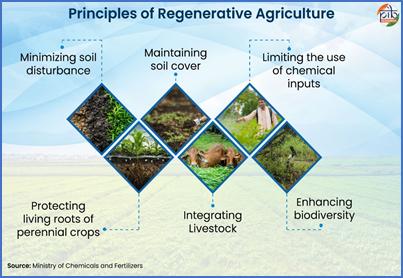
It is based on the following principles:
- Minimizing soil disturbance
- Protecting the living roots of perennial crops
- Maintaining soil cover
- Integrating Livestock
- Limiting the use of chemical inputs
- Enhancing biodiversity
In essence, Regenerative agriculture offers a practical and forward-looking pathway for the future of farming by restoring the natural foundations of agriculture.
Strengthening Agricultural Resilience through Regenerative Approaches
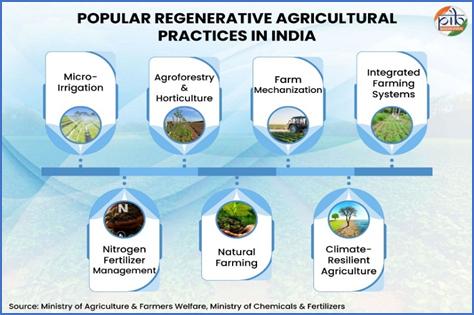
Regenerative agriculture draws upon a diverse set of farming practices adopted in India. While the spectrum of regenerative approaches is much broader, some of the prominent practices can be broadly classified into the following categories:
Water and Resource Efficiency
Micro-irrigation systems such as drippers, sprinklers, and foggers deliver water directly to plant roots. This reduces water wastage and improves water-use efficiency. By optimizing farm-level water management, these systems enhance crop productivity and strengthen resilience to droughts and water stress. As a result, farming systems become more climate-resilient and economically viable.
Farm Mechanization involves the use of agricultural machinery and equipment to streamline and automate various farm operations. It helps optimize the use of key inputs such as water, fuel, and fertilizers, reducing wastage and lowering the carbon footprint. By enabling timely and precise farm operations, mechanization improves resource management, enhances productivity, and helps reduce the environmental impact of farming.
Soil and Nutrient Management
Nitrogen Fertilizer Management helps reduce nitrous oxide emissions while improving crop productivity. It focuses on selecting the right fertilizer and optimizing application timing and dosage. Other practices include deep placement of supergranular urea and the use of leaf color charts for precise assessment of nitrogen status. The approach also promotes biological inputs such as cyanobacteria and legume intercropping. Overall, these measures improve nitrogen-use efficiency and minimize environmental losses.
Natural farming is a chemical-free agricultural approach rooted in India’s traditional knowledge systems. The system relies on on-farm biological inputs such as Beejamrut, Jeevamrut, GhanJeevamrut, Neemastra, and Dashparni, prepared using inputs from native livestock. It also promotes the use of traditional seed varieties and the integration of trees along farm boundaries. Pest management is undertaken through locally prepared, on-farm botanical formulations. Practitioners are encouraged to adopt continuous cover cropping, multi-cropping, mulching, and minimal soil disturbance to maintain soil fertility and ecological balance. The integration of livestock with diversified cropping systems further helps improve soil health, restores ecosystems, and reduces input costs for farmers.
Soil Health Management Practices such as green manuring, cover cropping, and mulching play a vital role in regenerative agriculture. Green manuring involves growing and incorporating specific crops into the soil to add organic matter and nutrients. It helps in improving soil fertility, structure, and carbon sequestration. Cover cropping refers to growing crops primarily to cover the soil rather than for harvest. It protects against erosion, maintains soil organic carbon, and supports nutrient cycling. Mulching involves covering the soil surface with organic residues such as leaves, straw, etc. It helps conserve moisture and regulate soil temperature. Mulching also suppresses weeds, promotes beneficial microbial activity, and improves crop productivity.
Integrated and Climate-Resilient Farming Systems
Integrated Farming Systems (IFS) is a holistic agricultural approach that combines multiple farm enterprises into a single system. It integrates crops, livestock, fisheries, and allied activities such as horticulture, agroforestry, and apiculture. The approach promotes practices such as intercropping, crop rotation, multi-cropping, and mixed farming that maximize resource use. This also reduces the risk of crop failure, diversifies livelihood opportunities, and enhances resilience to climate extremes such as floods and droughts.
Agroforestry integrates perennial tree systems with fruit and plantation crops to create a more sustainable and profitable farming system. It helps farmers earn additional income while improving soil moisture, regulating local temperatures, and storing more carbon.
In rainfed regions, agroforestry plays a crucial role in rejuvenating degraded land. These systems help mitigate the impacts of unpredictable rainfall, enhance agricultural resilience, and reduce greenhouse gas emissions over time.
Climate-Resilient Agriculture (CRA) encompasses a plethora of strategies and technologies to fortify agricultural systems against a changing climate. Its key components include:
- balanced use of nutrients and fertilizers,
- effective pest management,
- efficient and judicious use of water,
- conservation of soil moisture at the field level,
- and appropriate land preparation practices that safeguard soil health and enhance crop performance.
In addition, CRA includes innovations such as water-sharing groups, seed and fodder systems, community nurseries, and collective marketing mechanisms. Together, these practices and innovations strengthen agricultural systems, enabling them to better withstand climate-related stresses and shocks.
The Multifaceted Benefits of Regenerative Farming
Regenerative agriculture offers a wide range of environmental, economic, and social benefits, supporting both healthy ecosystems and resilient farming.
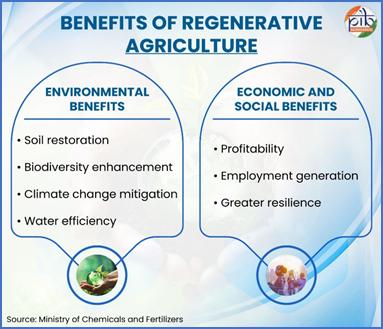
Environmental Outcomes
- Soil restoration: Regenerative practices rebuild soil organic matter, improve soil structure, and enhance long-term soil fertility, supporting stable agricultural productivity.
- Biodiversity enhancement: Regenerative approaches create favourable conditions for a wide variety of species, including pollinators, beneficial insects, and soil microorganisms. This helps in strengthening overall ecosystem balance.
- Climate change mitigation: These systems absorb and store more carbon than they emit, helping reverse agricultural emissions.
- Water efficiency: Healthier soils improve water retention and reduce runoff. This limits soil erosion and the flow of sediments and pollutants into rivers and lakes, helping protect water bodies.
Economic and Social Outcomes
- Profitability: Healthier soils reduce dependence on synthetic fertilizers, pesticides, and irrigation. This lowers input costs, stabilizes yields, and enhances farmers’ net incomes.
- Employment generation: Regenerative agriculture creates new livelihood opportunities across farming, advisory services, technology, and ecological management.
- Greater resilience: Farms adopting regenerative practices are better equipped to withstand climate variability and market fluctuations.
|
Advancing Sustainable Development Through Regenerative Agriculture

 Regenerative agriculture is closely aligned with SDG 13 (Climate Action). Target 13.1 focuses on strengthening resilience and adaptive capacity to climate-related risks and natural disasters. Since regenerative practices help reverse greenhouse gas emissions, they contribute to reducing climate-related risks at the farm level. Consequently, they help in enhancing farm-level climate resilience and strengthening adaptive capacity in the face of increasing climate variability. Regenerative agriculture is closely aligned with SDG 13 (Climate Action). Target 13.1 focuses on strengthening resilience and adaptive capacity to climate-related risks and natural disasters. Since regenerative practices help reverse greenhouse gas emissions, they contribute to reducing climate-related risks at the farm level. Consequently, they help in enhancing farm-level climate resilience and strengthening adaptive capacity in the face of increasing climate variability.
|
Promoting Regenerative Agriculture through Targeted Interventions
The government is implementing a wide range of schemes to promote regenerative agricultural practices. Some of the key initiatives support natural and organic farming, agroforestry, micro-irrigation, integrated farming systems, and scientific soil health management.
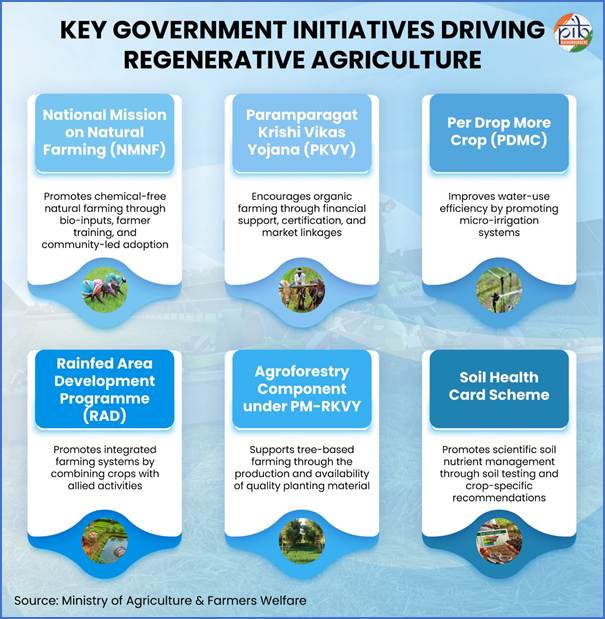
National Mission on Natural Farming
The National Mission on Natural Farming (NMNF), launched in 2024, creates a favourable support ecosystem to help farmers progressively transition to natural farming. The scheme provides an output-based incentive of ₹4,000 per acre per year for two years, covering up to one acre per farmer. In order to support farmers with easy access to bio-inputs such as Jeevamrit and Beejamrit, the mission provides for 10,000 need-based Bio-input Resource Centres. It also envisages the formation of natural farming clusters. Each cluster is supported by two Community Resource Persons (CRPs) to guide farmers in natural farming practices.
As of 05 March 2026, 18,786 clusters have been formed across the country. These clusters cover 8.80 lakh hectares, and 18.19 lakh farmers have been enrolled to promote Natural Farming. Additionally, 33,676 CRPs have been trained at Krishi Vigyan Kendras (KVKs)/ Agricultural Universities (AUs)/ local natural farming institutions.
Paramparagat Krishi Vikas Yojana
Paramparagat Krishi Vikas Yojana (PKVY), launched in 2015, has emerged as a key pillar of India’s organic farming initiative. It provides farmers with an organized framework for adopting eco-friendly practices, obtaining organic certification, and accessing markets that reward sustainable production. Under the scheme, farmers adopting organic farming are supported with ₹31,500 per hectare over three years.
As of 31 October 2025, a total area of 16.90 lakh ha has been covered under PKVY since its inception.
Per Drop More Crop (PDMC) is being implemented across the country since 2015-16. It helps improve on-farm water use efficiency through micro-irrigation systems, specifically drip and sprinkler irrigation. Drip irrigation delivers water directly to plant roots through pipes and emitters, reducing water wastage. Sprinkler irrigation sprays water onto the field through pipes and nozzles, ensuring uniform coverage.
Under PDMC, the Government provides 55% financial assistance to small and marginal farmers and 45% to other farmers for installing these systems. In addition, some states provide top-up subsidies to farmers from their own budgets.
Implemented since 2015-16, the scheme has covered about 109 lakh hectares as of May 2026. A total of ₹26,325 crore in central assistance has been released, significantly improving water-use efficiency.
Rainfed Area Development Programme
The Rainfed Area Development Programme (RAD), being implemented since 2014-15, promotes Integrated Farming Systems (IFS) through an area-based cluster approach. The programme encourages practices such as multi-cropping, crop rotation, inter-cropping, and mixed cropping. These are integrated with allied activities, including horticulture, livestock, fisheries, and apiculture, to enhance farm income, strengthen livelihoods, and build resilience to climate extremes.
Under RAD, clusters of about 20 hectares are developed within one or more adjoining villages. This approach promotes convergence, encourages community participation, and supports wider replication of successful models. Farmers are supported with financial assistance of ₹30,000 per family for adopting IFS. An additional ₹10,000 per cluster is provided for training and capacity-building activities.
Since its inception, ₹2251.98 crore has been provided as Central Assistance to States for adopting IFS. The scheme covered 9.53 lakh hectares and benefitted 15.73 lakh farmers (as of December 2025).
Krishi Vigyan Kendras (KVKs) further support the programme through demonstrations and training on location-specific IFS models. During 2024-25, KVKs conducted 4,416 demonstrations and trained 96,013 farmers on different IFS models.
In FY 2025–26, an allocation of ₹343.86 crore was made to States/UTs for the implementation of RAD, under which 96,013 farmers received training.
Sub-Mission on Agroforestry
The erstwhile Sub-Mission on Agroforestry (SMAF) was restructured as the Agroforestry Component under the Pradhan Mantri Rashtriya Krishi Vikas Yojana (PM-RKVY) from 2023-24. It supports the establishment of agroforestry nurseries to provide Quality Planting Material (QPM) to farmers. The scheme component includes:
- establishment of new nurseries,
- raising of saplings in existing nurseries,
- setting up tissue culture units,
- skill development and awareness,
- research and development,
- monitoring and evaluation,
- specialised technical activities,
- formulation of projects for the voluntary carbon market in the agriculture sector, and
- local initiatives.
It provides 100% assistance to Government agencies and 50% back ended credit-linked assistance to private beneficiaries.
During 2025-26, as on 31 October 2025, sanctions amounting to ₹78.31 crore were issued to 27 States/UTs. A total of 135 new nurseries were established. Sapling production was undertaken in 614 existing nurseries. About 176.59 lakh saplings were raised in these nurseries, benefitting around 25,693 farmers.
Launched in 2015, the Soil Health Card Scheme (SHC) provides farmers with plot-wise soil test reports, generated through scientific testing, for each landholding. The card assesses soil health on 12 key parameters, covering macronutrients, micronutrients, and critical soil properties.
Issued every 2 years, the Soil Health Card helps farmers understand the nutrient status and physicochemical conditions of their soils. It provides crop-specific recommendations on the appropriate use of chemical fertilisers, bio-fertilisers, organic inputs, and soil treatments.
As of 13 March 2026, a total of 25.89 crore Soil Health Cards have been generated since inception. Around 7.17 lakh demonstrations have been conducted to promote balanced fertiliser use. These demonstrations were conducted through advisories supported by the Agricultural Technology Management Agency (ATMA) and Krishi Vigyan Kendras (KVKs). In addition, 70,002 Krishi Sakhis have been trained to support the dissemination of soil health advisories at the grassroots level.
Growing towards a More Resilient Future
Regenerative agriculture is gradually reshaping the future of Indian farming. It restores soil health while improving resilience and resource efficiency. Practices such as natural farming, agroforestry, micro-irrigation, and integrated farming are contributing to resource-efficient agricultural systems.
Government initiatives are helping farmers adopt these approaches at scale. As more farmers embrace regenerative practices, agriculture can become both environmentally sustainable and economically rewarding. The journey begins with healthier soils and leads towards more resilient farms and secure livelihoods.
References
Ministry of Finance
https://www.indiabudget.gov.in/economicsurvey/doc/echapter.pdf \
Ministry of Agriculture & Farmers Welfare
https://www.pib.gov.in/PressReleaseDetail.aspx?PRID=2197692®=6&lang=1
https://naturalfarming.dac.gov.in/NaturalFarming/Concept
https://www.pib.gov.in/PressReleasePage.aspx?PRID=2244625®=3&lang=2
https://www.pib.gov.in/PressReleseDetailm.aspx?PRID=2201002®=3&lang=2
https://agriwelfare.gov.in/sites/default/files/RAD_Operational_Guidelines.pdf
https://www.pib.gov.in/PressReleasePage.aspx?PRID=2201000®=3&lang=1
https://agriwelfare.gov.in/Documents/AR_Eng_2024_25.pdf
https://agriwelfare.gov.in/Documents/DAFW_AnnualReport_2025_26_En.pdf
https://www.pib.gov.in/PressReleasePage.aspx?PRID=2239789®=3&lang=2
Ministry of Electronics and Information Technology
https://climate-resilience.vikaspedia.in/viewcontent/climate-resilience/agriculture/what-is-climate-resilient-agriculture?lgn=en
World Economic Forum
https://www.weforum.org/stories/2022/10/what-is-regenerative-agriculture/
United Nations
https://www.fao.org/family-farming/d%09etail/en/c/1512632/
https://sdgs.un.org/goals/goal13#targets_and_indicators
Government of Tamil Nadu
https://agritech.tnau.ac.in/agriculture/agri_irrigationmgt_microirrigation.html
Government of Odisha
https://agri.odisha.gov.in/sites/default/files/2025-03/RAD%20Operational%20Guidelines%20%28Revised%29.pdf
PIB Backgrounders
https://www.pib.gov.in/PressNoteDetails.aspx?NoteId=155019&ModuleId=3®=3&lang=2
https://www.pib.gov.in/PressReleasePage.aspx?PRID=2175205®=3&lang=2
https://www.pib.gov.in/FaqDetails.aspx?id=155374&NoteId=155374&ModuleId=4®=3&lang=2
https://www.pib.gov.in/PressReleasePage.aspx?PRID=2221117®=3&lang=2
https://www.pib.gov.in/PressReleasePage.aspx?PRID=2259279®=3&lang=1
Click here to see pdf
****
PIB Research
(रिलीज़ आईडी: 2302428)
आगंतुक पटल : 4385