Ministry of Science & Technology
Magnetic Trees help researchers unearth hidden flow in the Sun’s upper atmosphere
प्रविष्टि तिथि:
17 JUL 2026 3:09PM by PIB Delhi
Researchers have revealed a hidden connection between the Sun’s surface and its upper layers making fresh inroads to understanding space weather that affect satellites, communication systems, navigation networks and even power grids on Earth.
For many years, scientists have known that the Sun has a slow but steady flow of hot gas, or plasma, that moves from its equator toward the poles. This movement, known as the meridional flow, acts like a giant conveyor belt, helping transport the Sun’s magnetic fields across its surface. It plays an important role in controlling the Sun’s 11-year solar cycle, which influences the appearance of sunspots and other forms of solar activity. Until now, however, this flow had only been observed in the Sun’s lower atmospheric layers.
A new study led by scientists from Aryabhatta Research Institute of Observational Sciences (ARIES), an autonomous institute under the Department of Science and Technology (DST), along with researchers from the Physical Research Laboratory (PRL), Indian Institute of Technology Delhi (IIT Delhi), Indian Institute of Space Science and Technology (IIST), and NASA’s Goddard Space Flight Center, has shown that the slow movement of plasma continues much higher into the Sun’s atmosphere than previously known, revealing an underlying link between the Sun’s surface and its upper layers.
The Ms. Srinjana Routh from ARIES along with the other researchers analysed 27 years of radio observations collected by the Nobeyama Radioheliograph in Japan. Their study provides the first clear evidence that the poleward flow exists nearly 3,000 kilometres above the Sun’s visible surface, in a region known as the upper chromosphere. This discovery is particularly important because, at these heights, the Sun’s magnetic field strongly influences the movement of plasma. The findings therefore offer new insights into how magnetic fields and plasma interact throughout the solar atmosphere.
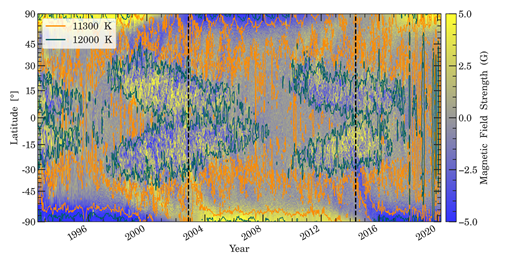
Fig: Latitude–time map showing how bright radio features (contours in orange and green) closely follow the Sun's magnetic field as both migrate toward the poles (southern hemisphere; vertical dashed lines) over two solar cycles
Instead of tracking individual sunspots or magnetic features, the team developed a novel image-correlation technique. They compared thousands of full-disk radio images of the Sun taken one day apart and measured tiny shifts in brightness patterns over nearly three decades. Using this method, they were able to map the large-scale movement of materials in the Sun’s atmosphere.
The researchers found that plasma in the upper chromosphere moves toward the poles at speeds of about 5 to 15 metres per second, similar to the speeds measured in deeper layers of the Sun. They also observed that the flow changes over the course of the solar cycle. In some periods, the northern and southern hemispheres behave differently, depending on which hemisphere is more magnetically active.
One of the most significant findings emerged when the radio observations were compared with long-term maps of the Sun’s magnetic field. The bright features seen in radio images were found to move poleward in close step with the transport of magnetic fields. This strong connection suggests that structures observed high in the Sun’s atmosphere remain linked to magnetic fields rooted much deeper inside the Sun.
The results provide strong observational evidence for the long-standing “magnetic tree” hypothesis which proposes that magnetic structures extending high above the Sun’s surface are connected to deeper layers in the same way that the branches of a tree remain connected to its trunk and roots.
This suggests that the Sun’s upper atmosphere is not isolated from the layers below but instead retains information about motions occurring deep within the Sun.
Understanding how plasma and magnetic fields move through the Sun is essential because these processes drive solar activity and influence solar storms and other space-weather events.
Published in The Astrophysical Journal, this study opens a new window for exploring the Sun’s internal dynamics through radio astronomy. By showing that the Sun’s upper atmosphere reflects large-scale flows occurring deep below the surface, the research provides an important new tool for studying the solar dynamo—the process responsible for generating the Sun’s magnetic field and powering its activity cycle.
Publication Link: https://iopscience.iop.org/article/10.3847/1538-4357/ae69dc
***
NKR/FT
(रिलीज़ आईडी: 2285705)
आगंतुक पटल : 1957