Ministry of Textiles
Ministry of Textiles organizes Departmental summit on “Textiles for Global Markets”
प्रविष्टि तिथि:
23 JUN 2026 7:35PM by PIB Delhi
The Ministry of Textiles today inaugurated a two-day Departmental Summit on “Textiles for Global Markets: Strategy for Achieving USD 100 Billion Exports by 2030” in New Delhi. The Summit is being organised under the Cabinet Secretariat’s initiative on Departmental Summits to strengthen Centre–State collaboration and foster cooperative federalism in achieving national development goals.
Aligned with the vision of Hon’ble Prime Minister Shri Narendra Modi to transform India into a global textile powerhouse, the Summit aims to chart a coordinated roadmap and increase textile and apparel exports from around USD 37 billion to USD 100 billion by 2030. Guided by the Prime Minister’s vision of “Farm to Fibre, Fibre to Factory, Factory to Fashion and Fashion to Foreign”, the Summit seeks to develop a coordinated and actionable roadmap for enhancing India’s global competitiveness in textiles and apparel.
The event has brought together senior representatives from all States and Union Territories, district administrations, Export Promotion Councils, industry associations, exporters, financial institutions, academia and other stakeholders. The Summit is the culmination of an extensive consultative exercise involving 36 State and UT consultations, nearly 200 district-level consultations and participation of more than 5,000 stakeholders, resulting in the preparation of 36 State Export Action Plans (SEAPs) and 200 District Export Action Plans (DEAPs).
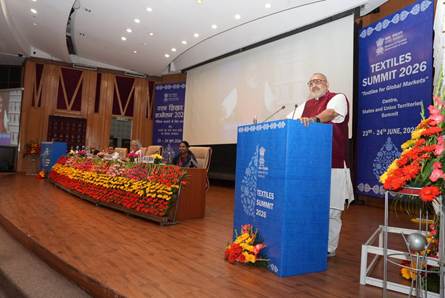
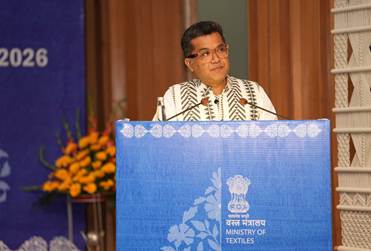
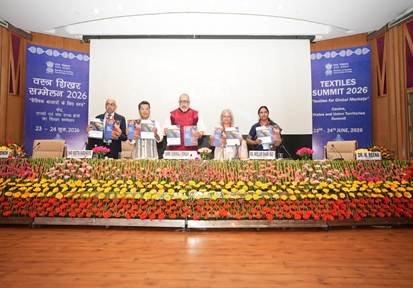
Addressing the inaugural session, Union Minister of Textiles Shri Giriraj Singh emphasised the importance of district-led export growth, product diversification, value addition, target setting of Champion and Aspirational Districts, value addition, technical textiles, creation of branded products, sustainability, skilling and improved market access for achieving the national export target. Minister of State for Textiles and External Affairs Shri Pabitra Margherita and Secretary, Ministry of Textiles, Smt. Neelam Shami Rao also addressed the gathering laying emphasis on state governments being catalysts for exports, decentralised thought process, value addition, product diversification and brand creation. During the session, two publications that were released were on “Leveraging India’s recent FTAs – A Textiles Perspective” and “How to Export – A Textiles Perspective”.
The first day of the Summit featured 3 Sessions. First session was based on intensive policy deliberations on district and cluster-led export strategies, competitiveness and export ecosystem. The first session provided an in-depth perspective on four major textile clusters—Ludhiana, Tiruppur, Surat, and Bhadohi—drawing insights from a diverse group of speakers. These included exporters, senior representatives from export promotion councils as well as senior government officials from the respective states.
The discussions covered a wide spectrum of issues, including the growth trajectories of these clusters, the challenges encountered along the way, and strategic pathways to boost exports in line with India’s 2030 textile export target. A key highlight was the need to align with evolving global demand patterns, particularly by accelerating the shift from cotton-dominated production to man-made fibre (MMF)-based consumption. The session also underscored the importance of targeted district-level interventions to enhance export performance, strengthen value chains, and improve the overall competitiveness of India’s textile sector.
Second session focussed on product and design enhancement, value addition, consumer alignment, material innovation and technical textiles opportunities and brand identity. The session highlighted the Northeast’s textile identity, with a focus on GI products as markers of heritage, along with successful entrepreneurial initiatives in technical textiles, luxury segments such as Pashmina, and rural cooperatives. Key priorities included strengthening design and branding, driving product innovation and consumer-aligned development, enhancing traceability and material advancement, and promoting local collectives and value addition to build a distinctive and competitive market presence
The Third session comprised of key export enablers including credit, logistics, infrastructure, PM-MITRA Parks, State-led policy and incentive support, technology adoption, labour compliance and skill development. The session focused on improving the competitiveness and growth of India’s textile sector by addressing cost disabilities, strengthening logistics and connectivity, and promoting integrated manufacturing ecosystems. The discussions also highlighted successful state and industry models that demonstrate the role of coordinated policy, infrastructure, and ecosystem development in boosting export competitiveness.
The States and Union Territories also participated in thematic breakaway sessions to deliberate on region-specific opportunities, challenges and priority interventions emerging from their State and District Export Action Plans.
The recommendations emerging from the Summit will be consolidated into a comprehensive National Textile Export Roadmap 2030, providing strategic direction for expanding India's textile exports, strengthening district and cluster ecosystems, promoting sustainable and value-added production, enhancing utilisation of trade agreements and positioning India as a preferred global sourcing destination.
****
MAM
(रिलीज़ आईडी: 2277199)
आगंतुक पटल : 1618