PIB Backgrounder
International Day of Yoga 2026
From Annual Observance to Everyday Wellness
प्रविष्टि तिथि:
20 JUN 2026 12:32PM by PIB Delhi
|
Since its first observance in 2015, the International Day of Yoga (IDY) has evolved from a United Nations-designated annual event into one of the world's largest participatory wellness movements. It brings together millions of people across countries, cultures and communities through the shared practice of Yoga. The 2026 edition, themed ‘Yoga for Healthy Ageing’(स्वस्थ आयु के लिए योग), carries this journey forward through nationwide participation, innovative initiatives and year-round engagement, while promoting preventive healthcare and active living.
|
India’s Global Wellness Movement
India and Yoga share a bond that spans millennia. Rooted in India's ancient traditions, Yoga has evolved from a spiritual and philosophical practice into a global movement for physical, mental, and emotional well-being.
Recognising its universal appeal and benefits, the United Nations proclaimed 21 June as the International Day of Yoga in 2014. The proposal, introduced by Prime Minister Shri Narendra Modi at the 69th session of the UN, was supported by 175 member states. The first observance was held on 21st June 2015.Yoga was inscribed on UNESCO's Representative List of the Intangible Cultural Heritage of Humanity in 2016.
This landmark recognition acknowledged India's contribution to global wellness. It also carried yoga's journey to a new stage, transforming it into a worldwide celebration across continents. Since then, the observance of International Day of Yoga has strengthened yoga's role as a bridge between nations, promoting health, harmony, and sustainable lifestyles.
|
A Civilisational Legacy: History of Yoga
Yoga is among the world's oldest knowledge traditions, with roots tracing back to the Indus-Saraswati Civilisation (c. 2700 BCE). The word 'yoga' derives from Sanskrit, meaning to join or to unite — symbolising the union of body and consciousness[1].
References to Yogic practices are found across the Vedas, Upanishads, Buddhist and Jain traditions, as well as the Mahabharata and Ramayana.
The Yogic tradition was systematised by Maharishi Patanjali through the Yoga Sutras, laying the foundation for its philosophical and practical framework. Over centuries, sages and Yoga masters have preserved and enriched this knowledge, helping it spread across the world.
|
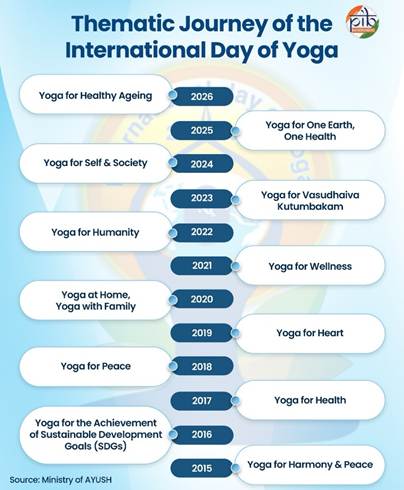
While International Day of Yoga is celebrated across India through thousands of events, each edition is anchored by a principal national celebration hosted in a different city. The journey began at Rajpath, New Delhi, in 2015 and has since travelled through cities such as Chandigarh, Lucknow, Dehradun, Ranchi, Mysuru, Jabalpur, Srinagar, and Visakhapatnam.
|
Common Yoga Protocol (CYP): The Foundation of International Day of Yoga
To make the International Day of Yoga a truly synchronised global event, a common and accessible format was needed. This led to the development of the Common Yoga Protocol (CYP) in 2015 by the Ministry of Ayush in consultation with some of India's most eminent Yoga gurus and institutions.
The CYP is a standardised 45-minute Yoga practice that serves as the core programme for International Day of Yoga celebrations worldwide, enabling people across countries and cultures to participate in a shared Yoga experience. The protocol combines loosening practices, like Yogasanas, Kapalabhati, Pranayama, meditation and relaxation techniques into a simple, structured routine that can be practised by people of different age groups and backgrounds.
The 2026 edition also allows institutions to incorporate an additional 15 minutes of Yogic practices such as Pranayama, Yoga Nidra, Dhyana and Satsang, where appropriate.
|
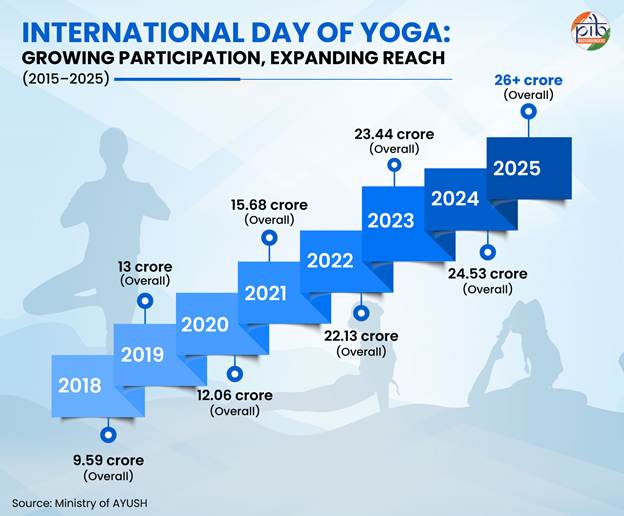
Over 11 editions, IDY has grown from a global observance into a people-led movement for preventive healthcare, healthier living and inner balance. Today, it is observed in more than190 countries.
International Day of Yoga 2026: What Is Happening This Year
The 12th edition of the International Day of Yoga is being observed on 21stJune 2026, with Kolkata hosting the main national celebration. This year's theme, 'Yoga for Healthy Ageing' (स्वस्थ आयु के लिए योग), reflects a growing global emphasis on healthy and active living across the lifespan. As populations age and non-communicable diseases and lifestyle-related health concerns rise globally, the emphasis is shifting from simply adding years to life to enhancing health span, quality of life and overall well-being.
|
Building the Foundations of Healthy Ageing Through Yoga
Healthy ageing is increasingly understood as the ability to maintain functional capacity, mobility, cognitive health and social participation throughout life. Within this framework, Yoga offers a multidimensional practice that combines physical activity, breath regulation and mindfulness. Practices such as Tadasana and Trikonasana help improve posture and flexibility, addressing the effects of prolonged sitting. Bhujangasana and Makarasana support spinal health and relaxation; while breathing practices such as AnulomVilom and Bhramari Pranayama encourage breath awareness and mental calmness. Meditation further helps cultivate focus and emotional well-being. Hence, all this support several determinants of healthy ageing simultaneously.
|
Building Towards 21st June 2026
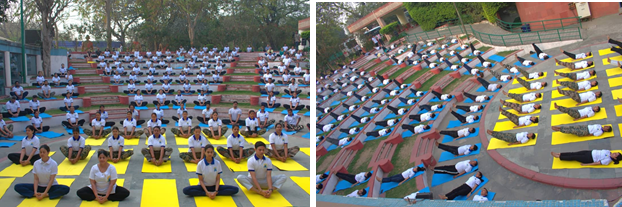
Preparations for IDY 2026 began well in advance through a series of nationwide countdown events. The 100-day countdown was launched at Vigyan Bhawan in New Delhi on 13th March 2026, marking the formal commencement of this year’s celebrations. This was followed by the 75-day countdown event at Lonar in Maharashtra, and the 50-day countdown at Kanha Shanti Vanam in Hyderabad. Each event brought together thousands of participants for the Common Yoga Protocol and reinforced the message of collective participation.A major milestone was also achieved in the run-up to IDY 2026. A special nationwide live yoga session organised on 14thJune saw participation of more than four lakh persons joining simultaneously, creating a new Guinness World Record.
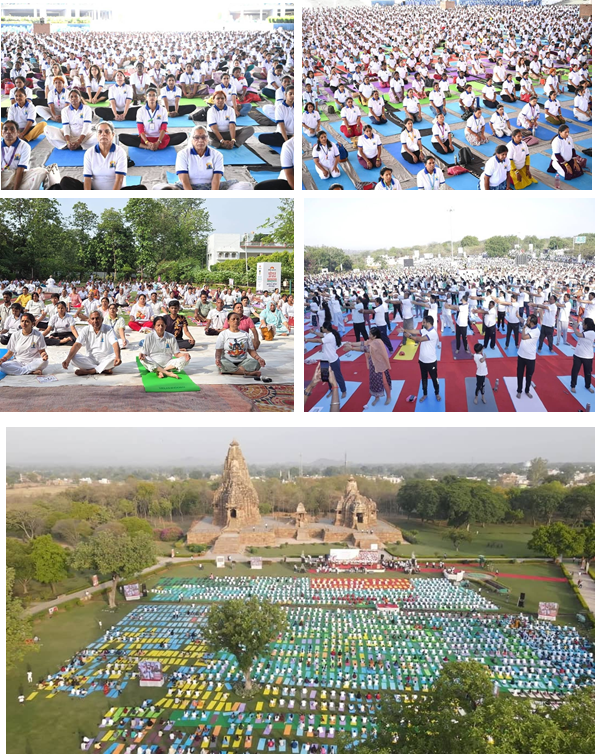
The celebrations have also been linked to India's cultural and natural heritage. The 25-day countdown event at the Khajuraho Group of Monuments combined Yoga with iconic heritage settings. Alongside these events, the government also launched the campaign '100 Days, 100 Cities, 100 Organisations'. This has encouraged institutions and communities across the country to make Yoga a regular part of daily life.
New Initiatives for a Wider Reach
|
Yoga 365: From One Day to Everyday Wellness
IDY 2026 emphasises continuity over a single-day observance. Through the Yoga 365 initiative, the Government is encouraging people to make Yoga a regular part of daily life. Supported by public campaigns, digital outreach and institutional participation, the initiative seeks to make Yoga accessible to people of all ages and easier to practise at home, in schools, workplaces and communities. It complements existing initiatives such as the Common Yoga Protocol, therapeutic Yoga programmes, and Y-Break(a brief workplace Yoga module designed to help employees de-stress).
|
Several new initiatives have also been introduced for IDY 2026, to make Yoga more accessible and relevant to diverse groups. Among them is Yoga for Air Travel, a specially designed protocol developed by the Morarji Desai National Institute of Yoga (MDNIY) for travellers undertaking long journeys. The initiative demonstrates how Yoga can be adapted to modern lifestyles and everyday needs.
Another major development is the launch of 10 Yoga Protocols for Non-Communicable Diseases and Target Groups. Developed by the WHO Collaborating Centre for Traditional Medicine at MDNIY, these protocols address conditions such as diabetes, hypertension, bronchial asthma and mental health concerns. Dedicated modules have also been prepared for children, adolescents, senior citizens, women, pregnant women and individuals undergoing de-addiction. Together, these protocols are intended to make Yoga practices more targeted and accessible for specific population groups and health conditions.
Citizen engagement has also been expanded through a series of activities on the MyGov platform, including quizzes, photography competitions, poster-making contests and short-video challenges. These initiatives are encouraging wider public participation in the International Day of Yoga on 21st June.
A Whole-of-Society Movement
The preparations for IDY 2026 reflect a broader whole-of-government and whole-of-society approach. Ministries, State Governments, educational institutions, corporate organisations, civil society groups and local bodies are being encouraged to participate actively in the celebrations. The objective is to ensure that Yoga reaches every section of society, including remote and underserved communities.
Digital platforms are playing an important role in this outreach. The Yoga Sangam Portal has been launched to facilitate registrations, event coordination and participation for organisations and communities across the country. The Yoga Park Portal supports the development and mapping of dedicated Yoga spaces, encouraging regular practice beyond the International Day of Yoga. Together, these platforms seek to strengthen public engagement and make Yoga more accessible to people throughout the year.
Previous Editions: A Decade of Scale, Innovation and Inclusion
From Global Recognition to Public Participation
|
Yoga During the Pandemic: Wellness in Challenging Times
The COVID-19 pandemic tested the ability of mass movements to remain connected in a period of isolation. International Day of Yoga adapted through digital participation, virtual events and home-based practice, ensuring continuity despite restrictions on public gatherings. The themes "Yoga at Home, Yoga with Family" (2020) and "Yoga for Wellness" (2021) reflected the needs of the time, highlighting Yoga's role in supporting physical fitness, mental well-being and emotional resilience during a global health crisis. The period demonstrated Yoga's adaptability and enduring relevance in changing circumstances.
|
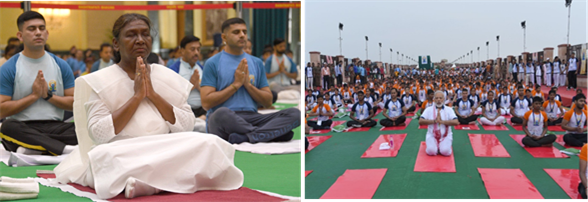
The first International Day of Yoga was observed on 21st June 2015 and marked the beginning of a new global wellness movement led by India. The main event at Rajpath in New Delhi brought together 35,985 participants, including representatives from 84 countries, for a mass demonstration of the Common Yoga Protocol.
The inaugural celebration entered the Guinness World Records on two counts. It recorded the largest Yoga lesson at a single venue, and the largest number of nationalities participating in a Yoga lesson.
The celebrations extended far beyond New Delhi. Yoga sessions were organised across India and in countries around the world. This reflected the unprecedented international support that had accompanied the declaration of International Day of Yoga. The first edition established the template for future observances — combining mass participation, global outreach and a shared commitment to health and well-being.
Expanding Across India
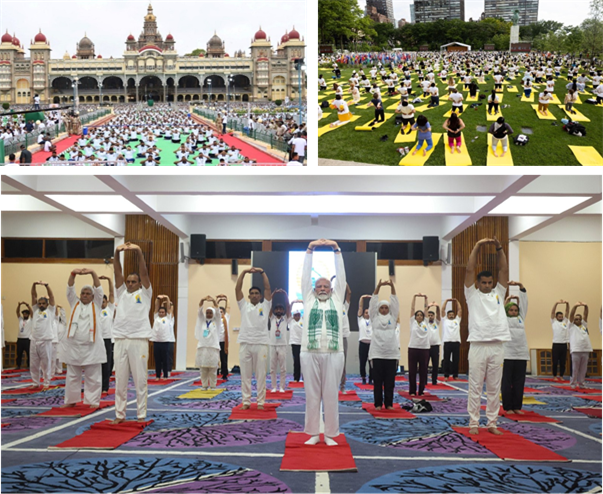
As the observance matured, the national celebrations travelled across the country. Host cities such as Chandigarh, Lucknow, Dehradun, Ranchi, Mysuru, Jabalpur, Srinagar and Visakhapatnam brought Yoga closer to diverse communities and regions. Each edition reflected local cultural contexts while reinforcing Yoga's universal appeal.
This geographic expansion also strengthened public participation. Schools, universities, armed forces, healthcare institutions, workplaces, local bodies and community organisations increasingly became part of the celebrations. Yoga was no longer viewed only as a traditional practice; it was being embraced as a shared public movement.
The Decadal Milestone: International Day of Yoga 2025
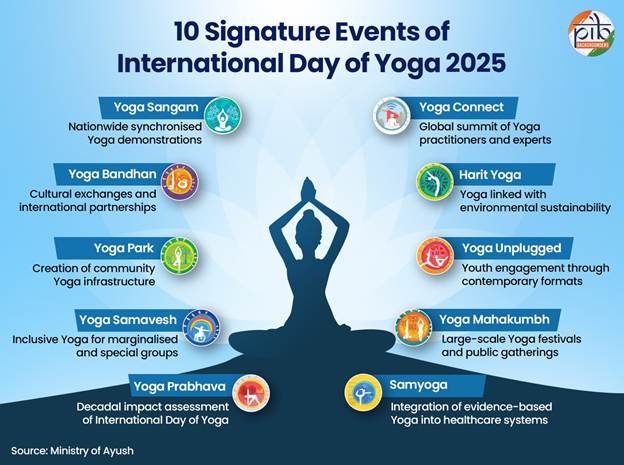
The 11thedition of the International Day of Yoga in 2025 marked a decade of global observance. Celebrated under the theme “Yoga for One Earth, One Health,” the edition highlighted the interconnectedness of human, societal and planetary well-being. To commemorate the milestone, the Government introduced ten signature events spanning sustainability, inclusion, youth engagement, healthcare integration and international cooperation, giving the celebrations greater depth and wider outreach.
The scale of participation reflected the maturity of the movement. More than 13 lakh Yoga events were organised across the country, with participation exceeding 26 crore people. The main event at Visakhapatnam brought together over 3 lakh participants and set two Guinness World Records — for the largest Yoga lesson and the largest simultaneous Surya Namaskar demonstration. The International Day of Yoga 2025 edition demonstrated how the day has evolved from an annual observance into a nationwide movement for health and well-being.
International Day of Yoga Around the World
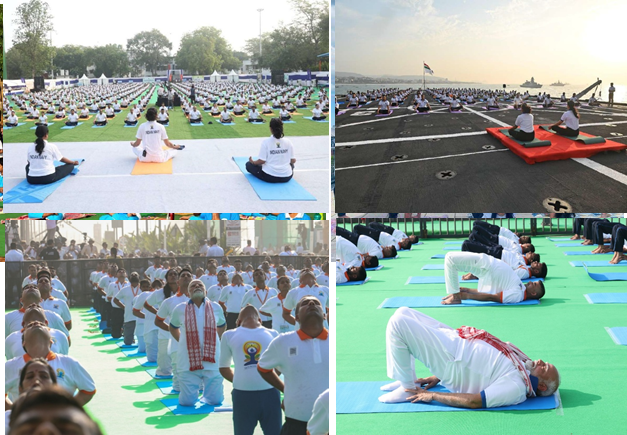
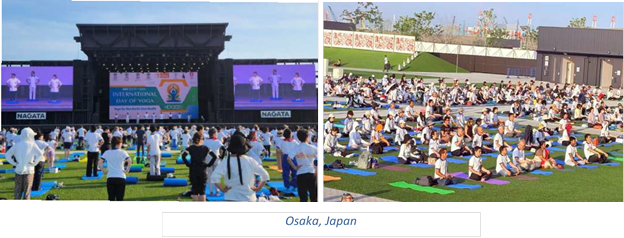
Over the past decade, the International Day of Yoga has become a truly global observance, bringing together people across continents through a shared celebration of health and well-being. Every year, Yoga sessions are organised at iconic locations, public spaces, educational institutions and cultural landmarks around the world.
In 2024, celebrations were held at the United Nations Headquarters in New York, reaffirming Yoga's continued global resonance. In Japan, Yoga enthusiasts gathered at the historic Tsukiji Hongwanji Temple despite rainy weather. In South Africa, nearly 8,000 participants came together at Johannesburg's Wanderers Cricket Stadium. In Brazil, celebrations took place at the Itaipu Binacional Central Viewpoint, while in Saudi Arabia, a Common Yoga Protocol session was conducted at Riyadh's Prince Faisal Bin Fahad Olympic Complex, led by a Saudi woman instructor. Yoga Day was also observed in countries including Oman, Egypt, Bangladesh, Bhutan, Sri Lanka, Argentina and Croatia.
The global footprint expanded further during the decadal celebrations of International Day of Yoga 2025. Indian Missions and cultural centres organised events across regions, while international collaborations formed an important component of the year's activities.
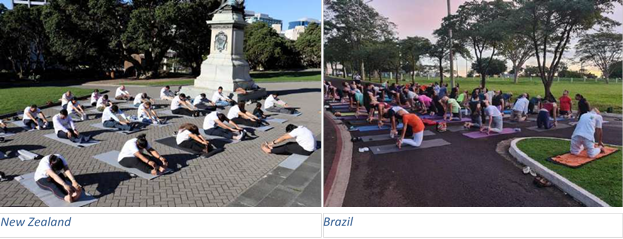
This year, in coordination with the Indian Council for Cultural Relations (ICCR), more than 210 Indian Missions abroad are organising International Day of Yoga events at nearly 2,500 locations across the world.
The Common Yoga Protocol has played a key role in creating this shared experience. Available in the six official languages of the United Nations — Arabic, Chinese, English, French, Russian and Spanish — it enables participants across countries to practise a common set of Yogic exercises and postures.
From One Day to 365 Days: Taking Yoga into Daily Life
As the International Day of Yoga enters its 12thedition, the focus is gradually shifting from celebration to continuity. The success of the movement is no longer measured only by the scale of participation on 21st June, but by its ability to encourage regular practice throughout the year.
This shift is reflected in initiatives such as Yoga 365, the expansion of the Common Yoga Protocol, community-based programmes and the growing integration of Yoga into schools, workplaces and public institutions. The theme Yoga for Healthy Ageing (स्वस्थ आयु के लिए योग) reinforces this message.
The larger message of IDY 2026 is clear: Yoga should not remain confined to a mat, a venue or a single day on the calendar. Whether practised for a few minutes at home, in a community park, at a workplace or in a classroom, its benefits are realised through consistency. The true legacy of the International Day of Yoga will be measured not by participation on 21st June alone, but by the extent to which people carry the practice into their daily lives in the days, months and years that follow.
References
Press Information Bureau
https://www.pib.gov.in/PressReleasePage.aspx?PRID=2272997®=3&lang=1
https://www.pib.gov.in/PressReleasePage.aspx?PRID=2265716®=3&lang=1
https://www.pib.gov.in/PressReleaseDetail.aspx?PRID=2116869®=48&lang=2
https://archive.pib.gov.in/yogaday2018/backge.htm
https://www.pib.gov.in/PressNoteDetails.aspx?NoteId=151900&ModuleId=3®=48&lang=2
https://www.pib.gov.in/FeaturesDeatils.aspx?id=154688&NoteId=154688&ModuleId=2®=48&lang=2
Ministry of AYUSH
https://yoga.ayush.gov.in/uploads/assets/cyp/CYP_Book_English_2026.pdf
https://yoga.ayush.gov.in/uploads/assets/IDY/IDY-Handbook-English-2026.pdf
https://yoga.ayush.gov.in/uploads/assets/IDY/IDY_2025_Report.pdf
https://yoga.ayush.gov.in/pm-gallery?type=image
https://yoga.ayush.gov.in/uploads/assets/IDY/IDY%202024%20Report.pdf
https://yoga.ayush.gov.in/CYP/un-languages
Others
https://www.un.org/en/observances/yoga-day
https://www.presidentofindia.gov.in/photo-gallery?field_field_select_year_target_id=319&page=13
Click here to see pdf
***
PIB Research
(रिलीज़ आईडी: 2275594)
आगंतुक पटल : 4432