Ministry of Communications
Union Minister Shri Jyotiraditya M. Scindia says, the future of 6G must be built on four pillars—interoperability, common standards, innovation, and inclusive growth
“Under the leadership of Prime Minister Shri Narendra Modi, the Bharat 6G Alliance was established in 2022, articulating India’s Bharat 6G Vision. Our ambition is clear—to contribute at least 10 per cent to global standards and patents as 6G evolves.”: Shri Jyotiraditya M. Scindia
International Workshop organised by TEC brings together global experts, industry leaders, academia and policy makers to discuss the evolving 6G ecosystem
The workshop reaffirmed India’s commitment to strengthening its role in global 6G standardisation efforts, particularly through active engagement in international standards bodies such as ITU and 3GPP
Artificial Intelligence, spectrum planning, network architecture and emerging applications identified as key pillars of future 6G systems
The workshop highlighted opportunities for Indian researchers, start-ups and technology innovators to participate actively in the evolving global 6G research and standardisation ecosystem.
प्रविष्टि तिथि:
18 MAR 2026 6:05PM by PIB Delhi
Union Minister of Communications and Development of North Eastern Region, Shri Jyotiraditya M. Scindia, today emphasised on India’s ambition to play a meaningful role in shaping the global telecommunications architecture of the future. He stated, “As we advance on this journey, our role must be anchored in four key pillars. First, ensuring global interoperability—across devices, networks and services—so that the world communicates seamlessly within a unified ecosystem. Second, developing a common technical framework, in collaboration with global bodies such as 3GPP and ITU, to establish shared standards across radio interfaces, core networks, spectrum and service architecture. Third, accelerating innovation and research, where clear global standards guide researchers, startups and industry in transforming breakthroughs into real-world solutions.
Fourth, and most importantly, ensuring inclusive growth and indigenous innovation. Open standards create a level playing field, enabling nations to contribute, build intellectual property and ensure that the benefits of technology reach every citizen across the globe. To realise these pillars, sustained international cooperation, global dialogue and continuous engagement are essential.”
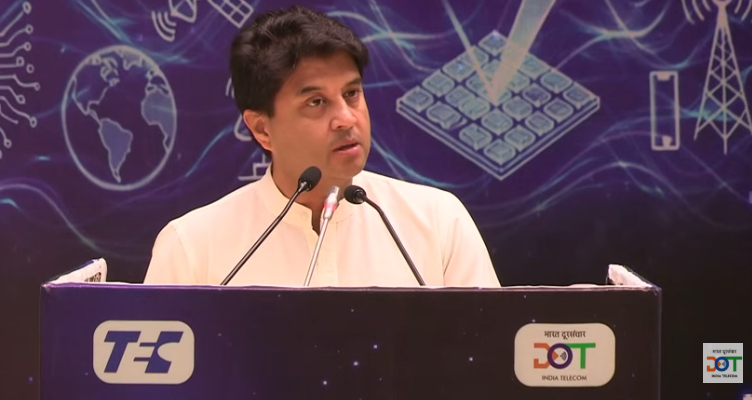
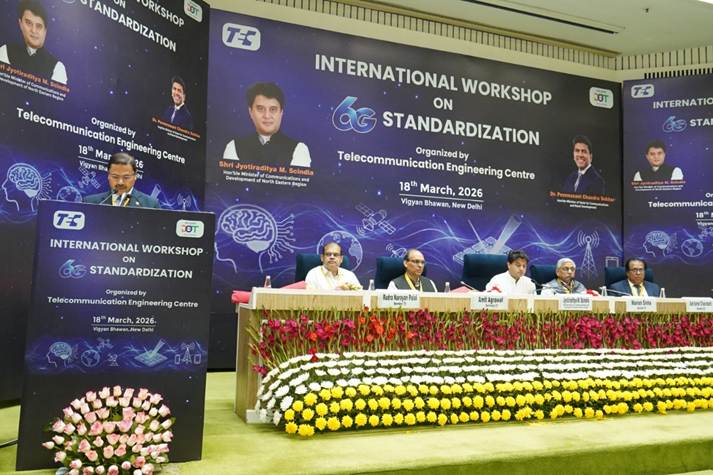
Union Minister Shri Scindia was delivering his inaugural address at an International Workshop on 6G Standardization at Vigyan Bhawan, New Delhi. Shri Amit Agrawal, Chairman DCC and Secretary (Telecom); Shri Manish Sinha, Member (Finance); Shri Rudra Narayan Palai, Member (Technology) and Shri Deb Kumar Chakrabarti, Member (Services) were among the dignitaries present on the dais. The workshop was organised by the Telecommunication Engineering Centre (TEC), the technical arm of the Department of Telecommunications (DoT). The event brought together leading experts from government, academia, industry and international standardisation bodies to deliberate on the evolving global roadmap for sixth generation telecommunications technologies.
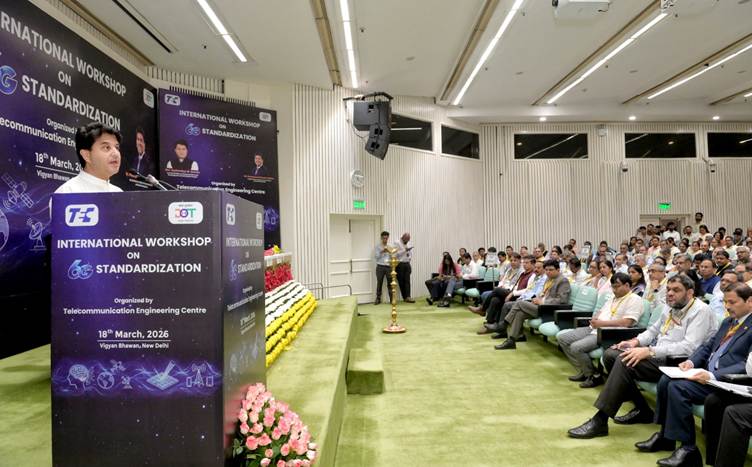
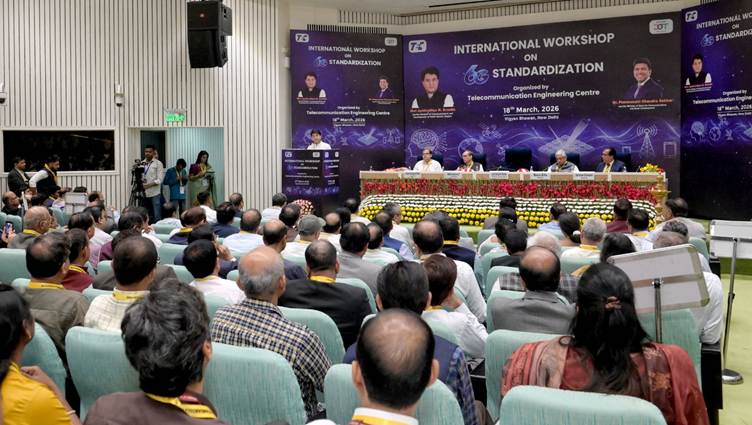
The workshop served as an important platform to review global developments in 6G research, spectrum planning, network architecture, artificial intelligence-enabled networks and emerging applications, while strengthening India’s participation in international standards development processes.
“Under the leadership of Prime Minister Narendra Modi, the Bharat 6G Alliance was established in 2022, articulating India’s Bharat 6G Vision. Our ambition is clear—to contribute at least 10 per cent to global standards and patents as 6G evolves.”, said Jyotiraditya M. Scindia.
He emphasised that “The promise of 6G lies not only in technological sophistication, but also in the democratisation of opportunity. It is here that India’s story comes to the fore on the global stage.” Union Minister Shri Scindia concluded, saying, “Let us pledge today to build a secure, resilient and truly global 6G ecosystem—one that connects not just devices, but people, opportunities and possibilities across the length and breadth of our world.”
Earlier, welcoming the dignitaries and participants, Advisor (Technology), DoT, Shri Shubhendu Tiwari emphasised the importance of early engagement in global standardisation efforts. He observed that India’s growing participation in international telecom standardisation had already demonstrated the country’s technical capability and innovation potential.
Technical Sessions
The workshop featured a series of technical sessions covering key dimensions of the evolving 6G ecosystem, including global standardisation efforts, network architecture, spectrum planning, artificial intelligence, security frameworks and emerging applications.
The session on Global Standardization Roadmap provided an overview of ongoing work in international forums such as the International Telecommunication Union Radiocommunication Sector (ITU-R) and the 3rd Generation Partnership Project (3GPP), highlighting major milestones towards the development of IMT-2030 and the importance of global coordination in the early stages of 6G standard formation.
Discussions on 6G Network Architecture focused on the evolution of radio access and core networks towards cloud-native, service-based and programmable frameworks capable of supporting next-generation digital services.
The Spectrum Roadmap for 6G session examined future spectrum requirements, global harmonisation efforts and traffic projections, while highlighting the importance of efficient spectrum utilisation to support growing connectivity demands.
A dedicated session on India’s Roadmap towards 2030 highlighted ongoing pre-6G research initiatives and the need to scale pilot projects into future commercial deployments through collaboration between government, academia and industry.
Sessions on Radio Access Network (RAN) developments explored emerging architectures such as virtualised and open RAN systems and their role in enabling flexible and scalable future networks.
Discussions on Intelligence in Future Networks examined the role of Artificial Intelligence and Machine Learning in enabling adaptive, autonomous and self-optimising network operations.
The session on Security and Trust Architecture for 6G emphasised the importance of resilient and secure frameworks for future communication systems.
Participants also discussed emerging 6G applications, including use cases beyond immersive communication, as well as the integration of terrestrial and non-terrestrial networks to support seamless and ubiquitous connectivity.
Background
Each generation of mobile communications has significantly transformed the global digital landscape. While 4G enabled true mobile broadband through all-IP architectures, 5G expanded capabilities to support ultra-reliable low-latency communications and massive machine-type connectivity, enabling new applications across industry and society.
The commercial rollout of 5G has accelerated global research and standardisation activities for sixth-generation (6G) technologies. Expected to evolve under the framework of IMT-2030, 6G aims to enable ubiquitous intelligent connectivity, integrated sensing and communication systems, AI-native networks and sustainable telecommunications ecosystems.
The vision and technology trends for IMT-2030 have been outlined within the International Telecommunication Union Radiocommunication Sector (ITU-R) through Recommendation M.2516. Technical Performance Requirements (TPR) for IMT-2030 have also been finalised under Working Party 5D, defining the key benchmarks for future mobile systems.
To translate these performance targets into deployable technologies, the 3rd Generation Partnership Project (3GPP) has initiated exploratory studies under Release-20 to identify key technology enablers and architectural directions beyond 5G-Advanced. These studies will eventually evolve into detailed technical specifications that guide equipment development and commercial deployment by telecom operators worldwide.
Alongside ITU-R and 3GPP, several international standards organisations and industry alliances are examining key aspects of future 6G systems, including spectrum planning, network architecture, artificial intelligence integration and emerging applications. India’s active participation in these efforts is expected to strengthen its role in shaping the future architecture of global telecommunications.
****
NJ/ARJ
(रिलीज़ आईडी: 2241976)
आगंतुक पटल : 1212