Ministry of Statistics & Programme Implementation
Environmental Accounting Explainer Series “Pollination Services”
प्रविष्टि तिथि:
18 MAR 2026 12:15PM by PIB Delhi
- India hosts rich pollinator diversity, including more than 800 species of bees along with butterflies, moths, beetles, birds, bats and flies.
- Pollination accounting quantifies and values the contribution of pollinators to agricultural output, addressing gaps in conventional agricultural statistics.
- The monetary value of pollination services accounted for about 8–10% of the total crop output value during 2012–13 to 2021–22.
- The contribution of pollination to crop output increased from ₹115.41 thousand crore in 2012–13 to ₹266.33 thousand crore in 2021–22.
- Fruits and vegetables contributed the largest share to pollination value, reflecting their high dependence on pollination and significant market value.
- Economic valuation of pollination services attempts to provides an evidence base for pollinator conservation, habitat protection and sustainable agricultural practices.
- The integration of pollination services into environmental-economic accounting strengthens policy formulation for agriculture, biodiversity conservation and sustainable development.
|
Introduction
The Ministry of Statistics and Programme Implementation (MoSPI) adopted the UN System of Environmental Economic Accounts (SEEA) Framework in 2018, an agreed international framework for the compilation of the Environment Economic Accounts.
On 18th March 2026, during the capacity building Workshop on Monitoring Frameworks of Sustainable Development Goals (SDGs), Compilation of Environment Accounts and Gender Statistics at Patna, Bihar, MoSPI released the publication on “Environmental accounting explainer series Pollination Services”. This is the first dedicated publication on pollination services, compiled with the objective of presenting comprehensive information at the national level, in accordance with the SEEA framework.
Relevance of Pollination Service
Pollination is a fundamental ecological process that supports agricultural production, biodiversity conservation, and ecosystem stability. A large number of crops depend partially or fully on animal pollinators. Effective pollination improves crop yields, enhances fruit and seed formation, and improves the quality of agricultural produce. Despite its critical importance, conventional agricultural statistics and national accounts capture the value of crop production but do not explicitly measure the ecosystem services provided by pollinators. Pollination accounting addresses this gap by quantifying and valuing pollinators' contributions to agricultural output, thereby making the economic significance of this essential ecosystem service visible. Hence, MoSPI has initiated compilation of Pollination service accounting, aligned with the SEEA framework, which provides a structured approach for understanding and quantifying the linkages between ecosystems, agricultural production, and economic development.
Publication Overview
The publication explains pollination biology, pollination processes, and their role in supporting Sustainable Development Goals (SDGs), including food security, biodiversity conservation, poverty reduction, and climate resilience. Further, it highlights the diversity and distribution of pollinators in India, including more than 800 bee species, as well as butterflies, moths, beetles, birds, bats, and flies, reflecting the country’s strong ecological foundation for pollination-dependent agriculture. It adopts a productivity-based approach to estimate the monetary value of pollination services provided by pollinators in crop production, using crop-specific pollination dependence ratios to determine the share of crop value attributable to pollinators. By applying a transparent, nationally consistent methodology aligned with existing National Accounts practices, the publication translates ecological processes into a monetary indicator that can be used for environmental-economic accounting, policy analysis, and informed decision-making.
Key Highlights of the Publication
- The monetary value of Pollination services is roughly 8-10 percent of the total crop output value between 2012-13 and 2021-22.
- The contribution of pollination to the value of crop output is ₹115.41 thousand crore in 2012-13 and ₹266.33 thousand crore in 2021-22
Figure 1: Contribution of each crop categories (decadal change)
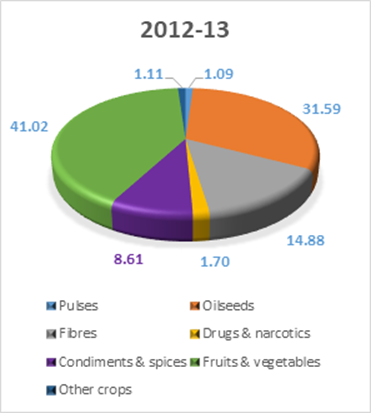
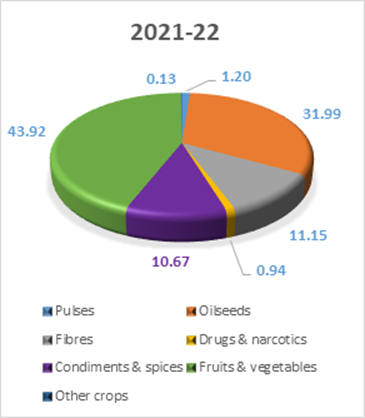
- Fruits and vegetables make the largest contribution to total pollination value over the decade, reflecting their high dependence on pollination services and substantial market value.
Figure 2: Share of pollination-attributed value of output (PVO) within crop category (%)
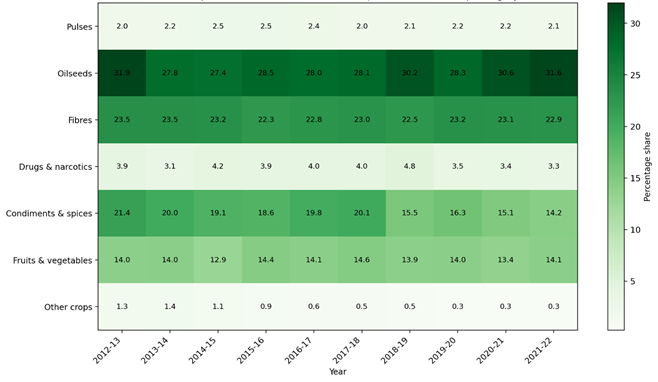
- The above heat map shows the percentage share of pollination-attributed value within each crop category from 2012-13 to 2021-22. It represents how dependent each crop category is on pollination services over time. Oilseeds (about 27-32%) and fibres (about 22-23%) consistently show the highest dependence, indicating strong and stable pollination linkages.
Policy Implications
The economic valuation of Pollination Service reveals, its significant contribution in crop output. This provides a clear policy rationale for strengthening beekeeping and pollination-support programmes- the National Beekeeping &Honey Mission (NBHM) with a multi–mini-mission design, the Mission for Integrated Development of Horticulture (MIDH), and the KVIC Honey Mission- as these interventions generate direct livelihood benefits (honey and allied products) while also safeguarding crop productivity and quality through improved pollination. Given the scale of pollination-attributed value, even modest improvements in pollinator management and habitat conditions through beekeeping, horticulture, habitat restoration, and afforestation initiatives can yield high economic returns. Accordingly, integrating pollinator-friendly practices into agricultural schemes and sustaining habitat-supporting measures in forest and landscape programmes are essential for long-term production resilience and food security.
|
The publication is available at the Ministry’s website www.mospi.gov.in
|
Scan the QR code to access the publication

|
****
Samrat
(रिलीज़ आईडी: 2241618)
आगंतुक पटल : 1987