Department of Space
Dr. Jitendra Singh visits Exhibition Showcasing India’s Space, Nuclear and Strategic Mineral Capabilities
Showcasing of India’s Space, nuclear and other scientific achievements helps ignite students’ aptitude and discover their intrinsic talent, says Dr Jitendra Singh
Space Launch Systems to Thorium Programme: Exhibition Maps India’s Science and Energy Roadmap
Dr Jitendra Singh advises the organisers to arrange conducted visits by school and college students to this exhibition and also try to prepare short social media versions of the exhibits
प्रविष्टि तिथि:
09 MAR 2026 6:58PM by PIB Delhi
NEW DELHI, March 9 : Union Minister of State (Independent Charge) for Science and Technology; Earth Sciences and Minister of State for PMO, Department of Atomic Energy, Department of Space, Personnel, Public Grievances and Pensions, Dr. Jitendra Singh said today that showcasing of India’s Space, nuclear and other scientific achievements helps ignite students’ aptitude and discover their intrinsic talent.
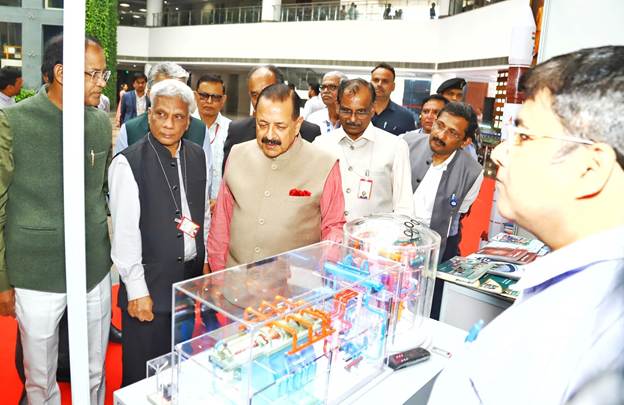
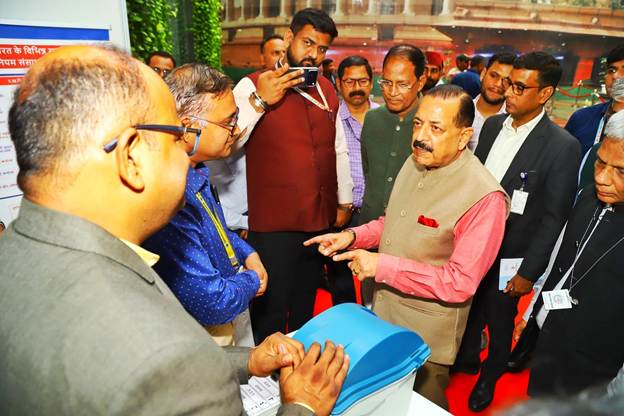
The Minister was on an invited visit to an exhibition at Dr. Ambedkar International Centre here, highlighting India’s advancements in space technology, nuclear energy development and strategic mineral exploration.
Dr Jitendra Singh advised the organisers to arrange conducted visits by school and college students to this exhibition and also try to prepare short social media versions of the exhibits.
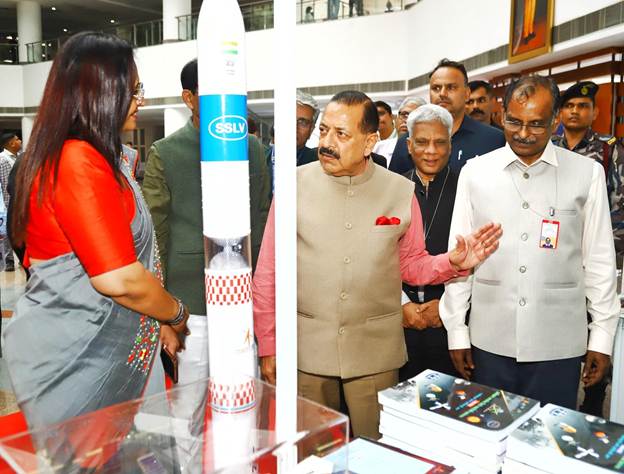
The exhibition showcased India’s expanding capabilities in launch vehicles, satellite systems and human spaceflight initiatives. Information presented highlighted the country’s launch vehicle fleet, including the Polar Satellite Launch Vehicle, Geosynchronous Satellite Launch Vehicle and the LVM3 heavy-lift rocket, which supports India’s human spaceflight programme. India has conducted more than a hundred launch missions, deploying hundreds of satellites that support communication, navigation, earth observation and scientific research.
The materials also outlined India’s long-term vision for space exploration, including the development of human spaceflight systems, crew and service modules, and the concept of an Indian space station, referred to as the Bharatiya Antariksh Station, aimed at enabling sustained human presence in low-Earth orbit and facilitating microgravity research. Future missions related to lunar exploration, deep-space studies and expansion of satellite-based services were also highlighted as part of the country’s broader space roadmap.
India’s satellite applications ecosystem was also reflected through examples of services supporting governance and development, including weather forecasting, navigation systems, communication networks, disaster management and agricultural monitoring.
Alongside the space programme, the exhibition highlighted India’s nuclear energy architecture and the country’s strategy for utilising its mineral resources to support long-term energy security. Information presented mapped the distribution of uranium-bearing geological formations across several states, including Jharkhand, Rajasthan, Andhra Pradesh, Telangana and Karnataka, as well as regions of the Himalayan belt where uranium deposits have been identified through geological exploration.
The country’s three-stage nuclear power programme was also explained as a long-term strategy to utilise limited domestic uranium resources while leveraging India’s large thorium reserves. The first stage is based on pressurised heavy water reactors using natural uranium fuel, the second stage focuses on fast breeder reactors designed to generate more fissile material than they consume, and the third stage envisages advanced reactor systems capable of using thorium-based fuel cycles.
Information related to India’s coastal mineral resources highlighted the presence of economically significant heavy minerals along the country’s nearly 11,000-kilometre coastline. These include ilmenite, rutile, zircon, monazite, garnet and sillimanite, which are found in coastal placer deposits. The Atomic Minerals Directorate for Exploration and Research carries out systematic exploration and assessment of these deposits to evaluate their industrial and strategic potential.
The exhibition also reflected the geographical spread of nuclear research institutions, fuel cycle facilities and power generation infrastructure associated with India’s nuclear programme, illustrating the role of these institutions in supporting energy generation, materials research and advanced scientific work.
India’s space and nuclear programmes form important pillars of the country’s scientific and technological development. While the space sector continues to expand its role in communication, navigation, earth observation and emerging commercial space activities, the nuclear energy programme remains central to India’s long-term strategy for meeting growing electricity demand while strengthening low-carbon energy capacity and technological self-reliance.
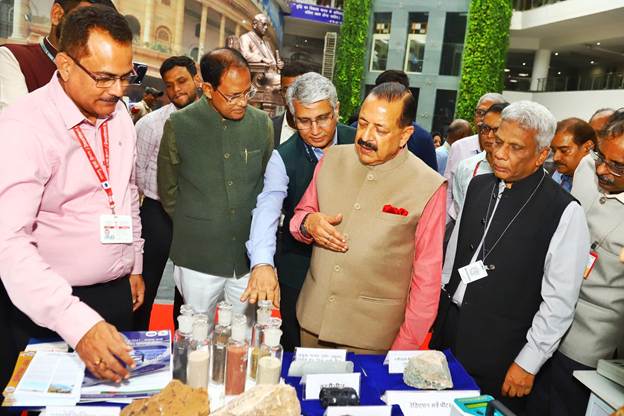
PHOTO : Union Minister Dr. Jitendra Singh exploring the exhibition highlighting India’s advancements in the Space Technology, Nuclear Energy Development and Strategic Mineral Exploration in New Delhi, on Monday.
*******
NKR/AK/AV
(रिलीज़ आईडी: 2237155)
आगंतुक पटल : 820