Posted On:
28 NOV 2026 1:49PM by PIB Delhi
India's Container Traffic: A Growing Demand for Port Capacity
India's maritime network is a vital gateway to global markets. Nearly 95 per cent of the country's trade by volume and around 70 per cent by value moves through maritime routes. As trade grows, ports must expand their capacity to handle larger cargo volumes.
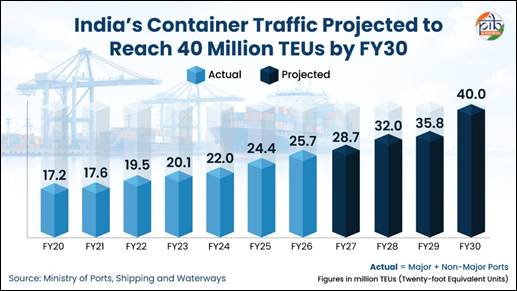
Container traffic across Indian ports grew at a compound annual growth rate (CAGR) of 6.9 per cent between FY 2019–20 and FY 2025–26, reaching 25.7 million Twenty-foot Equivalent Units (TEUs). A TEU is a standard unit for measuring container capacity, equivalent to one 20-foot shipping container. Container traffic is projected to reach about 40 million TEUs by FY 2030.
Between FY 2014–15 and FY 2025–26, the cargo-handling capacity of India’s major ports increased from 873 million tonnes per annum to 1,728 million tonnes per annum. Addressing this growing demand, the Government approved the development of a second container terminal at Tamil Nadu’s Kamarajar Port Limited on 25 November 2026. The project will add 2 million TEUs of annual capacity upon completion.
Kamarajar Port: Building on Existing Infrastructure
Located about 24 km north of Chennai, Kamarajar Port is an important maritime gateway for Tamil Nadu’s industrial hinterland. Formerly known as Ennore Port Limited, Kamarajar Port Limited (KPL) is one of India’s 12 major ports. It handles diverse cargo, including coal, petroleum products, LNG, LPG, containers, automobiles and general cargo.
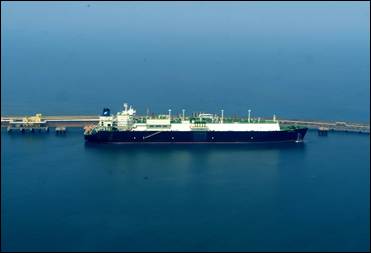
Kamarajar Port, Chennai
The first container terminal at Kamarajar Port commenced commercial operations in March 2018, with an annual handling capacity of 0.8 million TEUs.
In FY 2025–26, it handled approximately 0.7 million TEUs, operating at approximately 88 per cent of capacity. Container traffic at the port grew by around 9.9 per cent annually over five years.
During FY 2025–26, Kamarajar Port Limited (KPL) reported revenue of around ₹1,280 crore and profit before tax of ₹924 crore. Over the past five years, its cargo traffic registered a CAGR of 13.64 per cent, indicating sustained growth in port activity.
|
What is dredging?
Dredging involves removing sand, silt and other material from the seabed to deepen or maintain navigable channels. This allows ships with greater drafts to access ports safely.
|
The port has strengthened its maritime infrastructure through deeper navigational access. By July 2026, it completed Capital Dredging Phase VI, achieving an operational draft (the depth necessary to submerge a ship to its load line) of 18 metres. This enables Kamarajar Port to accommodate fully laden Capesize vessels of up to 1,70,000 Dead Weight Tonnage (DWT). It became the second major port in India to achieve this capability, after Visakhapatnam Port.
Second Container Terminal: Expanding Capacity at Kamarajar Port
The proposed terminal will add two million TEUs of annual capacity, enhancing the port’s container-handling capabilities. The 111-acre facility will have a terminal length of 900 metres, a berth width of 30 metres, a design draft of 18 metres and a water depth of 20 metres along the berth. It will accommodate container vessels up to 400 metres long, with capacities of up to 24,346 TEUs. The terminal is expected to serve industries across Tamil Nadu, Karnataka and Andhra Pradesh. Key industrial clusters in the region include Chennai–Sriperumbudur–Oragadam, Hosur, Bengaluru, Sri City and Tirupati.
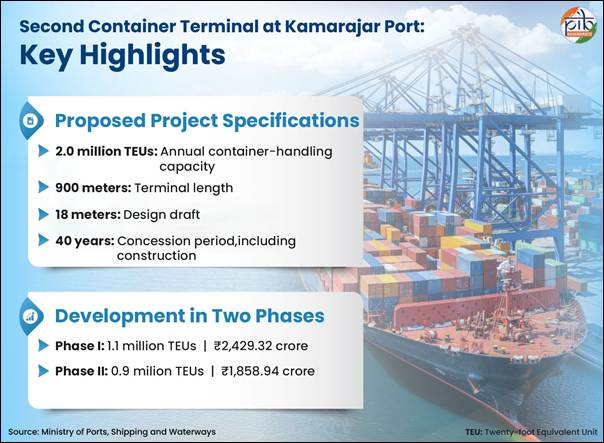
- Investment and Phased Development: The project will be developed under the Public-Private Partnership (PPP) model on a Design, Build, Finance, Operate and Transfer (DBFOT) basis. The estimated PPP project cost is ₹4,288.26 crore, including GST. Kamarajar Port Limited will separately bear an estimated ₹450 crore for dredging. The project will be implemented in two phases.
- Implementation Timeline: The project will have a 40-year concession period, with construction planned over 48 months. Phase I is expected to be completed within two years of signing the concession agreement, with commercial operations beginning in the 25th month. Phase II is expected to be completed by the end of the fourth year, with the full terminal becoming operational in the 49th month.
- Employment Generation: The project is expected to generate approximately 750 direct and indirect jobs during construction. Around 800 jobs are expected during the operational phase.
Conclusion
The new terminal will strengthen Kamarajar Port’s role in handling India’s growing container trade. By improving access to container-handling facilities for regional industries, it is expected to support cargo movement and trade connectivity.
The project aligns with Maritime India Vision 2030, which prioritises port capacity, modern cargo-handling technologies and multimodal connectivity. Its phased development under the public-private partnership model also supports the vision’s emphasis on private-sector participation.
References
Cabinet https://static.pib.gov.in/WriteReadData/specificdocs/documents/2026/nov/doc_10580_20261125_16131201.pdf
Cabinet Committee on Economic Affairs (CCEA)
https://www.pib.gov.in/PressReleaseDetail.aspx?PRID=2341174®=48&lang=1
Ministry of Ports, Shipping and Waterways
https://www.pib.gov.in/PressReleasePage.aspx?PRID=2282243&lang=2®=48
https://www.pib.gov.in/PressReleasePage.aspx?PRID=2286971&lang=1®=48
https://www.pib.gov.in/PressReleasePage.aspx?PRID=2233239®=3&lang=1
https://www.pib.gov.in/PressReleasePage.aspx?PRID=2341189&lang=1®=3
https://www.pib.gov.in/PressReleasePage.aspx?PRID=2227670&lang=1®=3
https://www.shipmin.gov.in/en/node/138
https://www.kamarajarport.in/about/genesis
https://www.kamarajarport.in/projects
https://www.kamarajarport.in/kpl-images
https://shipmin.gov.in/sites/default/files/Dredging%20Guidelines%20for%20Major%20Ports%202021.pdf
https://shipmin.gov.in/en/content/dredging-guidelines-major-ports2021
https://shipmin.gov.in/sites/default/files/502392410Annex.pdf
United Nations Economic Commission for Europe
https://unece.org/DAM/trans/main/wp6/pdfdocs/Glossary_for_Transport_Statistics_EN.pdf
Kamarajar Port Expansion: Strengthening India’s Container Infrastructure
*****
PIB Research