Posted On:
26 NOV 2026 11:14AM by PIB Delhi
A Morning in the Undergrowth
The winter mornings at Kuno National Park begin in tranquillity, as sunlight spreads across its grasslands and scrub. Amid this landscape, a species that disappeared from India seven decades ago is gradually reclaiming its place. A joint Field team at Kuno, comprising Madhya Pradesh Forest Department and Wildlife Institute of India personal monitor the cheetahs through radio-collar signals, field signs and associated changes in their behaviour. Consecutively in October and November this year, these daily observations brought two special developments: the arrival of two new litters of cheetah cubs.
Each birth reflects years of planning, scientific management, veterinary care and dedicated fieldwork under Project Cheetah. More importantly, each new birth is an encouraging indication that these highly stress-sensitive animals are adapting to their new environment, establishing themselves and successfully navigating the challenges of life in the wild. It is a testament to their resilience and a promising sign of the growing ecological suitability of the landscape and the progress of India's cheetah reintroduction programme. Collectively, these developments mark another chapter in India's efforts to establish a viable cheetah population. They also signal the emergence of a new generation born and raised on Indian soil. These new births also reemphasis India’s role in global metapopulations endeavours.
Also Read: A Sprinting Revival: The Return of the Cheetah
A New Generation at Kuno
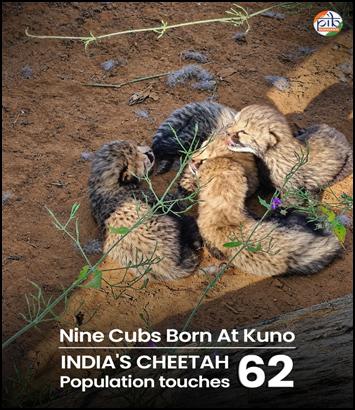
Kuno National Park, located in Sheopur district of Madhya Pradesh, lies in the northern part of the Vindhyachal mountain range. It has emerged as the principal site for India's cheetah reintroduction programme. The park recently witnessed two successive births, adding nine cubs to the country's growing cheetah population.
The first litter arrived in 5 October 2026, when KJP21, a 32-month-old Indian-born female, gave birth to five healthy cubs. She became the third India-born female cheetah to reproduce, following Mukhi and KGP12. The cubs' father is a male cheetah brought from Botswana. Their birth therefore introduced the Botswana genetic lineage into country's India-born cheetah population.
This development holds particular significance under the National Action Plan for Cheetah Introduction in India. The plan identifies successful breeding by the first India-born generation, or F1 generation, as one of the milestone necessary for successful establishment of cheetahs in reintroduced sites. KJP21's reproduction therefore marks an important step towards achieving this objective.
A second litter followed on 20 November 2026, when KOMG 3, a 30-month-old female brought from Botswana, gave birth to four healthy cubs. Significantly, KOMG 3 became the first female cheetah brought from Botswana to give birth in India. She delivered her cubs in free ranging conditions after spending more than four months in the wild. This also marked the second recorded instance of a cheetah giving birth in the wild (outside of Closed Natural Ares (CNA), which are large protected/fenced acclimatization areas within the release sites) since the reintroduction programme began in 2022. Successful reproduction in the wild is another criterion identified in the National Action Plan for assessing achievements of the programme's long term goals. This also is a critical milestone for the global metapopulation initiatives as India offers space for breeding Cheetahs from the African Sub-continent which otherwise are fragmented.
With the arrival of the November litter, India's cheetah population reached 62, including 43 cheetahs born cubs within the country. India-born cheetahs now account for nearly 70% of the total population. This reflects the growing contribution of reproduction within India to the programme's population base. Altogether, the two litters brought nine new cubs into India's cheetah population. Their arrival marks an encouraging milestone, while their survival and future reproduction will remain important indicators of conservation progress.
From Reintroduction to Natural Reproduction
|
Where did our cheetahs go?
The cheetah officially went extinct in India in 1952. The last confirmed sighting of wild cheetahs was recorded in 1947 in the Sal forests of present-day Koriya district, Chhattisgarh. The last three recorded wild Asiatic cheetahs in India were shot and killed in the Sal forests in December 1947. Thus, the nation lost the species once ranged from Punjab in the north to Tirunelveli in the south. India’s native Asiatic cheetah vanished due to a combination of excessive hunting, poaching, and the use of cheetahs for coursing. Large-scale habitat loss from agriculture, decline of prey, climate pressures, and the species’ low reproductive rate and narrow genetic base further accelerated their extinction. Project Cheetah is the first attempt anywhere to move a large carnivore between continents for reintroduction.
|
India’s cheetah story restarted with Project Cheetah on 17 September 2022 with a landmark release at Kuno National Park. On that day, the Prime Minister released eight cheetahs brought from Namibia into quarantine enclosures. Twelve more cheetahs arrived from South Africa in February 2023, completing a founder stock of twenty animals. The exercise remains the world’s first intercontinental translocation of a large wild carnivore anywhere. Project Cheetah is run by the Ministry of Environment, Forest and Climate Change through the National Tiger Conservation Authority. Its stated aim is to restore the cheetah as a flagship species of open forests and grasslands.
The programme widened further on 28 February 2026, when nine cheetahs arrived from Botswana. Six females and three males were released into quarantine enclosures at Kuno on that date. Each new source country adds genetic depth to a population that must sustain itself over many decades.
A Population Growing From Within
A reintroduction succeeds only when translocated animals settle into their new habitat and propogate there naturally. By that measure, India’s cheetah numbers are now growing largely through births on Indian soil.
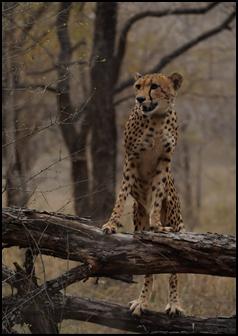
Population propagation by cheetahs born in India has now become an important driver of this growth. This trend began in November 2025, when Mukhi, the first India-born cheetah under Project Cheetah, gave birth to five cubs. Two more India-born females, KGP12 and KJP21, have since followed her and given birth at Kuno. Their litters show that India-born cheetahs can mature and breed locally, completing a full reproductive cycle. This marks steady progress from the survival of individual animals towards a self-sustaining cheetah population in India.
Furthermore, each new breeding line matters because the founder populations of large carnivores usually carry a narrow genetic base. Sourcing animals from Namibia, South Africa and Botswana widens that base in a planned manner. A broader gene pool supports disease resistance, fertility and the long-term resilience of future generations.
The Science Behind the Recovery
Kuno National Park was selected following expert assessment of habitat suitability, prey availability and human disturbance. Earlier relocation of 24 villages, involving 1,545 families, made nearly 6,258 hectares available for wildlife conservation. These efforts helped reduce human pressures and create suitable habitat for cheetahs. Habitat management measures, including grassland restoration, prey augmentation and water management, support the reintroduction programme.
Project Cheetah follows a scientific framework informed by the International Union for Conservation of Nature (IUCN) guidelines on conservation translocations. The Action Plan for Introduction of Cheetah in India was prepared jointly by the Wildlife Institute of India (WII), the National Tiger Conservation Authority (NTCA) and the Madhya Pradesh Forest Department. Monitoring combines satellite collars, camera traps and field observations. Distance sampling along fixed transects helps estimate prey abundance and assess habitat conditions. Veterinary teams monitor the cheetahs’ health, body condition, injuries and reproductive status.
Animals are first held in Closed Natural Areas before moving into the wider open landscape. This staged (soft-release) method allows each cheetah to adjust to terrain, prey and climate at its own pace. Successful propagation further indicates that cheetahs can reproduce under the conditions persistent at Kuno. However, reproduction alone does not establish that a population is self-sustaining. The survival of wild-born cubs remains an important measure of progress. The national action plan identifies cub survival beyond one year as an important milestone. Continued monitoring during this critical period helps assess survival, health and the programme’s longer-term prospects.
Grasslands, Prey and Local Communities
Under Project Cheetah, the cheetah has been designated a flagship and umbrella species for conservation. Protecting it requires the restoration of open forests, grasslands and semi-arid habitats. Kuno supports chital, sambar, nilgai, chinkara, chousingha, blackbuck and other wild ungulates. Chital is the most abundant wild prey and accounts for about three-quarters of recorded cheetah kills. Grassland recovery also improves soil stability, water retention and carbon storage across the wider landscape.
Communities living around Kuno are partners in this effort rather than observers of it. More than 450 Cheetah Mitras work as local ambassadors across 80 villages near the park. The programme has created about 380 direct jobs, including trackers, patrol workers and trained guides. Villages around Kuno also receive a five per cent share of eco-tourism revenue. Eco-development works covering roads, check dams and sanitation extend across more than one hundred villages. Conservation gains are more durable when local communities share in the benefits they help generate.
The Road Ahead
The long-term objective is a self-sustaining metapopulation of 60 to 70 cheetahs by 2032. This population is planned across about 17,000 square kilometres in the Kuno and Gandhi Sagar landscape.
Gandhi Sagar Wildlife Sanctuary in Madhya Pradesh has been developed as the second site under the programme. The first two cheetahs, named Prabash and Paavak, were moved there from Kuno National Park in April 2025. Subsequently, 2 females have also been shifted to the sanctuary.
A separate action plan guides prey recovery, habitat preparation and phased release at Gandhi Sagar. Additional habitats are being assessed so that the species is not confined to a single protected area.
As cheetah numbers grow, the programme is also spreading the animals across a wider landscape in Madhya Pradesh. In October 2026, Veerangana Durgavati Tiger Reserve in Sagar district became the third cheetah habitat in the State. Two cheetahs from Kuno National Park were released there by the Chief Minister of Madhya Pradesh.
The current total of 62 animals reaches the lower end of the planned range. It also includes very young cubs whose survival cannot yet be taken for granted. The nine cubs from the two recent litters are therefore an encouraging milestone rather than a final verdict. Their survival, and in time their own reproduction, will be the more meaningful measure of success. Each new litter brings India closer to a cheetah population that can sustain itself in the wild.
References
Ministry of Environment, Forest and Climate Change
MyGov
National Tiger Conservation Authority
District Administration, Sheopur
PrasarBharati News Services
Click to see pdf
***
PIB Research