Posted On:
19 NOV 2026 5:01PM by PIB Delhi
A new study has probed pollen grains, fungal spores and elemental signatures in the faeces of the Himalayan marmot (Marmota himalayana) to trace valuable information on the environmental conditions of the higher Himalaya and how climate change has affected them.
The Himalaya is highly sensitive to changes in temperature, precipitation and snow cover, which can have a significant impact on alpine vegetation and wildlife habitats. Most conventional palaeoenvironmental studies are based on lake sediments, peat and soil. Scientists from Birbal Sahni Institute of Palaeosciences (BSIP), an Autonomous institute of the Department of Science and Technology (DST), explored the potential of faeces of Himalayan marmot as an alternative biological archive for environmental changes with climate footprints. This could be especially valuable in remote, arid mountain environments where conventional sedimentary archives are rare.
The Himalayan marmot, a type of herbivorous mammal living at high altitudes in the cold and dry alpine environment of the Himalayan region, relies on local vegetation for food and shelter.
Pollen preserved in the faeces of marmots has left the footprints of the composition of plants consumed by the animal and provides information about the surrounding alpine-steppe vegetation.
The important plant groups in the diet of the marmot were Artemisia, Asteroideae, Caryophyllaceae, Poaceae, Cyperaceae and Chenopodiaceae.
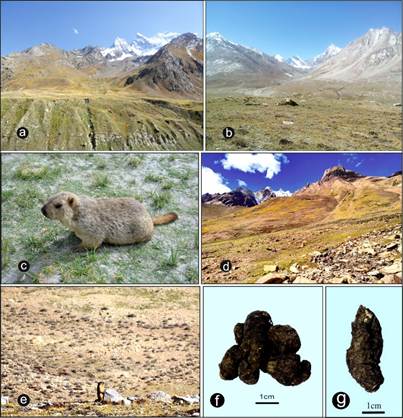
Fig 1. Field photographs- a and b. Alpine steppe vegetation at Pensila Pass in the Himalayan marmot habitat area. c. A Himalayan marmot in their natural habitat in Pensila Pass area. d. Alpine steppe vegetation in Rimkhim area. e. A Himalayan marmot in natural habitat in Rimkhim area. f. Midden faeces of Marmota himalayana, g. Shape and size of the marmot’s faeces pellet.
Photograph credits by Hukam Singh, Manish Mehta, and Vinit Kumar.
Researchers Sadhan K Basumatary, Hukam Singh, Manish Mehta, Swati Tripathi, Mahesh G. Thakkar, H. Gregory McDonald, Eline N. van Asperen & Vinit Kumar identified pollen grains and fungal spores preserved in faeces through palynological analysis, statistical methods for comparing samples from two Himalayan regions and Field Emission Scanning Electron Microscopy coupled with Energy-Dispersive X-ray Spectroscopy (FESEM–EDS) to identify elemental composition.
They first evaluated ratios of three types of pollens: Artemisia/Chenopodiaceae, Artemisia/Cyperaceae and Artemisia/Ephedra, for vegetation and climate interpretation based on faecal samples of marmots.
The results indicated that the mixed plant-based diet was dominated by groups like Artemisia, Asteroideae, Caryophyllaceae and Chenopodiaceae, pointing toward alpine vegetation and related environmental conditions. Based on the generated data, it was found that the Himalayan marmot could be a strong indicator species for understanding vegetation and climate changes in the higher Himalaya.
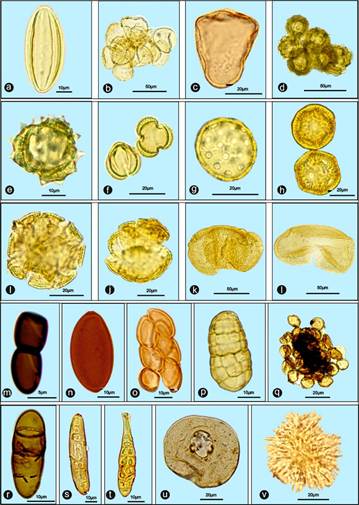
Fig 2. Palynomorphs assemblage recovered from the Marmota himalayana faeces samples.
- Ephedra, b. Cluster of Poaceae pollen, c. Cyperaceae, d. Cluster of Asteroideae pollen, e. Asteroideae, f. Artemisia, g. Chenopodiaceae, h. Amaranthaceae, i. and j. Convolvulaceae, k. Pinus sp., l. Abies, m. Sporormiella, n. Podospora, o. Cluster of Saccobolus, p. Pleospora, q. Cluster of Thecaphora, r. Meliola, s. Bipolaris, t. Alternaria, u. Arcella, v. Botryococcus.
This study also confirms that changes in the habitat of marmots can indicate shifts in altitude in relation to changing environmental conditions. This combination of pollen, fungal spores and elemental analysis provides a valuable modern reference for future palaeoecological and coprolite studies.
The study published in PLOS ONE would serve as a modern reference for reconstructing past ecological change and assessing potential impacts of climate change. The findings may also help with biodiversity conservation by improving our understanding of marmot habitat requirements, monitoring changes in the ecosystem and informing conservation strategies for associated wildlife, including the snow leopard, for which marmots are an important prey species.
It can contribute to biodiversity conservation, environmental monitoring, climate research and sustainable management of fragile Himalayan ecosystems.
Publication link:
https://doi. org/10.1371/journal.pone.0358642
***
NKR/FT/AA