Posted On:
06 NOV 2026 2:03PM by PIB Delhi
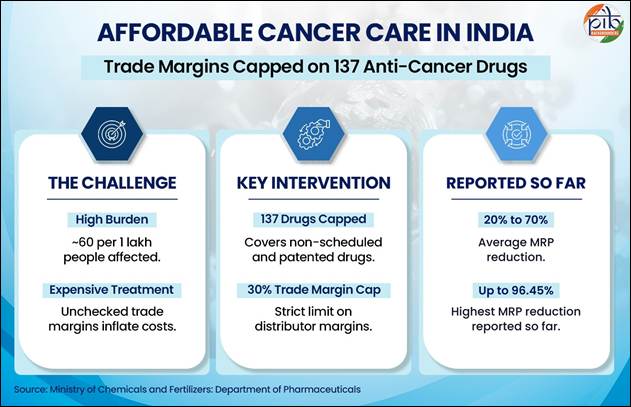
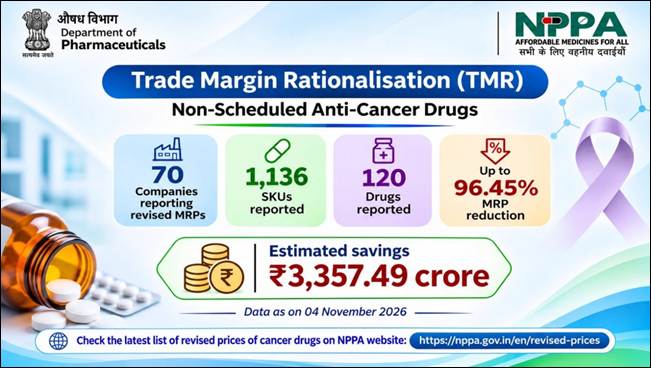
Affordable, quality cancer care for every family is a priority for the Government of India. On October 17, 2026, the National Pharmaceutical Pricing Authority (NPPA) capped the trade margin on 137 non-scheduled anti-cancer medicines, including patented ones, at 30% of the maximum retail price (MRP). The revised prices take effect on November 9, 2026. By November 4, 2026, 70 companies had reported revised MRPs for 120 drugs, with the highest reduction at 96.45% and estimated savings of Rs. 3,357.49 crore. MRP reductions average 20% to 70%.
Cancer Medicine Prices Reduced by 20% to 70% on Average
The Government has capped excessive markups along the pharmaceutical supply chain, in retail and hospital pharmacies across the country, to make cancer treatment in India more affordable.
- Companies have reported an average of 20% to 70% in MRP reductions. The highest reduction reported was 96.45% (as on November 4, 2026).
- Due to these MRP reductions, the estimated savings stand at Rs. 3,357.49 crore (as on November 4, 2026). The estimate represents the difference between the original and revised prices, applied to the volume sold from April 2025 to March 2026.
- The cap responds to concerns raised by State authorities, patients and civil society about the gap between the procurement price and the Maximum Retail Price (MRP) of anti-cancer medicines.
- Consumers can verify prices using both the NPPA website and the official Pharma Sahi Daam mobile app.
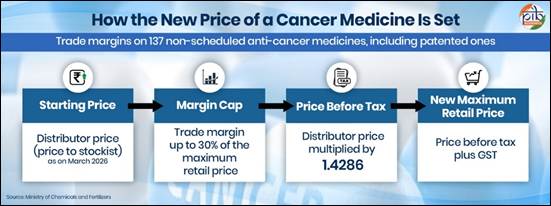
- The new prices are worked out from the distributor price of March 2026.
|
What Is a Trade Margin?
|
|
Trade margin is the difference between the price a manufacturer charges a stockist/distributor and the highest price (MRP) a patient pays for a medicine excluding Goods and Services Tax (GST). When this trade margin is very high, large profits are added along the supply chain. This heavily inflates the final cost for patients, making already expensive cancer drugs far more costly than the price at which the manufacturer sells them.
|
The Order sets the new maximum retail price of each medicine from its average distributor price of March 2026. The trade margin within that price can be no more than 30%, and GST is added on top.
How Medicine Prices Are Regulated
- To make essential life-saving drugs more affordable for patients, the Government regulates medicine prices under the Drugs (Prices Control) Order (DPCO), 2013.
- This is under the mandate of the Essential Commodities Act that seeks to regulate medicine prices, prevent profiteering and ensure essential treatments remain affordable.
- DPCO, 2013 places medicines in two groups:
- Scheduled medicines: These are the medicines included in the First Schedule of the DPCO, 2013, which is the National List of Essential Medicines (NLEM), 2022. The Government fixes a ceiling price for each of them. The NLEM 2022 lists 388 medicines, of which 63 are anti-cancer medicines.
- Non-scheduled medicines: These are the medicines not included in the First Schedule of the DPCO, 2013. Unlike scheduled medicines, which have a fixed ceiling price, these are regulated through price monitoring: under Paragraph 20 of the DPCO, 2013, a manufacturer may raise the MRP by no more than 10% in twelve months, and where the increase goes beyond 10%, the price must come back down to the 10% level for the next twelve months.
- To address high prices beyond these scheduled essential drugs, the Government piloted a Trade Margin Rationalisation (TMR) intervention in 2019 covering 42 non-scheduled anti-cancer drugs, which successfully drove down patient costs.
- Building on this, and on market data showing high mark-ups and gaps between retail and hospital prices, the Government invoked its extraordinary public-interest powers under Paragraph 19 of DPCO, 2013. On the recommendation of an Expert Committee constituted under the Directorate General of Health Services, the Authority brought 137 non-scheduled anti-cancer drugs (including patented ones) under trade margin rationalisation by its Order of October 17, 2026.
|
What Is the National List of Essential Medicines?
|
|
The National List of Essential Medicines (NLEM) is an official list of necessary, high-priority medicines for India. Its latest revision, NLEM 2022, was released by Union Health Minister Dr. Mansukh Mandaviya on September 13, 2022, under the Government’s vision of “Sabko Dawai, Sasti Dawai” (Medicine for everyone, affordable medicine).
History: First created in 1996, then updated in 2003, 2011, 2015, and 2022.
Who Made It: An expert panel called the Standing National Committee on Medicines (SNCM), after talking with doctors, scientists, industry experts, and checking WHO standards.
Why the List Matters
- Lower Costs: Helps lower out-of-pocket medical expenses for families.
- Good Healthcare: Ensures medicines are safe, effective, and good quality.
- Better Planning: Guides government buying, hospital budgets, health insurance, and training for medical students.
The Legal Power Behind the Order: Paragraph 19 of the DPCO, 2013
- Special Powers for the Government: In extraordinary circumstances, the Government can act in the public interest beyond the standard rules.
- Setting or Changing Prices: The Government has the power to set a maximum (ceiling) price or retail price for any drug for as long as it thinks is necessary.
- Changing a Price Already Fixed: If a price has already been set, the Government can raise or lower it directly, without waiting for the usual yearly revision linked to the wholesale price index.
|
How the New Order Limits Trade Margins on Cancer Medicines
- Trade Margin Capped at 30% of the Maximum Retail Price: The trade margin (the markup added between what the manufacturer charges the distributor and what the patient pays) cannot be more than 30%.
- Applies to All Versions: This rule applies to all the anti-cancer drugs listed below, whatever their dose or form (pills, injections and the like) and whether they are sold alone or in combination.
- Based on March 2026 Prices: The starting price for this calculation must be the distributor price (Price to Stockist/Distributor) as of March 2026.
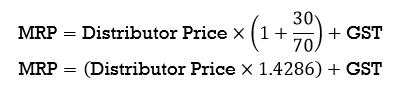
How the New Maximum Retail Price (MRP) Is Calculated
The Order sets the formula for the maximum retail price a patient can be charged:
Anti-Cancer Medicines Covered by the Order
|
Sr. No.
|
Name of the Drug
|
Sr. No.
|
Name of the Drug
|
|
1
|
Abemaciclib
|
70
|
Lenvatinib
|
|
2
|
Abiraterone acetate
|
71
|
Lomustine
|
|
3
|
Acalabrutinib
|
72
|
Lorlatinib
|
|
4
|
Afatinib
|
73
|
Lymphoseek kit
|
|
5
|
Alectinib
|
74
|
Megestrol
|
|
6
|
Alpelisib
|
75
|
Midostrurin
|
|
7
|
Amivantamab
|
76
|
Mirvetuximab soravtansine
|
|
8
|
Anastrazole
|
77
|
Mitomycin
|
|
9
|
Apalutamide
|
78
|
Mitoxantrone
|
|
10
|
Asciminib
|
79
|
Nelarabine
|
|
11
|
Atezolizumab
|
80
|
Netupitant
|
|
12
|
Avelumab
|
81
|
Nilotinib
|
|
13
|
Axitinib
|
82
|
Nimotuzumab
|
|
14
|
Azacitidine
|
83
|
Nintedanib
|
|
15
|
Belantamab Mafodotin
|
84
|
Niraparib
|
|
16
|
Bevacizumab
|
85
|
Nivolumab
|
|
17
|
Bosutinib
|
86
|
Obinutuzumab
|
|
18
|
Brentuximab Vedotin
|
87
|
Ofatumumab
|
|
19
|
Brigatinib
|
88
|
Olaparib
|
|
20
|
Busulfan
|
89
|
Osimertinib
|
|
21
|
Cabazitaxel
|
90
|
Palbociclib
|
|
22
|
Cabozantinib (S)- Maleate
|
91
|
Panitumumab (Vectibix)
|
|
23
|
Capmatinib
|
92
|
Pazopanib (as Hydrochloride)
|
|
24
|
Carfilzomib
|
93
|
Pegasparginase
|
|
25
|
Carmustine
|
94
|
Pegfilgrastim
|
|
26
|
Ceritinib
|
95
|
Pegylated interferon Alpha 2B
|
|
27
|
Cetuximab
|
96
|
Pembrolizumab
|
|
28
|
Cladribine
|
97
|
Pemetrexed
|
|
29
|
Clofarabine
|
98
|
Pertuzumab
|
|
30
|
Crizotinib
|
99
|
Pertuzumab + Trastuzumab
|
|
31
|
Cytarabine
|
100
|
Plerixafor
|
|
32
|
Dabrafenib
|
101
|
Polatuzumab Vedotin
|
|
33
|
Dacomitinib
|
102
|
Pomalidomide
|
|
34
|
Daratumumab
|
103
|
Ramucirumab
|
|
35
|
Darolutamide
|
104
|
Regorafenib
|
|
36
|
Dasatinib
|
105
|
Relugolix
|
|
37
|
Datopotamab Deruxtecan
|
106
|
Ribociclib
|
|
38
|
Decitabine
|
107
|
Rucaparib
|
|
39
|
Degarelix
|
108
|
Ruxolitinib
|
|
40
|
Denosumab
|
109
|
Selpercatinib
|
|
41
|
Dostarlimab
|
110
|
Selumetinib
|
|
42
|
Durvalumab
|
111
|
Serplulimab
|
|
43
|
Elranatamab
|
112
|
Sotorasib
|
|
44
|
Enfortumab vedotin
|
113
|
Sunitinib
|
|
45
|
Entrectinib
|
114
|
Talquetamab
|
|
46
|
Enzalutamide
|
115
|
Teclistamab
|
|
47
|
Epirubicin
|
116
|
Tegafur + Uracil
|
|
48
|
Erdafitinib
|
117
|
Tegafur, Gimeracil and Oteracil
|
|
49
|
Eribulin mesylate
|
118
|
Temsirolimus
|
|
50
|
Erlotinib
|
119
|
Tepotinibe
|
|
51
|
Estramustine
|
120
|
Thiotepa
|
|
52
|
Everolimus
|
121
|
Tislelizumab
|
|
53
|
Exemestane
|
122
|
Tocilizumab
|
|
54
|
Fludarabine
|
123
|
Topotecan
|
|
55
|
Fulvestrant
|
124
|
Toripalimab
|
|
56
|
Gilteritinib
|
125
|
Trabectedin
|
|
57
|
Goserelin acetate
|
126
|
Trametinib
|
|
58
|
Ibritumomab
|
127
|
Tremelimumab
|
|
59
|
Ibrutinib
|
128
|
Treosulfan
|
|
60
|
Idelalisib
|
129
|
Trifluridine + Tipiracil
|
|
61
|
Ifosfamide & Mesna
|
130
|
Triptorelin
|
|
62
|
Nivolumab and Relatimab
|
131
|
Tucatinib
|
|
63
|
Pegylated Liposomal Irinotecan
|
132
|
Vemurafenib
|
|
64
|
Inotuzumab Ozogamicin
|
133
|
Venetoclax
|
|
65
|
Interferon Alpha 2B
|
134
|
Vinorelbine tartrate
|
|
66
|
Ipilimumab
|
135
|
Vorasidenib
|
|
67
|
Ivosidenib
|
136
|
Zanubrutinib
|
|
68
|
Lapatanib
|
137
|
Zolbetuximab
|
|
69
|
Lazertinib
|
|
|
Source: Ministry of Chemicals and Fertilizers, NPPA Order S.O. 5690(E) of October 17, 2026
What Changes for Patients and Companies
- Manufacturers must recalculate their maximum retail prices using their average distributor prices from March 2026. Free medicines given under patient assistance programmes and direct government sales do not count in this calculation.
- The new lower prices will go into effect on November 9, 2026. Medicines that are already cheaper than the new price limit cannot be made more expensive.
- Companies must inform NPPA of their revised prices. They must also publish the price cuts in newspapers, post them on their websites, and share them with all retailers and hospitals.
- NPPA has put up the revised prices of these medicines on its website, and the list is updated as and when companies submit their revised prices.
- By November 4, 2026, 70 companies had reported revised MRPs, covering 1,136 stock keeping units (SKUs) of 120 drugs.
- Companies are not allowed to cut medicine production without permission, and they must give 6 months’ notice before stopping a medicine completely.
- Hospitals and chemists must clearly display the new prices. Any company that does not lower its prices has to deposit the overcharged amount with interest.
Wider Government Support for Cancer Care
The Government runs various health programmes to provide affordable cancer care treatment, screenings and medicines for the public.
AB-PMJAY: Cashless Hospital Care, Including Cancer Treatment
- The Government of India, through the Ayushman Bharat Pradhan Mantri Jan Arogya Yojana (AB-PMJAY) provides Rs. 5 lakh per family per year to families from the poorest 40% of society and to all senior citizens aged 70 and above.
- The scheme has authorised 12.69 crore hospital admissions worth Rs. 1.92 lakh crore (as on June 30, 2026).
- The scheme covers cashless treatment for 1,961 procedures across 27 medical specialties, including Medical Oncology, Surgical Oncology and Radiation Oncology, through empanelled public and private hospitals.
- Under the scheme, 19.5 lakh admissions for medical oncology, worth about Rs. 2,926 crore, have been authorised (as on November 4, 2026).
NP-NCD: Cancer Care from Screening to Treatment
- The Government, through its National Programme for the Prevention and Control of Non-Communicable Diseases (NP-NCD), which is also part of the National Health Mission, strengthens infrastructure, human resource development, screening, early diagnosis, referral, treatment and health promotion for non-communicable diseases, including cancer.
- Under the NP-NCD:
- 770 District NCD clinics and 6,410 NCD clinics at Community Health Centres and 524 Day Care Cancer Centres have been set up for cancer patients.
- To strengthen cancer treatment infrastructure, the Government is supporting the establishment of State Cancer Institutes (SCIs), Tertiary Care Cancer Centres (TCCCs) under the Strengthening of Tertiary Care Cancer Facilities Scheme and DCCCs under NP-NCD to improve equitable access to quality cancer care across the country.
- 19 State Cancer Institutes (SCIs) and 20 Tertiary Care Cancer Centres (TCCCs) have been approved across the country to strengthen tertiary cancer care.
- Further, Tata Memorial Centre (TMC) has established six hospitals at Varanasi, Visakhapatnam, New Chandigarh, Guwahati, Sangrur and Muzaffarpur to provide cancer care.
- Cancer treatment services, including diagnostic, medical and surgical facilities, have also been extended to all 22 new AIIMS.
- In addition, the National Cancer Institute (NCI), Jhajjar and the second campus of Chittaranjan National Cancer Institute (CNCI), Kolkata provide advanced diagnostic and treatment facilities.
- The programme also supports population-based screening, awareness generation on risk factors, and strengthening of cancer surveillance through the National Cancer Registry Programme (NCRP) of the Indian Council of Medical Research (ICMR).
Screening for Common Cancers at Primary Healthcare Centres
- The Ayushman Arogya Mandirs, which are primary health care centres across the country, also provide cancer screening in their communities.
- Over 1.86 lakh Ayushman Arogya Mandirs (AAMs) are functional across the country (as on August 12, 2026). They screen people over 30 years of age for common cancers (oral, breast and cervical), among other primary healthcare services.
- Prevention, control and screening services are provided through trained frontline workers such as Accredited Social Health Activists (ASHAs) and Auxiliary Nurse Midwives (ANMs).
- Screenings carried out as on July 2026:
- Oral cancer: 36.11 crore
- Breast cancer: 16.94 crore
- Cervical cancer: 9.31 crore
Free HPV Vaccination to Prevent Cervical Cancer
- The Nationwide Human Papillomavirus (HPV) Vaccination Campaign was launched on February 28, 2026 for approximately 1.2 crore eligible beneficiary girls aged 14 years across all 36 States and Union Territories.
- India has administered more than 80 lakh doses of HPV vaccine free of cost under the Campaign since its launch in February 2026 (as on September 11, 2026).
Low-Cost Medicine Outlets: Jan Aushadhi and AMRIT
- The Government also runs various schemes to make essential drugs, including cancer drugs, more affordable for the common public.
- They improve access to affordable cancer medicines, stents, and implants, reducing out-of-pocket expenses and supporting long-term treatment adherence.
Pradhan Mantri Bhartiya Janaushadhi Pariyojana (PMBJP)
- The PMBJP covers 2,110 medicines and 315 surgicals, medical consumables and devices, covering all major therapeutic groups including cancer.
- There are 20,149 Jan Aushadhi Kendras across the country (as on June 30, 2026).
- In the five financial years from 2021-22 to 2025-26, PMBJP made sales of Rs. 7,873.85 crore through Jan Aushadhi Kendras across the country, which led to savings of about Rs. 37,200 crore to the citizens (as on March 31, 2026).
Affordable Medicines and Reliable Implants for Treatment Pharmacies
- AMRIT (Affordable Medicines and Reliable Implants for Treatment) aims to make medicines for cancer, cardiac diseases and other serious illnesses available at affordable prices.
- The initiative offers more than 6,500 medicines, implants, surgical products and other healthcare items at discounts of up to an average of 50% on the Maximum Retail Price (MRP).
- 285 AMRIT outlets are operational across 24 States and four Union Territories.
- Since its inception, AMRIT has served more than 8.13 crore patients.
- Medicines and healthcare products worth approximately Rs. 22,323 crore at MRP have been distributed through the network, resulting in savings of around Rs. 10,969 crore for patients and helping reduce their out-of-pocket healthcare expenditure (as on September 24, 2026).
Teleconsultations for Cancer Care
Teleconsultation services are provided through the eSanjeevani platform to improve access to specialist care, particularly in remote and underserved areas. This includes oncology care.
- Over 50 crore patients have used this service for all kinds of care, including cancer care (as on October 21, 2026).
Making Cancer Treatments Affordable and Accessible
The trade margin cap adds to the support the Government already gives at every stage of cancer care: screening at Ayushman Arogya Mandirs, free HPV vaccination for girls, cashless hospital treatment under AB-PMJAY, and lower-cost medicines at Jan Aushadhi Kendras and AMRIT pharmacies. Together, these measures bring quality cancer care within reach of more families, closer to where they live.
References
Ministry of Chemicals and Fertilizers
https://www.pib.gov.in/PressReleasePage.aspx?PRID=2321092®=48&lang=2
https://www.pib.gov.in/PressReleasePage.aspx?PRID=2324743
https://nppa.gov.in/storage/uploads/tender/277271-17-10-2026.pdf
https://www.pib.gov.in/PressReleasePage.aspx?PRID=2297568®=3&lang=1
https://nppa.gov.in/storage/uploads/pdf/DPCO-inclusive-of-all-ammendmentscompressedpdf-6f9edc1bf7c000eb02b7eee6c180b527.pdf
https://nppa.gov.in/en/search_medicine_price
https://www.pib.gov.in/PressReleasePage.aspx?PRID=2329698
https://nppa.gov.in/storage/uploads/tender/revised-mrp-report-04112026-04-11-2026.pdf
https://x.com/nppa_india/status/2117986916121628974
https://x.com/Pharmadept/status/2117305360692466164
Ministry of Health and Family Welfare
https://www.pib.gov.in/PressReleasePage.aspx?PRID=1858931®=48&lang=2
https://www.pib.gov.in/PressReleasePage.aspx?PRID=2286948®=48&lang=2
https://www.pib.gov.in/PressReleasePage.aspx?PRID=2294278
https://dashboard.nha.gov.in/public/
https://sansad.in/getFile/lsapps/loksabhaquestions/annex/188/AU931_DhFQWt.pdf
https://elibrary.sansad.in/server/api/core/bitstreams/b3b40e24-2357-43ce-b2ec-89a9d548f521/view
https://www.pib.gov.in/PressReleaseDetail.aspx?PRID=2309109®=3&lang=1
https://esanjeevani.mohfw.gov.in/
https://www.pib.gov.in/PressReleasePage.aspx?PRID=2314433®=48&lang=2
PIB Backgrounders
https://www.pib.gov.in/FactsheetDetails.aspx?Id=150834®=5&lang=1
Click to see pdf
***
PIB Research