Posted On:
03 NOV 2026 5:34PM by PIB Jaipur
What if Artificial Intelligence could help recover knowledge that has remained hidden in fragile, fading manuscripts for centuries? Researchers at the Indian Institute of Technology Jodhpur are working towards making this possible through the development of an Adaptive AI-based Manuscript Processing Platform, an innovative research initiative aimed at preserving and unlocking the intellectual wealth contained in India's ancient handwritten manuscripts.
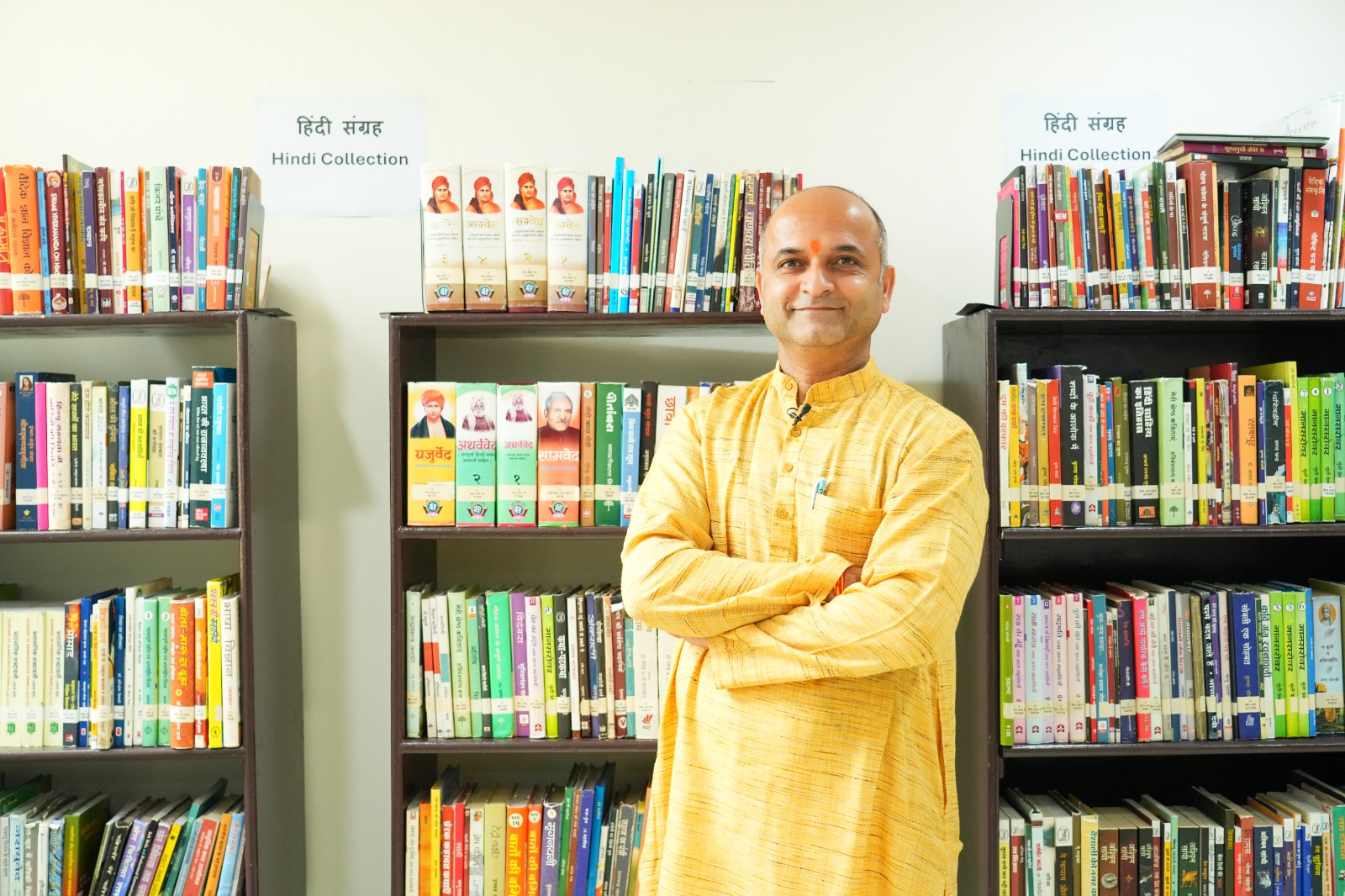
Led by Dr. Dinesh Mohan Joshi, Assistant Professor, School of Liberal Arts, IIT Jodhpur, the research brings together Artificial Intelligence (AI), Computational Linguistics and Indian Knowledge Systems (IKS) to address a critical challenge in manuscript preservation: the identification, restoration and interpretation of historical texts that are often difficult to read because of fading ink, damaged pages, incomplete characters and centuries of deterioration.
India's manuscript heritage holds a vast body of knowledge spanning mathematics, astronomy, medicine, philosophy, literature and architecture. However, a significant challenge lies in making this knowledge accessible. Many manuscripts contain faded text, stains, torn sections, overlapping words and complex handwritten characters. Conventional Optical Character Recognition (OCR) technologies, primarily designed for printed and relatively clear documents, are often inadequate for interpreting such manuscripts.
Addressing this challenge, the IIT Jodhpur research is developing an intelligent processing framework that goes beyond simply converting manuscript images into digital text. It aims to restore damaged content, recognise historical handwriting, understand linguistic structures, and support transliteration and translation, while maintaining the authenticity and traceability of the original material.
A key innovation of the research is the development of an Adaptive AI Orchestrator, which acts as the coordinating intelligence of the entire platform. Unlike conventional systems that follow a fixed sequence of processing operations, this framework is designed to assess the condition and characteristics of each manuscript and determine the most appropriate processing approach.
The system begins by profiling the manuscript to identify its probable script, language and other characteristics, including mixed-script or multilingual content. It then guides the manuscript through a series of specialised processing stages involving quality assessment, image restoration, page-layout analysis, text segmentation, handwritten text recognition and linguistic processing.
This adaptive approach is particularly important because historical manuscripts differ considerably in their writing styles, physical condition and textual structures. A faded manuscript may require image enhancement, while another may need specialised treatment for damaged characters, complex ligatures or marginal notes. The orchestrator evaluates the outcomes at different stages and determines whether a particular operation should be repeated, an alternative processing technique should be adopted, or the material should be referred to a scholar for verification.
The platform is being designed to support six important Indian scripts: Devanagari, Sharada, Grantha, Nandinagari, Modi and Tulu-Tigalari, with provisions for multilingual processing through validated language packs covering classical and regional Indian languages.
Each of these scripts presents distinct challenges for computational recognition. Devanagari requires attention to its characteristic headline structure, while Sharada, Grantha and Nandinagari involve historical glyphs and complex ligatures. Modi requires handling of cursive handwriting, while Tulu-Tigalari presents its own challenges relating to character combinations and manuscript layouts. The research therefore proposes script-specific segmentation techniques and specialised recognition models rather than relying on a single approach for all manuscripts.
Another important component is Handwritten Text Recognition (HTR), which enables the system to interpret handwritten content rather than relying solely on printed-text recognition. The proposed framework is designed to account for variations in handwriting, historical character forms, incomplete strokes and damaged writing. Its objective is to generate machine-readable Unicode text with confidence scores, enabling experts to examine and validate the results.
The research also recognises that reading a manuscript involves much more than identifying individual characters. Historical texts often contain older vocabulary, spelling variations, specialised terminology and grammatical structures that require contextual understanding. To address this, the platform is designed to incorporate language processing capabilities for text normalisation, word separation wherever applicable, transliteration, contextual interpretation and translation into modern Indian languages or English. The intention is to support scholars in interpreting historical texts, rather than replace the role of scholarly expertise.
Complementing this technology-driven initiative, Dr. Joshi is also engaged in the critical study and editing of significant unpublished manuscripts relating to Indian mathematics and astronomy. These include a commentary on the Brahmasphuṭasiddhānta, originally authored by the seventh-century mathematician and astronomer Brahmagupta and subsequently commented upon by the tenth-century scholar Pṛthudakasvāmi. His work also includes the Sūryasiddhānta, along with its commentary by Viśvanātha, a sixteenth-century mathematician and astronomer. These scholarly engagements bring an important historical and disciplinary perspective to the research, connecting contemporary computational approaches with the study of India's classical scientific traditions.
Commenting on the research, Dr. Dinesh Mohan Joshi, Assistant Professor, School of Liberal Arts, IIT Jodhpur, said,
"India's manuscripts preserve an extraordinary intellectual legacy, including knowledge developed over centuries in mathematics, astronomy, philosophy and several other disciplines. However, much of this knowledge remains difficult to access because of the physical condition and linguistic complexity of historical manuscripts. Through this initiative, we aim to bring Artificial Intelligence and traditional manuscript scholarship together to address this challenge. Our focus is not merely on digitising manuscripts, but on developing an intelligent system that can help restore, recognise and interpret their contents while preserving scholarly authenticity and ensuring that expert knowledge remains central to the process."
The initiative is aligned with the objectives of the Government of India's Gyan Bharatam Mission, which seeks to preserve, digitise and make the country's manuscript heritage more accessible. Once developed, the platform is expected to create a valuable multilingual and multi-script digital resource for researchers, historians, academicians, palaeographers, language specialists and students. It could also facilitate new research into historical scientific texts and India's contributions to mathematics, astronomy and other disciplines.
Through this initiative, IIT Jodhpur is advancing research at the intersection of emerging technologies and India's knowledge traditions. By bringing together Artificial Intelligence, computational language technologies and manuscript scholarship, the Institute is exploring new ways to address complex research challenges while contributing to the preservation and wider accessibility of India's intellectual heritage.
00000