Posted On:
02 NOV 2026 9:19PM by PIB Delhi
CSIR-National Institute of Science Communication and Policy Research (NIScPR) is organising the 3rd International Conference on Communication and Dissemination of Traditional Knowledge (CDTK-2026) on 02-03 November 2026 at CSIR-NPL, New Delhi. The first day of the conference was inaugurated on 2nd November 2026.
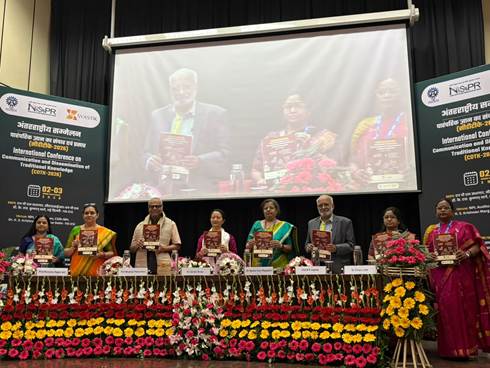
Dignitaries releasing the Souvenir and Abstract Book and SVASTIK Vol. III edition
Dr Joram Aniya, Hon’ble Member, NITI Aayog, was the chief guest. She highlighted on indigenous practices of Arunachal Pradesh which serves as a resilient model and urged young minds to share this knowledge with the world and help policymakers frame policies that benefit the society and traditional knowledge holders which eventually serve as a key step towards Viksit Bharat. She commended the 'SVASTIK' (Scientifically Validated Societal Traditional Knowledge) initiative of CSIR-NIScPR and especially its publications which focus on traditional knowledge in various languages as a remarkable achievement.
Prof. Bhushan Patwardhan, Guest of Honour of the program, urged that traditional knowledge has to be approached with curiosity and rigour. He described reverse pharmacology, in which research ideas drawn from tradition become hypotheses and are validated through laboratory and clinical work. He also spoke on Ayurgenomics, dosha genetics, rasayana and longevity, and said Bhartiya wisdom in all domains should be incorporated in school curriculum.
Dr Geetha Vani Rayasam, Director, CSIR-NIScPR, highlighted the initiatives of CSIR-NIScPR in protection and promotion of traditional knowledge. She mentioned about the encyclopaedic series The Wealth of India which documented flora, fauna and mineral wealth of India, and the Indian Journal of Traditional Knowledge which is a peer-reviewed diamond open access journal and is celebrating its 25 years. She mentioned about Traditional Knowledge Digital Library and its importance as well as the SVASTIK initiative.
Prof. Ranjana Aggarwal, Outstanding Scientist, CSIR, and Mentor of SVASTIK, explained about the national initiative SVASTIK which shares authenticated traditional knowledge and practices in eight broad areas through social media and its web portal.
The Conference also witnessed release of its Souvenir and Abstract Book, SVASTIK Stories: Indian Traditional Knowledge through the Lens of Science (Vol. III), and flipbook Treasure of Indian Traditions in Assamese and Maithili. Dr Charu Lata, Principal Scientist, CSIR-NIScPR and Organising Secretary of the conference, proposed the vote of thanks.
Following this, the first scientific session entitled, “Bridging Wisdom and Evidence: Documenting, Validating and Communicating Traditional Knowledge Responsibly” was chaired by Prof. B.N. Jagatap, IIT Bombay and Chair, SVASTIK Steering Committee. Prof. Tanuja Manoj Nesari, Director, ITRA, Jamnagar, called for responsible grading of evidence, and shared vocabulary through NAMASTE and ICD-11 TM2. She further suggested that SVASTIK seek access to the WHO Traditional Medicine Global Library (TMGL) for effective dissemination to the society. Ms Ma’aly Hazzaz, UNESCO Regional Adviser for Communication and Information, South Asia and Chief, Culture sector, stressed that TK belongs to communities, so ethics, consent, fair attribution and benefit sharing must come before dissemination. Dr Mrittunjoy Guha Majumdar, Amrita Viswa Vidyapeetham, Faridabad spoke on consciousness and computability.
The second scientific session on “Environmental Consciousness in Traditional Wisdom and its Relevance for Modern Climate Strategies” was chaired by Dr. Atul Narayan Vaidya, Vice Chancellor, LIT University, Nagpur. He in his keynote talk presented a holistic vision of Indian Knowledge Systems, and its integrated approach where science and philosophy exist as one by embracing “Ishavasyam Idam Sarvam” and offer a viable ethical framework for modern environmental practice. The session co-chair, Dr. Subarna Roy incepted the talk by marking International One Health Day, and emphasized on bridging dynamic TK with science, governance, and policy. He quoted key Indian stewardship examples from the Western Ghats such as Devarakadu sacred groves, village forest management, traditional tanks, leaf litter mulching, and local seed diversity and advocated a two-way partnership where science validates practice while local knowledge enhances uptake. Dr. Kailash Rao, Director, School of Planning and Architecture, Bhopal explored traditional architecture via creation by addition and subtraction, referencing the Neelkanth Mahadev Temple and shared his expertise in integrating generative drawing into studying Dravidian and Kalyani Chalukya architecture. Following this, a video message by Dr. Anil P. Joshi highlighted worsening mountain climates, insisting we must respect traditional ecological wisdom to combat climate change.
The Panel discussion on “Documentation, Digitisation and Ethical Issues, including AI in Traditional Knowledge” was chaired by Prof. Raghurama Bhatta U, CAO, IKS, MoE, who emphasised the evolution of knowledge documentation from Vedic oral traditions and ancient manuscripts to modern digitisation, highlighting AI's role in documentation and dissemination. Dr Viswajanani Sattigeri, Head, CSIR-Traditional Knowledge Digital Library Unit, highlighted TKDL's systematic classification of traditional knowledge, documenting 5,19,978 practices and formulations and supporting 375 favourable outcomes in patent applications. Dr Ann Edillon, Director, Traditional Knowledge Division, World Intellectual Property Organization (WIPO) discussed the WIPO’s Treaty, emphasising mandatory disclosure, patent verification and community consultation to prevent the misappropriation of genetic resources and associated traditional knowledge. Dr. Sudha Gopalakrishnan, Executive Director, India International Centre, through her video message, highlighted the evolution of knowledge preservation from oral traditions to manuscripts and the importance of digitisation, safeguarding and accessibility of oral traditions for future generations. Dr. Rajeshwari Singh, Senior Consultant, World Health Organization Headquarters highlighted global AI-for-health initiatives and WIPO's efforts in promoting AI-driven innovation. Sunita Verma, CTO, Ironclad, USA emphasised the need for safeguarding strategies and codified protocols before digitising traditional knowledge to ensure its ethical use and protection.
The first day of the conference also hosted a total of 22 oral and 40 poster presentations by national and international researchers on various key themes. A vibrant exhibition pavilion served as the key highlight of the conference where SVASTIK and 07 CSIR laboratories exhibited their knowledge products and technologies.
*****
NKR/AK