Ministry of Education
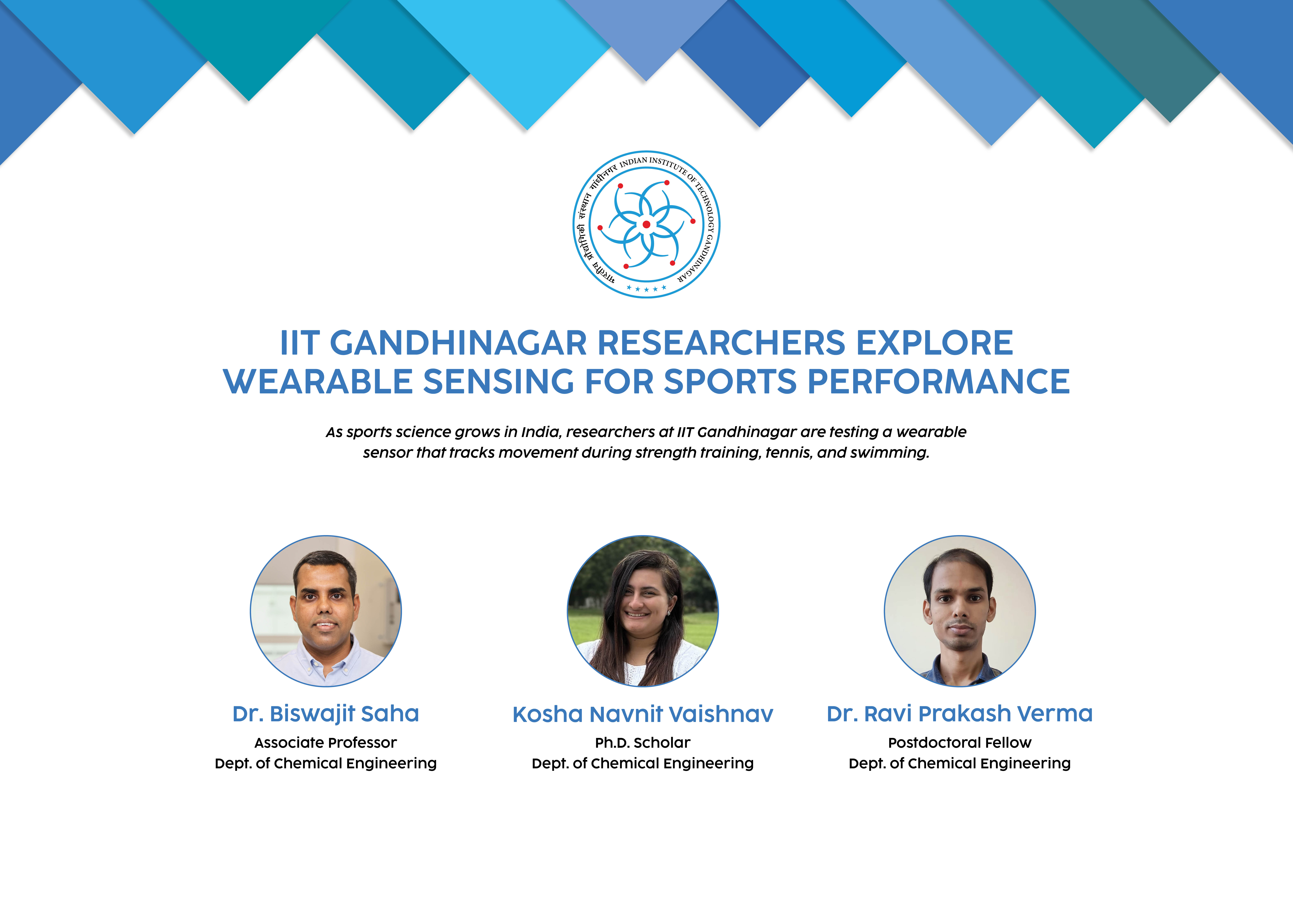
IIT Gandhinagar researchers explore wearable sensing for sports performance
As sports science grows in India, researchers at IIT Gandhinagar are testing a wearable sensor that tracks movement during strength training, tennis, and swimming
IITGN researchers develop wearable sensor patches to track movement during sports and exercise. The system compares movement signals with reference patterns from experienced athletes and trainers
The prototype is at Technology Readiness Level 5, with a patent filing in progress, and is being tested for strength training, tennis and swimming
Posted On:
16 OCT 2026 12:51PM by PIB Ahmedabad
What does a good bicep curl look like? Walk into a busy gym, and the answer may vary from one person to the next. Some people learn by watching a trainer, whilst others copy fellow gym-goers or follow videos on their phones. Without regular supervision, beginners may not recognise when their form changes or a movement is being performed incorrectly.
“An experienced coach can often spot such differences quickly. But in a crowded gym or training centre, watching every repetition by every person is difficult,” said Dr Biswajit Saha, Associate Professor in the Department of Chemical Engineering, Indian Institute of Technology Gandhinagar (IITGN). “We wondered whether a wearable sensor could provide an additional way to examine movement, even when a coach cannot observe every repetition?”
His research group at the Smart Materials Laboratory explored this question by building small, flexible sensor patches designed for strength training and sports such as tennis and swimming. The patches are now being tested on gym-goers and athletes in real training sessions, and the team is seeking industry and government partners to develop them further.
Turning movement into a signal
Placed on selected parts of the body, the patches record electrical changes associated with movement. The underlying principle is called piezoresistive sensing. In these sensors, mechanical deformation changes the electrical resistance. When the body moves, the patch deforms along with the skin and surrounding tissue. That deformation changes the sensor’s electrical response, producing a measurable signal.
The signal travels through a small electronic system, where it is sampled and transmitted to a mobile device using Bluetooth. A machine-learning model then examines patterns in those signals and compares them with reference data collected from experienced practitioners, including coaches, trainers, and sportspersons competing at the state and national levels.
“By comparing these patterns with those recorded from experienced practitioners, we aim to provide trainers with additional information to assess exercise and sports performance,” explained Ms Kosha Navnit Vaishnav, a PhD scholar in IITGN’s Department of Chemical Engineering who is part of the research team developing the wearable sensor.
Learning from the best
The designed framework of the new sensor can examine differences in the signals, including their timing, strength and consistency across repetitions. Since there is no single correct pattern that every person must follow, two people may perform the same exercise differently because of their body proportions, mobility or individual movement habits. Even the same person may move differently when tired. Thus, a difference between two signals is not necessarily evidence of a mistake. The challenge is to establish which differences matter and what they reveal about the movement being studied.
“Our framework is intended to complement conventional coaching by providing quantitative information about movement patterns that may be difficult to assess consistently through observation alone,” said Dr Ravi Prakash Verma, a Postdoctoral Fellow at IITGN’s Department of Chemical Engineering who has been an integral part of developing the sensor platform.
The potential sports patch is part of a larger effort by the IITGN group to develop flexible sensors that can be worn on the body and adapted to different applications. In a 2024 study published in Sensors and Actuators B: Chemical, researchers developed a stretchable sensor integrated into a textile bandage to track body movements and physiological signals. It withstood 50,000 cycles of repeated use in tests and showed antibacterial activity against Escherichia coli. Another 2024 study, published in ACS Applied Nano Materials, introduced a stretchable, printable sensor that monitored human physiological signals and physical activity. In a third study, published in the IEEE Sensors Journal, the technology was applied in a different direction, integrating a sensor into a wearable mask to monitor breathing patterns. The three studies illustrate the range of wearable sensing approaches the group has explored, providing a foundation for its ongoing work on wearable sensors for sports.
The team is refining the measures used to interpret the signals for different exercises and sports, creating a broad repository that trainers can access. In addition to the recorded benchmarks from experts and trainers, they have evaluated the sensor and the signal interpretation system on beginners participating in gym training and sports activities. The study has been monitoring 50 individuals involved in weightlifting and strength training, and also capturing movements associated with tennis, swimming and other physical activities for 30 trainees.
The road to real-world use
“Findings of the current work are yet to be published,” said Ms Vaishnav. The team has integrated the sensing hardware, data acquisition and analysis into a single platform. “Our prototype is at Technology Readiness Level 5 and is being refined and validated in real training settings, with a patent filing in progress,” she added.
As India puts greater emphasis on sports science, the work reflects the growing role of research and technology in supporting athlete training and performance assessment. The National Sports Policy 2025 calls for wider use of sports science, medicine and technology to improve performance. In addition, the revamped Khelo India framework envisages collaboration with private academies, corporate partners, and other institutions to attract investment and expertise to sports development.
The team is building collaborations with fitness and strength-training facilities, personal trainers, sports academies, and athletes to support further validation and product development. “As we scale upwards towards a commercially oriented product, we are looking for technology-development partnerships and funding from relevant industry counterparts and government funding bodies,” added Dr Saha.
સોશિયલ મીડિયા પર અમને ફોલો કરો :  @PIBAhmedabad
  /pibahmedabad1964
  /pibahmedabad
  pibahmedabad1964[at]gmail[dot]com
(Release ID: 2324256)
Visitor Counter : 12