Ministry of Education
IIT Gandhinagar Professor Mithun Radhakrishna Receives National Teachers’ Award from President of India
Recognised for innovative teaching, interdisciplinary education and student mentoring
Posted On:
04 SEP 2026 10:25AM by PIB Ahmedabad
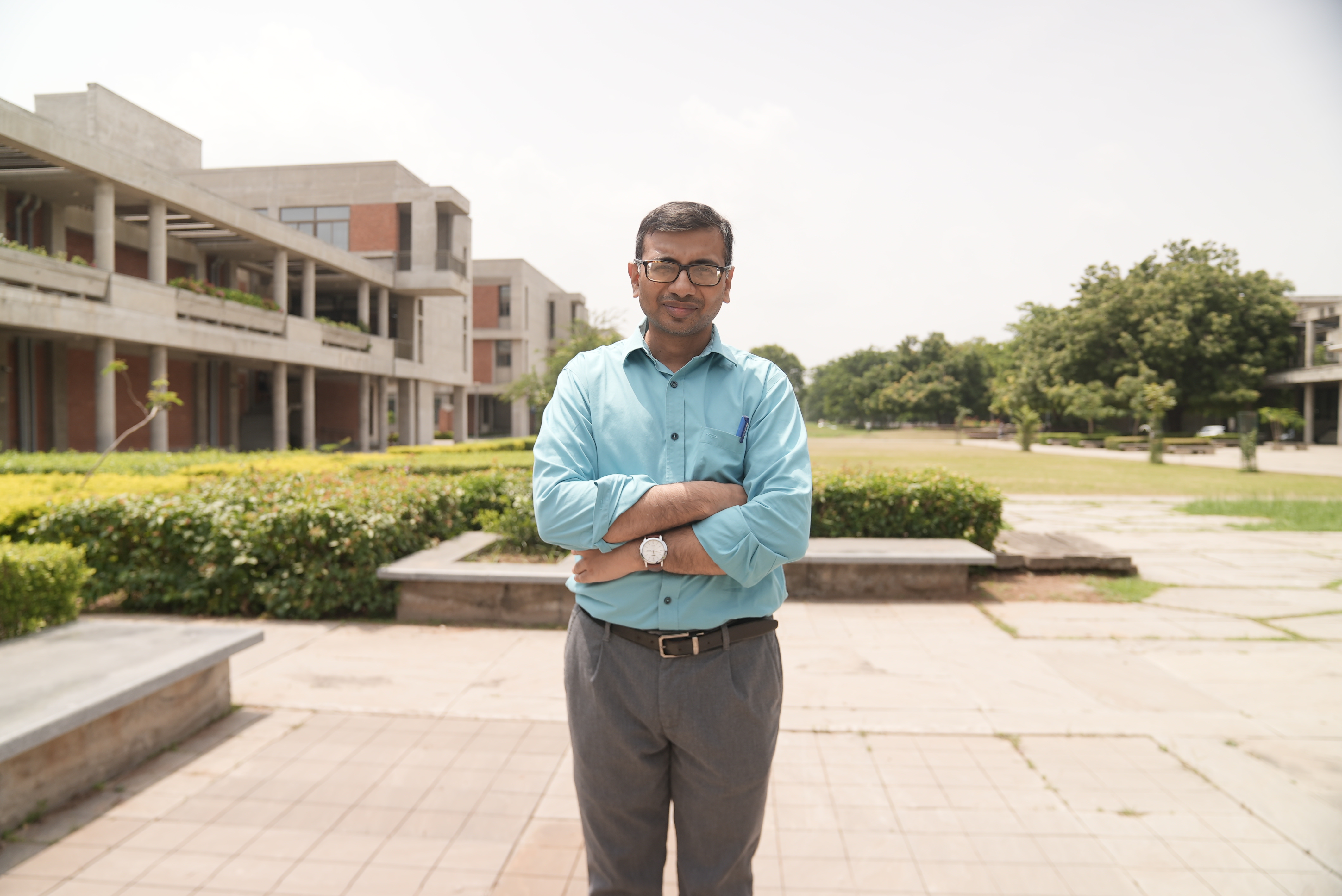
Dr Mithun Radhakrishna, Associate Professor, Chemical Engineering, Indian Institute of Technology Gandhinagar (IITGN) has been awarded the National Award to Teachers 2026 by the Hon’ble President of India, Smt Droupadi Murmu on the occasion of Teachers’ Day, September 5, 2026. He is among 21 teachers and faculty members from higher education institutions across India selected for the prestigious national recognition.
The National Award to Teachers 2026 recognises the exceptional contributions of teachers to teaching-learning, outreach, research and innovation, and other areas of academic excellence. The recognition is a proud moment for the IIT Gandhinagar community and acknowledges Dr Radhakrishna’s contributions towards innovative teaching, interdisciplinary education, research-led learning and student mentoring.
For Dr Radhakrishna, the recognition is both an honour and an encouragement to continue evolving as an educator. “My first reaction was a mixture of surprise, gratitude and happiness. Teaching is something I have always taken very personally, so receiving a national recognition for it is extremely meaningful. More than anything, it made me think of the students and teachers who have shaped my own journey,” he said.
His own approach to teaching has been shaped by several teachers and experiences across different stages of his academic journey. He recalls his high school teachers at Sadvidya School in Mysore, Karnataka, who made learning engaging and meaningful, and his PhD advisor, Professor Sanat Kumar at Columbia University, whose way of thinking and approaching problems influenced his own academic outlook.
However, he traces his strongest early inspiration for teaching to his BTech years. Before examinations, he would often study with friends and spend considerable time discussing concepts and helping them clarify their doubts. This was when he realised that he genuinely enjoyed explaining ideas and seeing someone arrive at an understanding.
His interest in teaching also influenced his decision to pursue research. As an undergraduate, he recalls thinking that if he wanted to teach at an IIT, he would need to pursue a PhD. His opportunity to work with Professor Anil Kumar at IIT Bombay through the JNCASR fellowship subsequently introduced him to the excitement of asking unanswered research questions.
“Academia therefore became a very natural choice because it is one of the few professions where I could combine both things I enjoyed deeply—teaching and research. It also gives you the intellectual freedom to explore new ideas, move across disciplines, and think about questions simply because they are interesting or important. That freedom to teach, learn, question, and discover is what continues to make academia meaningful to me,” he said.
At IIT Gandhinagar, Dr Radhakrishna has sought to bring together teaching, research, computation and real-world applications. Along with teaching fundamental courses, he has introduced interdisciplinary courses such as Molecular Simulations and Financial Modeling, and incorporated projects and research into classroom learning.
His teaching approach centres on developing independent thinkers rather than simply helping students arrive at predetermined answers. He connects theoretical concepts with computation, experiments, research papers and real-world problems, encouraging students to understand not only how something works, but why.
For Dr Radhakrishna, some of the most meaningful evidence of the impact of teaching emerges years after a student has left the classroom. Former students have approached him to share how a course or discussion encouraged them to pursue research, explore a new area, take up computational work or coding, approach scientific problems differently, or influenced their eventual career path.
One particularly fulfilling milestone in his teaching journey was seeing his first PhD student go on to join IIT Kharagpur as a faculty member. For him, watching a student become an independent researcher and teacher represents one of the most rewarding outcomes of academic mentorship.
“The most meaningful part is not necessarily that they remember a particular equation or topic. It is when they say that something they learned changed the way they think about a problem. That, to me, is a much deeper outcome of education,” he said.
He also remembers the smaller moments that make teaching rewarding—the point when a difficult concept suddenly becomes clear to a class, an unexpected student question takes a lecture in a new direction, or a discussion continues even after the formal class has ended. Such moments, he says, transform the classroom from a place where information is delivered into one where everyone is thinking together.
With the rapid growth of technology and Artificial Intelligence (AI), he believes this role of the teacher is becoming even more important. Rather than competing with the availability of information, educators must help students develop the ability to question, evaluate, connect ideas and exercise judgement.
“The teacher can no longer be primarily a transmitter of information because information is available instantly. Our role is increasingly to help students ask better questions, evaluate answers critically, connect ideas, develop judgement and discover what they are capable of doing independently,” he said.
For Dr Radhakrishna, independent thinking is also inseparable from academic values. He hopes students remember not only the subjects they studied but also the importance of questioning assumptions, thinking logically and developing a scientific temperament. He places equal emphasis on integrity, ethics and responsibility, values that are reinforced through IIT Gandhinagar’s Honour Code.
“I would be happiest if they remember me not simply as someone who taught them a subject, but as someone who encouraged them to think independently, remain intellectually curious, and conduct themselves with integrity,” he said.
Looking ahead, Dr Radhakrishna aims to explore how AI can be integrated into education without compromising independent thinking, while continuing his research in computational molecular science and mentoring students to pursue original research questions.
For Dr Radhakrishna, the National Award to Teachers is an important milestone, but the process of learning and teaching continues. Every new batch of students brings different questions and perspectives, sometimes challenging assumptions that educators themselves may have stopped questioning.
The National Award to Teachers 2026 adds to IIT Gandhinagar’s emphasis on research-led education, interdisciplinary learning and close faculty–student engagement, and celebrates the contribution of its faculty to advancing teaching and learning.
સોશિયલ મીડિયા પર અમને ફોલો કરો :  @PIBAhmedabad
  /pibahmedabad1964
  /pibahmedabad
(Release ID: 2306632)
Visitor Counter : 54