Ministry of Science & Technology
New study on temperature change induced structure recovery patterns could help drug delivery
Posted On:
02 SEP 2026 4:32PM by PIB Delhi
Scientists have unveiled a way to make jammed systems flow momentarily by giving them temperature shocks, wiping out memory imprints in them. This could have far-reaching implications in areas such as drug delivery.
Materials such as glass exhibit mechanical properties akin to those of solids though their structural characteristics resemble those of liquids. They also retain memory imprints. Scientists are trying to find ways to erase the memory imprints and convert glass to liquid form so that its structure can be controlled effectively.
Researchers from the Raman Research Institute (RRI), an autonomous institute of the Department of Science and Technology (DST) explored ways to momentarily get the glass to liquid state for erasing their memory.
For the experiment, Sonali Kawale, first author on the paper and PhD student at RRI, jam-packed squishy particles so that they resemble hard materials, to be specific, glass, which has particles in disorder inside it.
The floppy particles Kawale used were made of microgels, a material that can absorb 300-500 times its weight in water and is used in diapers and sanitary napkins. “Squeezing is never a good thing. In an ideal environment, these particles would like to move around. But they can’t do that. So, they’re unhappy. If the whole thing starts flowing, that’s a happy situation,” said Ranjini Bandyopadhyay, co-author of the study published in the Journal of Colloid and interface Science.
They found a way in which one can get them a little happier. The process by which a system tries to flow and reach its minimum energy configuration is known as structural recovery.
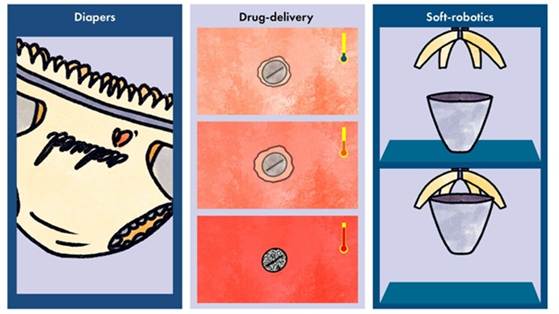
Fig 1. Various uses of microgel particles: (a) due to their enhanced ability to absorb liquids, they are often used in diapers (b) being thermo-responsive, they are used as coatings in medicine, that later disintegrates with exposure to high-temperatures and allows the drug to interact with the body, and (c) due to their nature, they are used to create flexible material that mimics biological material.
Kawale first synthesised microgel particles in a three-neck round-bottom flask and ground them to a fine powder, created a suspension of this microgel powder by adding it to water, stirred them for 24 hours, sonicated (agitated with sound waves) them for 15 minutes and refrigerated them at 4 degrees Celsius, where they remain stable enough to use for months.
The team found that the path the suspension followed to reach the target temperature of 20 oC during heating differed from that during cooling. There was no mirror symmetry. Instead, there was what scientists call ‘asymmetry’ in the path the suspension took during the heating and cooling processes. The system depends not only on the initial and final temperatures, but also on the path taken.
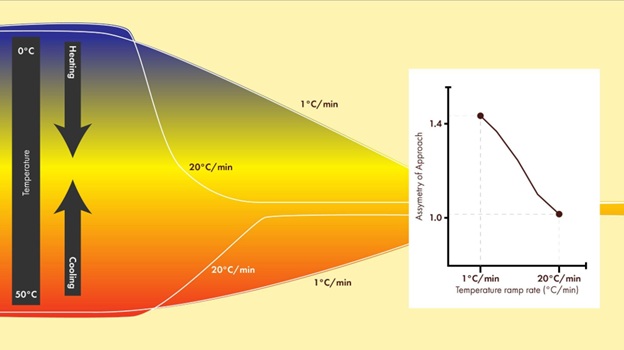
Fig 2. Providing temperature shocks can help control the asymmetries in the system
They found that as they increased the temperature ramp rate suddenly, giving a kind of thermal shock, the particles rearranged, sending the jammed system into a temporary liquid state. These rearrangements erase the memory of the different paths navigated by the system during heating and cooling, and reduce asymmetric relaxations in the systems. So, though scientists had seen asymmetries earlier, here they could control them. They could obliterate the asymmetries because of the temperature ramp they forced on the system.
Control of the structural recovery process can enhance the utility of these dense materials. For example, the microgel particles they used, are used in drug delivery where temperature plays a crucial role. They loaded drugs when they were cool and swelled like puffed-up jelly. When they rose above 34 °C—a shade below body temperature—they collapse, squeezing out the medicine at the targeted site, such as a tumour. This targeted and controlled drug release reduces side effects. Therefore, it is essential to understand how external perturbations, thermal shocks in their case, influence the structural recovery of these materials.
In future work, they would study how the intricate path-dependent dynamics of jammed systems depend on the application of mechanical shocks, and how mechanical shocks compare with thermal shocks.
Publication link: 10.1016/j.jcis.2026.139830
*****
NKR/FT
(Release ID: 2305938)
Visitor Counter : 1075