Ministry of Social Justice & Empowerment
From Financial Struggle to Mechanised Sanitation Entrepreneurship: How NAMASTE–SUY Support Strengthened Kapil Pal’s Livelihood
Posted On:
28 AUG 2026 6:42PM by PIB Delhi
For sanitation workers supporting large families, limited financial resources and the absence of mechanised equipment can make it difficult to build a stable livelihood. Structured financial assistance can help them expand their work, improve their earnings and serve their communities with greater safety and dignity.
Demonstrating the impact of support under the Swachhta Udyami Yojana (SUY) component of the NAMASTE Scheme, Kapil Pal, a 32-year-old sanitation worker from Noor Nagar, Sihani, Ghaziabad, Uttar Pradesh, strengthened his livelihood through mechanised sewer and septic tank sanitation services.
Belonging to the OBC/Gadaria community, Kapil completed his education up to the 12th standard and entered sanitation-related work to support his family. He lives in a joint family with his wife, two children, parents and elder brother. His wife is a homemaker, while his elder brother’s contribution to the household income is limited. As the primary earning member, Kapil bears most of the responsibility for meeting household expenses and supporting the needs of the entire family.
Kapil has a four-year-old son and a seven-year-old daughter, who is studying in the second standard. He aspired to improve his family’s financial condition, provide quality education to his children and build a secure future through self-employment.
Before receiving assistance, Kapil faced limited financial resources, heavy family responsibilities and dependence on sanitation work for regular income. The lack of capital and limited opportunities for livelihood expansion made it difficult for him to achieve long-term financial security.
A major challenge emerged when Kapil had to undergo a back operation. The treatment created physical, emotional and financial stress, as unexpected medical expenses added to his existing household responsibilities.
Kapil received assistance under the Swachhta Udyami Yojana component of the NAMASTE Scheme on 21 September 2021. He was provided upfront capital subsidy for the procurement of a tractor-cum-suction machine to strengthen his sanitation service-related livelihood activities.
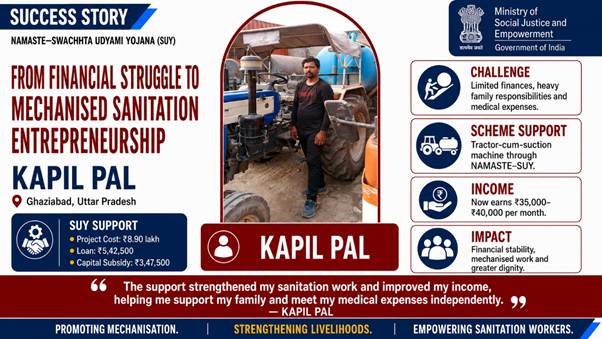
The project involved a total cost of ₹8.90 lakh, comprising a loan of ₹5,42,500 and a capital subsidy of ₹3,47,500. Kapil is repaying the loan through a monthly instalment of ₹18,640, with approximately ₹1,21,000 currently remaining outstanding.
The mechanised equipment enabled Kapil to strengthen and expand his work through suction-machine operations under Nagar Nigam Ghaziabad. He now provides sewer and septic tank sanitation services primarily in the Raj Nagar Extension area.
Following the intervention, Kapil’s livelihood and economic condition improved significantly. He now earns approximately ₹35,000–₹40,000 per month, enabling him to meet household responsibilities, support his children’s education and build savings for unforeseen circumstances.
The benefits of his improved financial position became especially evident during his recent back operation. Kapil was able to meet the entire cost of his medical treatment independently through savings generated from his sanitation service work, without creating additional financial pressure on his family.
The assistance has strengthened Kapil’s confidence, financial independence and social dignity. He is now better equipped to support his family, fulfil his responsibilities and face future challenges with greater security.
Expressing his satisfaction with the support received under the Scheme, Kapil Pal said,
“The support helped me strengthen my sanitation service work and improve my income. I now earn approximately ₹35,000–₹40,000 per month. The savings from my work enabled me to meet the expenses of my back operation independently while continuing to support my family and my children’s education.”
Kapil Pal’s journey demonstrates how structured financial assistance, mechanisation and livelihood support can empower sanitation workers to become self-reliant entrepreneurs. The intervention under NAMASTE–SUY reflects the Government’s commitment to promoting safe sanitation practices, sustainable livelihoods and dignified economic opportunities for sanitation workers.
Today, Kapil stands as an inspiring example of resilience and self-reliance—serving his community while building a more secure and dignified future for his family.
*****
SS-54-TAR-KV-GA-RK
(Release ID: 2304359)
Visitor Counter : 672