Ministry of Science & Technology
India develops critical equipment for International Mega Science project FAIR
Posted On:
07 AUG 2026 5:05PM by PIB Delhi
The first of three units of beam catcher equipment, an integral part of the beam line (the path leading from particle generator to the experimental end-station) has reached the International Mega Science Project, Facility for Antiproton and Ion Research (FAIR) site and waiting for its installation. These are one of the key elements of the super fragment separator (super-FRS) that produces the radioactive beams.
The equipment is required to absorb the remnants from the primary heavy-ion beams of energy 0.4-1.5 GeV/nucleon when it hits to production target for production of radioactive beams. A typical order of 5x10¹¹ particles/spill deposit ~ 29kJ energy in the absorbing medium (graphite) within a pulse of 50-100 ns at a time interval of 1.67s. The localized energy deposition density in the absorber (Bragg peak) causes the peak energy density to be as high as 300 J/g per pulse. This is expected to induce thermal shock waves in the absorbers and is one of the major challenges in design of beam catchers.
The beam catcher was designed by the Central Mechanical Engineering Research Institute (CSIR-CMERI) in Durgapur under the supervision of Bose Institute, the primary coordinator for Indian institutional and scientific participation in FAIR.
India became one of the founding members of the International Mega Science Project, Facility for Antiproton and Ion Research (FAIR) by signing a convention on October 4, 2010 at Wisbaden, Germany.
FAIR is a large multipurpose particle accelerator facility being built at Darmstadt, Germany. India’s contribution to FAIR is funded jointly (50:50) by the Department of Science and Technology (DST) and Department of Atomic Energy (DAE) of Government of India. Bose institute, Kolkata, an autonomous R&D Institute under the Department of Science & Technology, Ministry of Science & Technology, Government of India, has been designated as the Indian shareholder in the FAIR GmbH and the nodal Indian Institution for the implementation of FAIR programme in India.
The contribution of India includes certain cash components and a number of in-kind supplies. Several key elements for the accelerator such as ultra-high vacuum chambers, power converters, IT and diagnostic cables and beam catchers are some of the in-kind supplies from India.
Among them the beam catchers are of unique nature not only because there are only three of them that will form the heart of the accelerator system, but also because the system, a combination of heavy engineering, precision movement and vacuum technology, has been designed and being manufactured in India.
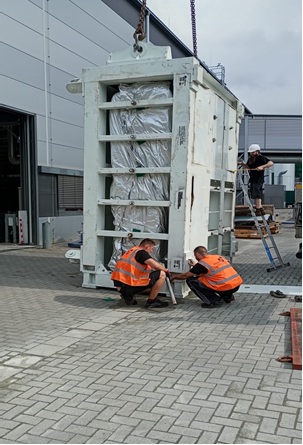
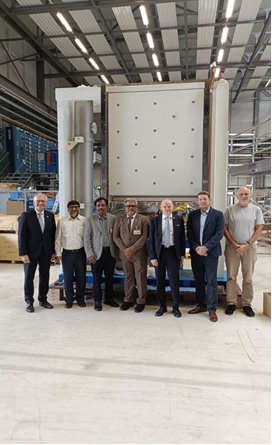
Fig 1: Beam Catcher (BC-3) at FAIR site
The absorbers of the beam are housed in a vacuum chamber of dimension 1600 mm (L) X 600 mm (W) X 2620 mm (H) which will remain under vacuum level of ~10-7 mbar. The absorbers, made of fine-grained graphite and hyper pure copper, are subjected to motorized horizontal and vertical movements inside the chamber with a precision of mm scale. As the dissipated energy from the absorbed beam makes the absorbers extremely hot, they are required to be water cooled to prevent them from getting melt. The whole system is shielded with iron plates for protection from any unwanted radioactivity. Along with the structural frame around the chamber, the overall dimension of one unit is 2838 mm (L) X 860mm (W) X 3450mm (H) and with all shielding plates it weighs about 40 t.
In addition to the Beam Catchers (3 units designed by CSIR-Central Mechanical Research Institute, Durgapur and manufactured by M/s. Trident Autocomponents Pvt. Ltd., Kanpur), India is also supplier of Ultra High Vacuum Chambers (58 units manufactured by M/s. Vacuum Technique Pvt. Ltd., Bengaluru) required to house the beam diagnostics devices, special multi-core IT and diagnostic cables (932 km manufactured by Siechem Technologies, Chennai) for signal and data transmission, ultra-stable power converters (524 units manufactured by M/s. Electronics Corporation of India Ltd., Hyderabad) to power the room temperature as well as superconducting magnets.
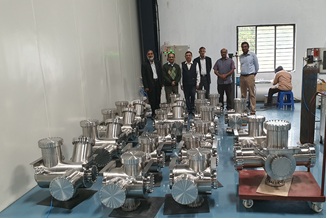
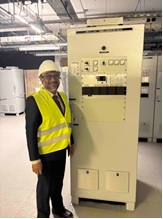
Fig 2: Left- UHV Chambers at VTPL, Bengaluru; Right- Power Converter at FAIR site
In addition to the in-kind supplies, several other Indian companies are also aware of the opportunities at FAIR and some of them have won international tender from either FAIR or other shareholding countries to supply components to FAIR. One of them is the Cryogenic component supplied by INOXCVA, Vadodara.
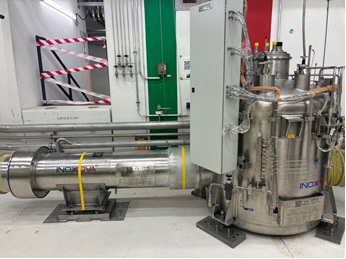
Fig 3: Cryogenic component from INOXCVA at FAIR site
Along with the accelerator components, two large group of scientists from several Indian Institutes and Universities are also working to develop and fabricate advanced detector systems as in-kind supplies for Nuclear Structure and Astrophysics (NuSTAR) and Compressed Baryonic Matter (CBM) experiments to be performed using the FAIR facilities when the beam is delivered from the accelerator.
Under supervision of Bose Institute, the Indian industries are working to produce these components thus fulfilling the ‘Make in India’ mandate from the Government of India. Through their engagement in such international mega science project, the Indian industries are scaling up their technical and overall capability to meet benchmarks of technical parameters on a time bound manner. These efforts are expected to make them ready for other mega-science facilities such as ITER, TMT, CERN, SKA, LIGO where India is involved and also enhance large scale in-house activities in India.
****
NKR/FT/NM
(Release ID: 2296099)
Visitor Counter : 1508