Ministry of Science & Technology
Pollens help trace why the Harappan Civilization shrank
Posted On:
29 JUL 2026 4:45PM by PIB Delhi
The expanse of the Harappan Civilization reduced and people living along the Indus River and the Ghaggar-Hakra River of Indus Valley Civilization (IVC) or Harappan Civilization migrated to the east Ganga plains, due to weak Indian Summer Monsoon (ISM) between ~5100 and 4000 cal yr Before Present (BP), where Present is 1950 CE.
Understanding the vegetation dynamics and corresponding hydro-climate variability from the Garhwal Himalaya, India, could be crucial in understanding the monsoonal variability during the Late Holocene (Meghalayan Age; 4.2 ka to the present). The Holocene Lake records (Nachiketa Tal, Chharaka Tal, Dewar, Tal, Deoria Tal) from the Himalaya are limited by poorly constrained radiocarbon chronologies characterized by reservoir effects, large age errors and coarse sampling.
Hence, to fill this research gap, the Birbal Sahni Institute of Palaeosciences (BSIP), an autonomous institute of the Department of Science and Technology (DST) carried out investigations on a well-dated (10 AMS 14C dates) sediment core recovered from the Deoria Tal (Lake) of Garhwal Himalaya for providing a high resolution (centennial-to millennial-scale) pollen-based record of vegetation dynamics, hydroclimate change and the ISM variability spanning the mid-Holocene to present.
Pollen and spores have been used as established tools for reconstructing past vegetation dynamics and contemporary climate change.
Ten AMS radiocarbon (14C) dates, obtained on Trapa seed cases, helped develop the chronology for sediment core recovered from the Deoria Tal. Radiocarbon dating was undertaken at the Center for Applied Isotope Studies (CAIS), University of Georgia, USA and dates were converted to calendar years using OxCal 4.355.
The researchers led by Dr. Mohammad Firoze Quamar found an, abrupt increase in the Oak/Pine ratio around 4250 cal yr BP corresponding with previously documented elemental and sedimentological evidence from the site of an abrupt, short-lived dry climate condition at 4200 cal yr BP, which is globally known as the “4.2 ka event” (ka= thousand).
The scientists suggested that this led to migration of population residing along the Indus River and the Ghaggar-Hakra River of Indus Valley Civilization (IVC) or Harappan Civilization to new areas of the east Ganga plains for domestic and agricultural use, as reliable seasonal flooding of the river system around the edge of the Thar desert disappeared. Thus, researchers attributed the shrinking of Harappan Civilization to the Abrupt Climate Change (ACC) at 4.2 ka BP of the Holocene from the Garhwal Himalaya, India.
They ascribed the cool-dry climate and weak ISM to the southward shift of the Inter Tropical Convergence Zone (ITCZ), which occurs in response to decreasing summer insolation in the Northern Hemisphere. The abrupt ISM weakening at the 4.2 ka has been linked to the stronger phase of El-Niño and a shift of the Indian Ocean Dipole (IOD) to a strong negative state.
As one of the most pronounced Holocene cooling events, the 4.2 ka event provides a natural experiment to investigate the teleconnections between the ISM, as well as various forcing factors, such as the El Niño, Inter Tropical Convergence Zone (ITCZ), Indian Ocean Dipole (IOD), and Summer Insolation (SI) in the low-latitude region.
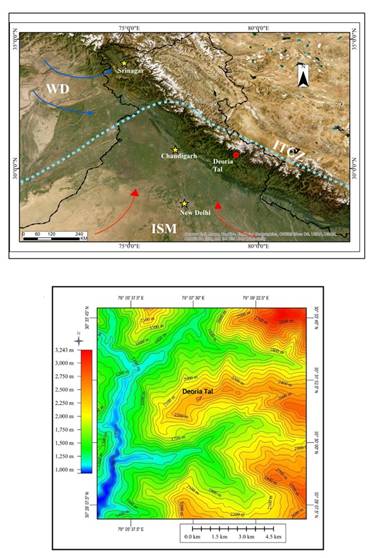
Fig. 1. Map of the study area with the study site, Deoria Tal, highlighted. Upper panel provides national context, including the location of New Delhi, Chandigarh and Srinagar. Lower panel depicts the local topography surrounding the study site.
The study conducted in collaboration with Drs. David F. Porinchu (University of Georgia, USA), Anoop Kumar Singh (University of Lucknow; Lucknow, now at the BABU, Lucknow), and Bahadur Singh Kotlia (Kumaun University, Nainital; now deceased) underscores the signatures of other global climate events during the different periods.
The researchers also said that the ISM, during the Roman Warm Period (RWP: 2500–1450 cal yr BP) interval when the circum-North Atlantic region was warm, (due to solar variability or internal North Atlantic variability) was strong (resulting in high agricultural productivity leading to the “Golden Age of India”), probably due to increased solar insolation and the associated northward shift of the ITCZ.
Northward shift of the ITCZ also resulted in strong ISM during the Medieval Climate Anomaly (MCA: 1050–650 cal yr BP). Other factors identified were fluctuations in El Niño-Southern Oscillation (ENSO)-modulated solar insolation, positive temperature anomalies, increased sunspot activity, high solar radiation and changes in the strength of the thermohaline circulation in the North Atlantic. Additionally, enhanced wind strength in the Arabian Sea and wetter conditions over India coincided with this period.
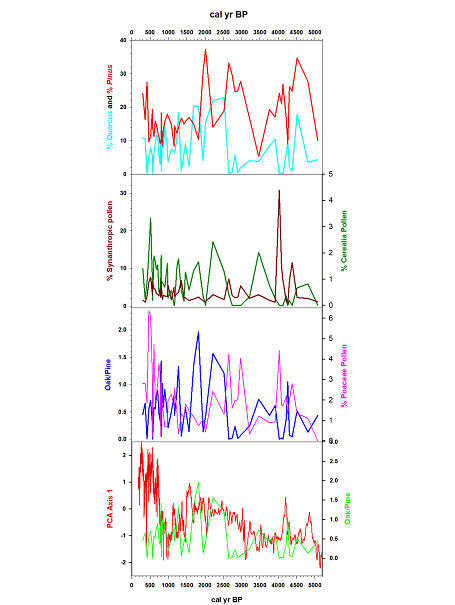
Fig. 2. A) Relative abundance of Quercus and Pinus plotted against time. B) Relative abundance of synanthropic pollen taxa, comprised of Artemisia and Cannabis sativa, Amaranthaceae, Brassicaceae, Alternanthera, Caryophyllaceae and Convolvulaceae, and relative abundance of Cerealia. C) Oak/Pine pollen ratio and relative abundance of Poaceae. D) Oak/Pine pollen ratio and PCA Axis 1 scores of XRF-derived elemental data (Niederman et al., 2021).
Image copyright @ Palaeogeography, Palaeoclimatology, Palaeoecology (Elsevier), 2026.
ISM was weak during the Little Ice Age (LIA: 650–100 cal yr BP; CE 1350-1850), which may be linked to an intensification of the Asian westerly jet stream and Westerlies over the Middle East during a positive phase of the North Atlantic Oscillation (NAO) and the migration of the Asian jet to the lower latitudes during the warm phase of ENSO. The weakest phase of the ISM during the LIA has been related to the southward shift of the ITCZ owing to increased northward energy flux across the equator during a cold Northern Hemisphere. ENSO restricts the northward movement of the ITCZ that delays the onset of the summer monsoon causing a reduction in the rainfall.
Published in Palaeogeography Palaeoclimatology Palaeoecology, it improves our understanding of the present ISM-influenced climatic conditions, as well as of possible future climatic trends and projections and provides insights for policymakers to develop scientifically informed strategies that address societal needs effectively.
Publication link: https://doi.org/10.1016/j.palaeo.2026.113764
******
NKR/FT/NM
(Release ID: 2291136)
Visitor Counter : 1079