Ministry of Education
IIT Gandhinagar researchers propose a framework that can pave the way for smarter, climate-resilient roads
The framework combines climate data, thermal modelling, and machine learning to improve rigid (concrete) pavement design recommendations
Researchers identified five microzones, showing that Gujarat’s rigid pavements experience different thermal behaviours, challenging the one-size-fits-all approach used in concrete road design
The framework is transferable and can support the development of region-specific rigid pavement design practices in other parts of India and the world
Exploring A Smarter Way to Build Climate-Resilient Roads
Posted On:
21 JUL 2026 1:05PM by PIB Ahmedabad
Every year from June to September, India experiences the monsoon season. While the visible heavy rainfall often takes the blame for many roads requiring repairs much sooner than expected, a far less visible yet critical force is at play long before the first raindrop falls on the road.
Rigid or concrete pavements are a type of road construction that uses concrete slabs. They distribute traffic loads over a wide area and exhibit the ability to withstand heavy loads. These pavements are used in places like highways and airports, and are becoming increasingly popular on city roads as well.
What is interesting is that together with their surrounding environments, concrete pavements form an integrated system. Daily fluctuations in temperatures, such as those due to sunlight and cool nights, along with seasonal changes, result in cycles of heating and cooling of the pavement layers. It is these cycles that create internal stresses within the pavement structure.
Imagine a chocolate bar. When left outside the refrigerator in summers, it would soften. However, keeping it inside the refrigerator would cause it to harden. Upon trying this process of repeatedly cooling and uncooling chocolate during my childhood, I observed changes in its texture. My chocolate bar became grainy and crumbly! It was due to the thermal stress on the chocolate’s butter and sugar structures.
In a similar manner, the stresses within the pavement structure affect concrete pavements and contribute to progressive fatigue damage, ultimately affecting the pavement’s service life.
As an effort to tackle this issue, researchers from the Indian Institute of Technology Gandhinagar (IITGN) have used machine learning, a subset of artificial intelligence, to develop a framework that can support the development of tailored rigid pavements in a climate-resilient and region-specific manner. It is a smarter approach that could make roads more durable and reduce maintenance costs. Their study was published in the American Society of Civil Engineering (ASCE) Journal of Transportation Engineering, Part B: Pavements.
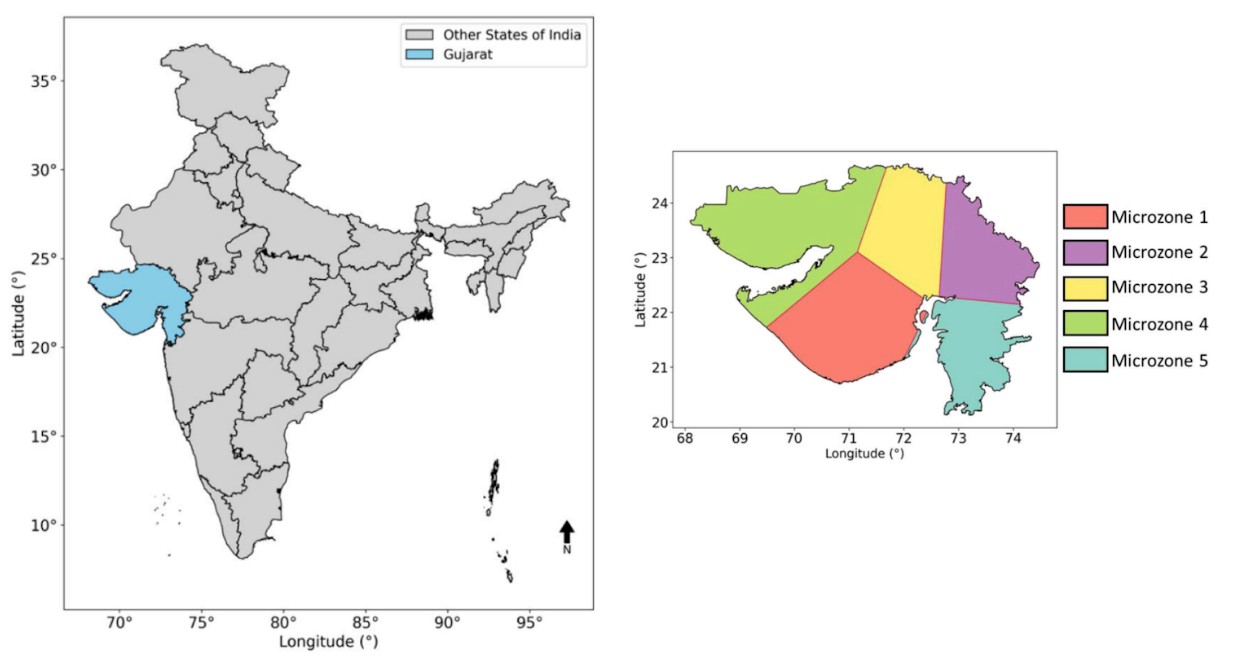
The team worked in India’s fifth-largest state, Gujarat, the coastal regions of which experience humid conditions, while inland areas are prone to summer heat. Different parts of the state with the country’s longest coastline vary in temperature and wind patterns.
The standard for considering thermal stresses while building rigid pavements in countries like India and Nepal involves providing certain temperature values obtained from data as old as 1974, which may not accurately reflect present-day conditions. Further, the use of broad zones, often spanning hundreds of square kilometres and encompassing diverse climatic conditions within a single zone, fails to capture localised thermal behaviour. It results in an inadequate characterisation of thermal stress behaviour in rigid pavements, influencing the accuracy of pavement performance predictions and design reliability. For example, in the present state of practice, all of Gujarat and Rajasthan are grouped into a single climatic zone.
“We started by thinking that if rigid pavements in different parts of the state experience different levels of thermal stress, it would really not be a good idea to build these roads using the same design recommendations,” remarked Dr Sumit Nandi, a former postdoctoral fellow in the Department of Civil Engineering at IITGN. The first author of this study, Dr Nandi, is currently a Scientist at the CSIR-Central Road Research Institute and an Assistant Professor at the Academy of Scientific and Innovative Research (AcSIR).
“We began by capturing the spatial variability across the state, which led to a final dataset of 126 land-based grid points. Next, we obtained hourly weather data for these grid points using the ERA5 database developed by the Copernicus Climate Change Service,” explained Dr Nandi. The researchers collected this information for the years 1961–1991 and 1992–2022, representing distinct climatic periods.
This data served as input for thermal modelling of rigid pavement across all 126 grid points. Think of thermal modelling as a technique that uses data and computer calculations to understand and predict how heat would behave in a place, which, in the present case, is the rigid pavement.
The simulations were conducted for combinations of three slab thicknesses of 200, 250, and 300 mm based on the IRC:58, the Indian Roads Congress guidelines for designing jointed rigid pavements for highways in India. These simulations also considered two surface albedo values of 0.30 and 0.50. Simply put, surface albedo shows the extent to which a particular surface reflects sunlight instead of absorbing it. Hence, while 0.30 would refer to a conventional pavement, 0.50 would be a “cooler” pavement!
After reducing the complexity of their data without losing its essential information, the team used machine learning to identify locations that behaved similarly from a thermal perspective. Think about how Spotify groups songs into playlists based on specific moods or how Netflix and Hotstar recommend movies and series with similar themes. The algorithms grouped locations where roads experienced similar patterns of heating, cooling and the associated stress.
The team finally identified five distinct thermal clusters or microzones in Gujarat based on combining the outputs of different algorithms. The bottom-up linear temperature differentials across these microzones varied from approximately 16.3°C to 17.2°C. In the present context, a bottom-up temperature differential is a gradual change in temperature from the bottom of the rigid pavement to its top, which causes the road to progressively crack over its service life.
According to Dr Sushobhan Sen, “These findings are interesting and confirm that Gujarat does not exhibit a one-size-fits-all rigid pavement thermal behaviour. Our study shows that the design that performs well in one part of the state may not be robust enough to withstand local climate conditions in another part of the same state.” Dr Sen is an Assistant Professor in the Department of Civil Engineering at IITGN and runs the Built Environment Lab, IITGN. “Extending the proposed framework to a pan-India scale represents a promising avenue for future research, facilitating the development of zone-specific thermal design charts for rigid pavements that can inform better-informed decisions that balance durability, safety and material use. It should be noted that the present study does not take into account the construction materials associated with building the rigid pavements. The quality of such materials may also adversely affect the life span of these roads. Future studies can also explore this crucial parameter,” he continued.
As India moves through another monsoon season, the condition of its roads is again becoming part of everyday conversation. The present research is a reminder that climate is a major player that contributes to the health of roads: not just the rains, but also the scorching summers and the chilly winters! Understanding these invisible thermal processes that occur in rigid pavements can lead to the development of smarter and climate-resilient roads.
This research is in alignment with PM Gati Shakti, a master plan launched for India's economic growth and sustainable development with roads as its critical component, and the Ministry of Road Transport and Highways’ Bharatmala Pariyojana. The researchers acknowledged the support by IITGN through a Post-Doctoral Fellowship to Dr Nandi.
(Release ID: 2286937)
Visitor Counter : 133