Posted On:
01 JUN 2026 4:56PM by PIB Delhi
Launching the ₹200-crore "Anusandhan National Research Foundation (ANRF) –Ministry of Jal Shakti MAHA Water Mission to support StartUps in the Water sector, Union Minister of State (Independent Charge) for Science & Technology, Earth Sciences and Minister of State for PMO, Personnel, Public Grievances, Pensions, Atomic Energy and Space, Dr Jitendra Singh today said that the Anusandhan National Research Foundation (ANRF) is democratising research funding by expanding opportunities for StartUps, MSMEs, universities and innovators across the country, ensuring that national missions, scientific resources and innovation support are no longer confined to a limited number of institutions.
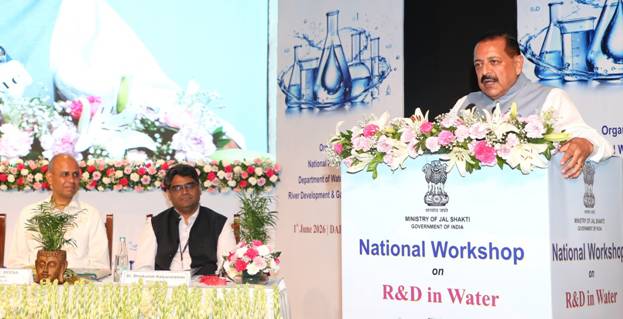
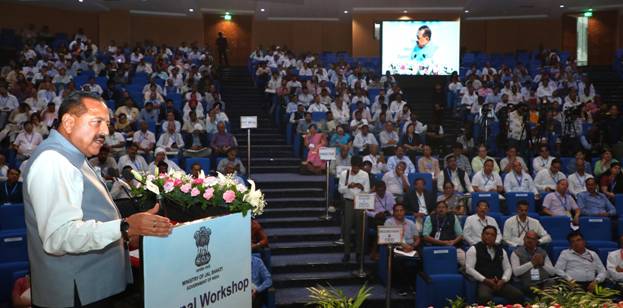
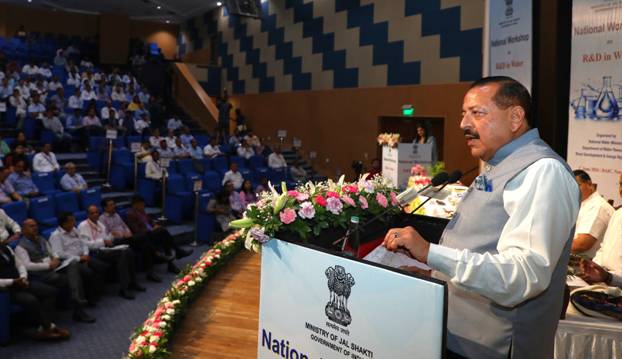
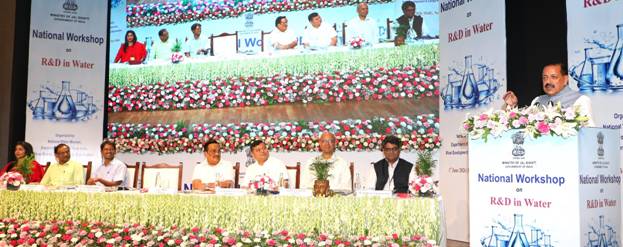
Addressing the inaugural session of the National Workshop on R&D in Water at Dr Ambedkar International Centre, New Delhi, Dr Jitendra Singh said ANRF was created to address a long-standing concern that a significant share of research funding often flowed to a few established institutions, while smaller universities, startups and emerging innovators remained outside the mainstream innovation ecosystem. The Foundation, he said, is widening access to resources, partnerships and mission-oriented research opportunities, enabling institutions and innovators from across the country to contribute to national priorities.
The Minister said ANRF has emerged as a national platform for mission-driven innovation and has already launched Missions for Advancement in High-Impact Areas (MAHA) in strategic sectors including Electric Vehicles, Drones, Medical Technologies, 6G Communications and Water. These missions are creating an integrated pathway from fundamental research to technology development, validation and deployment while bringing together academia, industry, startups and government institutions to solve critical national challenges. The launch of the MAHA Water Mission, he said, marks another major step in this direction.
Dr Jitendra Singh said the mission reflects Prime Minister Narendra Modi’s vision of leveraging science, technology and innovation to address developmental priorities. He said that the Prime Minister had, for the first time, brought water-related functions under a unified framework through the creation of the Ministry of Jal Shakti, elevating water security to a national priority. The MAHA Water Mission, he said, seeks to build on that vision by creating a collaborative platform that connects scientific institutions, industry, startups and grassroots stakeholders to develop scalable and sustainable solutions for the water sector.
Highlighting India’s expanding innovation ecosystem, Dr Jitendra Singh said the country has progressed from about 350–400 startups a decade ago to more than two lakh startups today, generating nearly 20–24 lakh jobs. He said India’s startup movement has become one of the strongest drivers of innovation-led growth and programmes such as the MAHA Missions are intended to ensure that entrepreneurial talent is channelled towards solving national challenges while creating new opportunities for employment, research and technology development.
The Minister said the Government’s Whole-of-Government approach has transformed the manner in which national missions are conceived and implemented. Referring to the space sector, he said reforms introduced under Prime Minister Modi’s leadership opened the sector to wider participation and created new opportunities for innovators and private enterprise. India’s space economy, which remained limited in scale for decades, is today valued at nearly USD 9 billion and is expected to grow to about USD 40–45 billion in the coming years, demonstrating the power of collaborative innovation and policy support.
Dr Jitendra Singh said India’s space programme has generated significant societal benefits through applications in governance, infrastructure planning, agriculture, resource mapping and public service delivery. He cited initiatives such as SVAMITVA and PM GatiShakti as examples of how space technology is contributing directly to developmental outcomes. He said similar convergence of science and technology is now being harnessed to strengthen water security and resource management.
Referring to the signing of an MoU between the Ministry of Jal Shakti and the Department of Space/ISRO, the Minister said satellite technologies, geospatial applications and scientific data are increasingly contributing to water resource mapping, groundwater assessment, irrigation planning and infrastructure development. He added that future collaborations involving Earth Sciences, Biotechnology, CSIR laboratories and other scientific institutions would further strengthen India’s ability to address water-related challenges through technology-driven solutions.
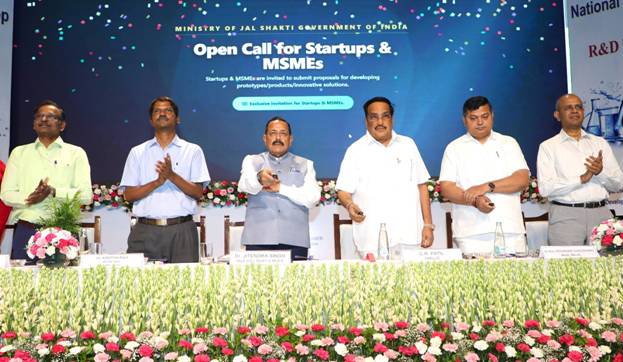
During the programme, Dr Jitendra Singh and Union Minister for Jal Shakti Shri C.R. Patil jointly launched the ANRF–MoJS MAHA Water Mission, released the mission flyer and announced an open call for proposals. An Open Call for Startups and MSMEs for Product and Prototype Development was also launched during the inaugural session. The event additionally witnessed the signing of an MoU between the Department of Water Resources and the Department of Space/ISRO, besides the launch of the Jal Sanchay Jan Bhagidari, Citizen Tracking and Reporting (JSJB-CTR) Portal and App.
The MAHA Water Mission has been conceived as a national platform to accelerate innovation in the water sector by connecting science, entrepreneurship, industry, academia and grassroots action. With a projected outlay of ₹200 crore over five years, jointly contributed by ANRF and the Ministry of Jal Shakti, the programme will support multidisciplinary consortia involving universities, national laboratories, research organisations, startups, MSMEs and industry partners. Up to ₹20 crore support will be available for selected consortia to undertake technology development, field assessment, validation and deployment of high-impact solutions in the water sector.
The mission will focus on five priority themes, Water Resource Assessment and Sustainable Management, Drinking Water, Water Quality and Ecological Health, Water Use Efficiency and Circular Economy, and Climate Resilience and Adaptation. It aims to support innovations from laboratory research to field deployment while generating scalable and localised solutions for strengthening India’s long-term water security.
Dr Jitendra Singh also referred to the Government’s broader Research, Development and Innovation (RDI) framework, saying it would provide an additional pathway for technologies emerging from mission programmes such as MAHA Water to progress towards commercialisation and large-scale deployment. He encouraged startups, researchers, innovators and institutions to actively participate in the opportunities being created through ANRF and contribute to building indigenous solutions for national priorities.
Union Minister for Jal Shakti Shri C.R. Patil said water security is fundamental to India’s developmental aspirations and called for greater integration of research, innovation and public participation in water management. He welcomed the partnership between the Ministry of Jal Shakti and ANRF and expressed confidence that the MAHA Water Mission would help generate practical and scalable solutions for the country’s water sector. Shri Patil also highlighted the growing success of the Jal Sanchay Jan Bhagidari campaign and emphasised the role of citizen participation in water conservation efforts.
The National Workshop brought together senior policymakers, scientists, researchers, startups, MSMEs, industry representatives and officials from State Water Resources Departments. Among those present were Union Minister for Jal Shakti Shri C.R. Patil; Ministers of State for Jal Shakti Dr Raj Bhushan Choudhary; Secretary, Department of Space and Chairman, ISRO Dr V. Narayanan; Secretary, Department of Water Resources, River Development and Ganga Rejuvenation Shri V.L. Kantha Rao; Secretary, Department of Drinking Water and Sanitation Shri Ashok K.K. Meena; senior officials of ANRF, researchers, innovators and representatives from academia and industry. The workshop also featured presentations on completed R&D studies and emerging technologies in water resource management, groundwater sustainability, climate resilience and water quality
*****
NKR/AK/NM