Ministry of Science & Technology
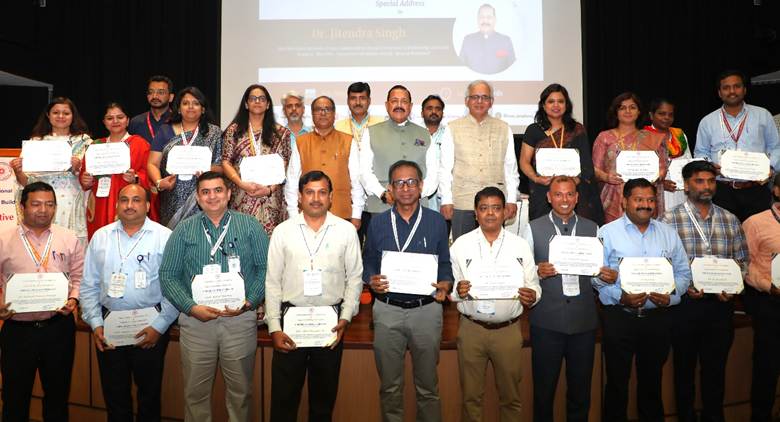
Union Minister Dr Jitendra Singh presents certificates and testimonials to the first batch of Scientists and Academicians receiving a formal training course in administration and governance
3-day programme is first-of-its-kind initiative jointly organised by the Indian National Science Academy and the Capacity Building Commission under Mission Karmayogi
Scientific excellence alone is not sufficient to lead modern institutions, scientists moving into leadership roles must also be equipped with governance, administrative and financial management capabilities: Dr Jitendra Singh
23 scientists from ICMR, CSIR, DSIR, DST, Ministry of Earth Sciences and DRDO participated in the programme, covering themes such as administrative vigilance, strategic decision-making, leadership governance, public service values, financial management and public decision-making processes
Posted On:
06 MAY 2026 5:39PM by PIB Delhi
Union Minister of State (Independent Charge) for Science & Technology; Earth Sciences and Minister of State for PMO, Personnel, Public Grievances and Pensions, Department of Atomic Energy and Department of Space, Dr. Jitendra Singh today presented certificates and testimonials to the first batch of Scientists and Academicians receiving a formal training course in administration and governance.
Dr. Jitendra Singh described the 3-day programme as a first-of-its-kind initiative jointly organised by the Indian National Science Academy and the Capacity Building Commission under the broader vision of Mission Karmayogi. He noted that the initiative emerged from discussions on the gap between scientific expertise and administrative preparedness, particularly for scientists at senior levels who often move into institutional leadership without formal training in governance systems, procurement rules, parliamentary procedures and public administration.
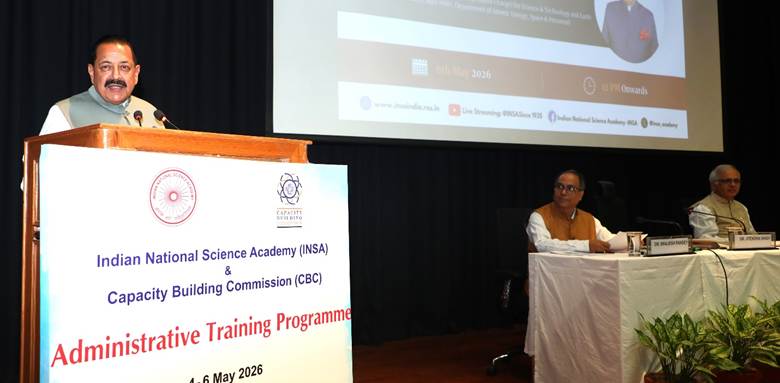
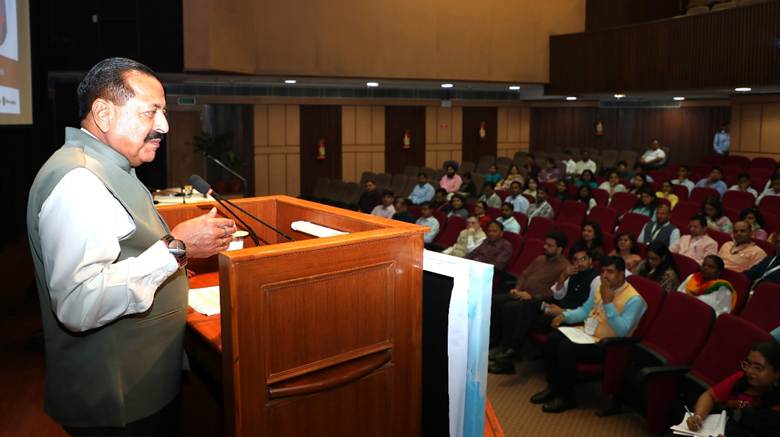
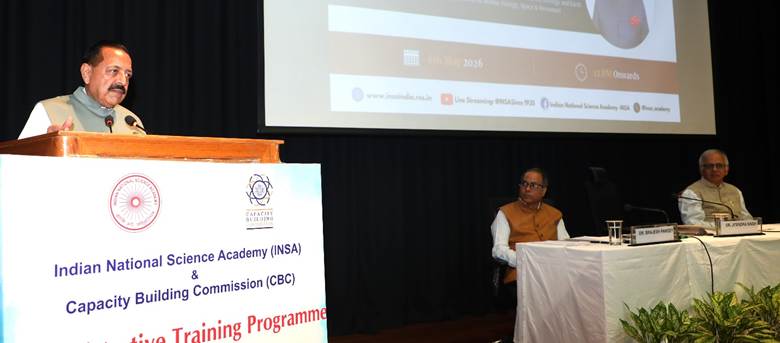
Dr Jitendra Singh said that scientific excellence alone is not sufficient to lead modern institutions, emphasising that scientists moving into leadership roles must also be equipped with governance, administrative and financial management capabilities. Addressing the valedictory session of the first INSA–CBC Administrative Training Programme at the Indian National Science Academy (INSA), New Delhi, the Minister highlighted the growing need for structured administrative training for scientists assuming institutional leadership responsibilities.
The Minister stated that India today stands at a critical juncture, with its scientific ecosystem making global contributions in areas ranging from space exploration and vaccine development to quantum technologies and deep-sea missions. However, he stressed that institutional leadership, resource management and strategic decision-making would be equally important in determining the future trajectory of India’s scientific growth. Referring to Mission Karmayogi, he said the initiative represents a shift from rule-based to role-based governance and from compliance-oriented administration to competence-driven public service.
Highlighting the importance of continuous capacity building, Dr. Jitendra Singh said the programme should not remain limited to a pilot initiative and called for its institutionalisation as a recurring national-level training platform. He also referred to the integration of such learning mechanisms with the iGOT Karmayogi platform, noting that digital platforms can help scale similar training initiatives across India’s scientific establishments.
Addressing the participants directly, the Minister urged them to apply the learnings from the programme within their respective organisations and emerge as change agents capable of improving institutional systems and governance practices. He emphasised that transparency, efficiency and accountability in the use of public resources are moral responsibilities attached to leadership positions in publicly funded scientific institutions. He also highlighted the need for stronger coordination between scientific research and societal needs, stating that science administrators occupy a crucial interface between laboratories, governance and public policy.
Prof. Shekhar Mande, President, INSA, highlighted that the programme was conceptualised to strengthen the administrative and institutional capacity of scientists working across government scientific departments and organisations. He noted that 23 scientists from institutions including ICMR, CSIR, DSIR, DST, Ministry of Earth Sciences and DRDO participated in the programme, which covered themes such as administrative vigilance, strategic decision-making, leadership in science governance, public service values, financial management and public decision-making processes. He emphasised that the programme aimed to familiarise scientists with the rules, accountability structures and governance mechanisms necessary for effective institutional leadership.
Dr. Brajesh Pandey, (Executive Director, INSA) highlighted that the programme reflected a larger effort to build institutional and administrative capacities within India’s scientific ecosystem. He underlined the importance of equipping scientific leaders with governance and management capabilities in line with the vision of Viksit Bharat 2047. He also referred to the role of emerging technologies, digital governance systems and collaborative institutional mechanisms in strengthening science administration and public service delivery.
The INSA–CBC Administrative Training Programme brought together scientists and administrators from leading scientific institutions and departments for structured sessions on governance frameworks, budgeting, procurement systems, parliamentary procedures, leadership and strategic thinking through interactive discussions, case studies and simulation-based learning exercises.
****
NKR/FT/SK
(Release ID: 2258439)
Visitor Counter : 748