Ministry of Science & Technology
SCIENTISTS EXPLORE POSSIBILITY OF DWARF GALAXIES HOSTING BLACK HOLES
Posted On:
17 APR 2026 10:42AM by PIB Delhi
A new study has probed the possibility of some of the smallest galaxies in the universe, particularly dwarf spheroidal galaxies orbiting the Milky Way, hosting black holes. This can help advancing our understanding of black hole formation and galaxy evolution across cosmic time.
Supermassive black holes are routinely observed at the centers of large galaxies, but the smaller ones like the dwarf spheroidal galaxies orbiting the Milky Way are extremely faint, gas-poor, and dominated by dark matter, making direct detection of black holes exceptionally challenging.
This question is deeply connected to how the first black holes formed, how they grew in low-mass environments, and whether the well-known relation between the central black hole mass and the stellar velocity dispersion of galaxies, a cornerstone of galaxy evolution, extends to the smallest galaxies. Resolving this issue is essential for building a unified theory of black hole growth across cosmic time.
K. Aditya and Arun Mangalam of the Indian Institute of Astrophysics recently succeeded in constructing self-consistent dynamical models of dwarf spheroidal galaxies orbiting the Milky Way, that include three gravitational components: stars, a dark matter halo, and a possible central black hole. Using high-quality stellar kinematic data, they modeled how stars move in these galaxies and used this information to constrain the mass of any central black hole, if one were to exist.
The researchers employed stellar anisotropy, that is, the velocities have different properties in radial and tangential directions. This allowed for realistic orbital structures and directly fixes the stellar component from observations while jointly constraining the dark matter halo and black hole mass. In the study published in The Astrophysical Journal they applied this framework to a representative sample of dwarf spheroidal galaxies and derived robust limits on black hole masses. Crucially, they combined their new results with black hole measurements and upper limits from the literature to construct a unified black hole mass - stellar velocity dispersion relation spanning dispersions from roughly ~10 to ~300 km per second, covering nearly seven orders of magnitude in black hole mass.
“We find that our models, combined with the data, place strong upper limits on central black hole masses of these dwarf spheroidal galaxies, typically below one million solar masses, with several galaxies allowing only much smaller values. The data do not require that massive black holes must exist, but are fully consistent with the presence of intermediate-mass black holes instead”, explains Arun Mangalam. The unified black hole mass - velocity dispersion relation derived in this work smoothly connects dwarf spheroidal galaxies to massive galaxies and shows that the same scaling law holds across the entire galaxy mass spectrum, albeit with increased uncertainties at low masses. This work therefore provides the most comprehensive empirical calibration of the relation to date.
“We also compared our constraints with physically motivated black hole growth models. Models based on momentum-driven gas accretion naturally predict black hole masses of order 1000 solar masses in dwarf spheroidal galaxies, while stellar capture processes allow growth up to about 10000 solar masses and higher, even after gas accretion shuts off as predicted by our group earlier”, explained Arun Mangalam. Both mechanisms predict black hole masses that lie comfortably within the observational upper limits. In addition, they explored tidal stripping scenarios in which dwarf spheroidal galaxies were once more massive systems that lost a significant fraction of their stars during interactions with the Milky Way, which offers an alternative explanation as well.
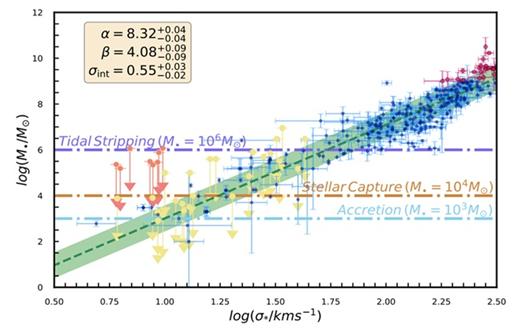
Fig: A unified M•–σ∗ relation spanning stellar velocity dispersions from ∼ 10 km s⁻¹ to ∼ 300 km s⁻¹. Blue points represent black hole mass estimates, while yellow arrows denote upper limits. The red arrows indicate the upper limits obtained in the present work. The green line shows the best-fit regression, and the shaded region indicates 1σ scatter. Magenta points depict ultramassive black holes (M• > 109. Theoretical limits on black hole masses (for our sample range σ∗ ∼ 6−12 km s⁻¹) due to accretion, stellar capture, and tidal stripping are also overlaid on the plot for comparison.
“This work has important implications for both theory and future observations. By establishing a unified relation down to the smallest galaxies, it provides a critical benchmark for simulations of galaxy and black hole evolution,” said Arun Mangalam. This work is particularly timely in the context of upcoming next-generation observing facilities, including the proposed National Large Optical Telescope (NLOT) by IIA and the Extremely Large Telescope (ELT).
These facilities will deliver unprecedented spatial and spectral resolution, enabling precise measurements of stellar kinematics in faint, low-mass galaxies. The unified relation presented in this study provides a robust theoretical and observational framework for interpreting such data, especially in the regime of dwarf galaxies, where black hole signatures are subtle. Moreover, the physically motivated growth models explored here, ranging from momentum-driven gas accretion and stellar capture to tidal stripping of progenitor galaxies, offer clear, testable predictions that future observations with NLOT and the ELT can directly probe. Together, these efforts will play a crucial role in establishing whether dwarf galaxies host primordial black hole seeds.
Paper link: https://iopscience.iop.org/article/10.3847/1538-4357/ae2d4f
******
NKR/FT/NM
(Release ID: 2252835)
Visitor Counter : 1350