Ministry of Science & Technology
CLASSICAL MESSAGING CANNOT REPLACE A QUANTUM COMMUNICATION CHANNEL
Posted On:
07 APR 2026 4:39PM by PIB Delhi
A recent study by an international team of researchers reveals a fundamental limitation of classical communication: no finite amount of classical messaging can faithfully simulate a quantum communication channel. This result not only deepens our understanding of the foundations of physics but also carries significant implications for the development of future quantum technologies.
Can quantum processes be faithfully reproduced using only classical resources? This deceptively simple question, first asked by Richard P. Feynman in a seminal paper marks the boundary between classical and quantum descriptions of nature and lies at the heart of what we mean by quantum advantage in information processing.
Researchers Sahil Gopalkrishna Naik and Manik Banik from S. N. Bose National Centre for Basic Sciences, an autonomous institution of the Department of Science and Technology (DST), in collaboration with Mani Zartab (Universitat Autònoma de Barcelona) and Nicolas Gisin (University of Geneva), addressed this long-standing question.
They investigated this question in the context of quantum channel simulation in network scenarios. In their study published in journal Proceedings of the Royal Society A (2026) they studied a scenario in which multiple distant parties attempt to reproduce the outcome statistics of quantum measurements at a central location, using only classical communication. While earlier studies had shown that such simulations are possible in simple two-party settings, the new results reveal a sharp breakdown in more complex network configurations.
“Our findings show that when multiple senders are involved, no finite amount of classical communication is sufficient to perfectly reproduce the behavior of a quantum channel,” said the authors.
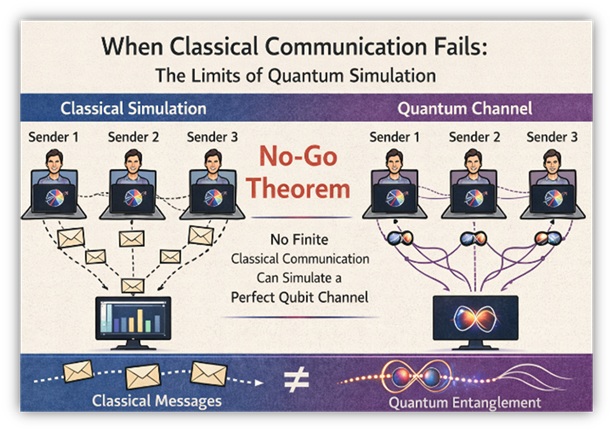
Fig: Distant senders holding privately known qubit states cannot reproduce the measurement statistics at a central node by means of finite amount of classical messaging.
The key challenge arises from the need to account for entangled measurements—a uniquely quantum phenomenon that cannot be replicated using classical means alone.
This led establishment of a powerful no-go theorem: a perfect qubit channel cannot be simulated using any finite amount of classical communication, even when allowing the most general multi-round and bidirectional classical protocols.
When several distant parties attempt to reproduce measurement statistics at a central node, the task inevitably requires accounting for entangled measurements—and these cannot be simulated perfectly with any finite classical resources. It is precisely this requirement that drives the no-go result.
Beyond its technical significance, the study has important implications for the interpretation of quantum mechanics. It places strong constraints on treatment of quantum state as merely a representation of knowledge. Instead, the results lend support to reflection of quantum state as an underlying physical reality.
The findings also reinforce the notion of quantum advantage—the idea that quantum systems can outperform classical ones in information processing tasks—not just in practice, but in principle.
The work highlights that even when quantum states are fully known, their behaviour cannot always be reduced to classical information. Quantum channels, especially in networks, possess an irreducibly quantum character—one that resists any finite classical imitation.
Publication Link: https://doi.org/10.1098/rspa.2025.0831
*****
NKR/FT/NM
(Release ID: 2249738)
Visitor Counter : 929