Ministry of Electronics & IT
India AI Impact Summit 2026 Showcases Global South Leadership in Driving Inclusive and Trustworthy AI
Ministers from Togo, Indonesia and Egypt Emphasise Inclusivity, Infrastructure, Institutional Capacity and Trust as Cornerstones of AI Impact
Panel Calls for AI Success to Be Measured by Lives Transformed, Not Size of Models
Posted On:
19 FEB 2026 7:45PM by PIB Delhi
A High-Level Panel at the India AI Impact Summit 2026 brought together global leaders from Togo, Indonesia and Egypt to deliberate on how Artificial Intelligence (AI) can transition from infrastructure-building to measurable societal impact. The panel discussion focused on adoption gaps, public-interest applications, regulatory balance and the metrics that should define AI success over the next five years.
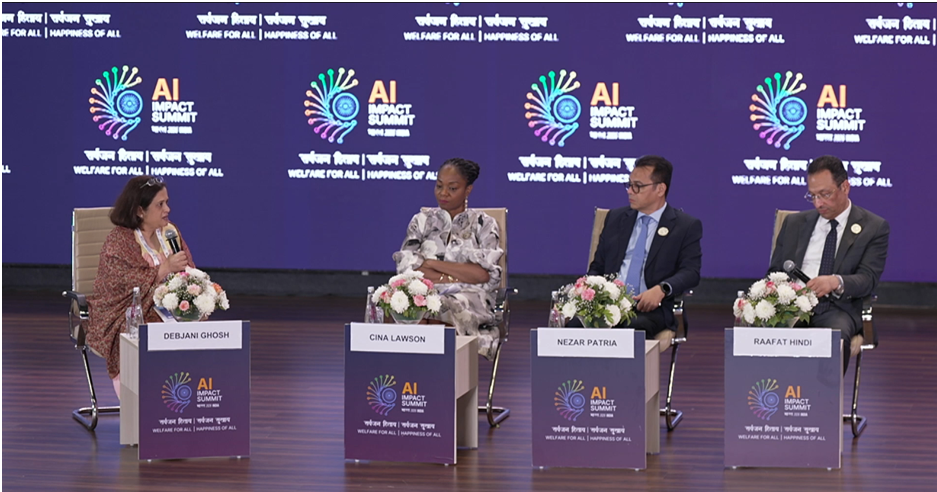
Mr. Nezar Patria, Vice Minister of Communications and Digital Affairs, Indonesia, observed that while AI is widely discussed and increasingly present in daily life, adoption remains uneven across the Global South. Rating global AI impact at “six out of ten,” he underlined that access must be meaningful, not merely infrastructural. He highlighted Indonesia’s efforts to expand internet penetration across its vast archipelagic geography, now reaching around 80 per cent of the population. He stressed the importance of integrating AI on top of digital infrastructure to deliver public services efficiently, citing the use of AI-driven diagnostic tools to assist doctors in remote areas in detecting tuberculosis. He emphasised the need for balanced regulation that protects citizens without stifling innovation, greater investments in research and development, strengthening digital talent, and ensuring AI systems are transparent, accountable and trustworthy. Looking ahead, he stated that AI must be accessible, problem-solving in orientation and trusted by society.
Ms. Cina Lawson, Minister of Public Sector Efficiency and Digital Transformation, Togo, stated that for Africa, AI is not about technology alone but about solving real-life problems in priority sectors such as health, education, agriculture and public administration. She noted that Africa accounts for less than one per cent of global AI talent and continues to face infrastructure and connectivity gaps. Sharing Togo’s pandemic experience, she highlighted how AI algorithms applied to satellite imagery and telecom metadata were used to prioritise beneficiaries for financial aid, ensuring efficient and targeted support. She informed that Togo has since established an in-house data science team within the Ministry to support evidence-based policymaking across government departments. She identified infrastructure gaps, limited institutional capacity and the need for local language AI models as major roadblocks to scaling impact. Envisioning success five years from now, she stated that AI should enable every citizen to seamlessly access public services, potentially through conversational interfaces in local languages, backed by trusted and inclusive AI systems.
Mr. Raafat Hindy, Minister of Communications and Information Technology, Egypt, emphasised that AI success must be measured by the percentage of citizens who benefit from high-quality AI-enabled services, particularly in healthcare, education and government services. He underlined Egypt’s approach of leveraging AI to expand access to medical screening and learning support for underserved communities, ensuring that AI reaches beyond elite institutions and major cities. He stressed that AI must be framed as a development tool rather than a dominance tool, calling for shared compute resources, prioritisation of public services and strong national AI institutions. He further highlighted the importance of addressing gaps in infrastructure, compute capacity and local language models to ensure equitable adoption.
Debjani Ghosh, in her moderating remarks stated, "I think governments today are thinking very similarly about artificial intelligence. Its success, again, is not about the size of your infrastructure, but about how many lives are changed, and in order to scale transformation of lives, you need to ensure your technology is trustworthy. You need to ensure it's inclusive by design. You need to invest in capacity development and innovation. And it's fantastic to see everyone thinking along the same lines, because it really brings forth the importance of collective action and collaboration, and I think that's what has come out of the summit."
The panel concluded that the true measure of AI progress lies not in the size of models or scale of computing infrastructure, but in the number of lives transformed. The discussion underscored the importance of inclusive design, trust, institutional capacity building, innovation-friendly regulation and global collaboration to ensure AI serves humanity equitably and responsibly.
*****
Mahesh Kumar/ Pawan Faujdar/ Navin Sreejith
(Release ID: 2230394)
Visitor Counter : 748