Ministry of Science & Technology
Astronomers probe into intriguing beats from black hole systems
Posted On:
29 JAN 2026 4:01PM by PIB Delhi
Astronomers have unravelled the mystery behind an intriguing flicker that they noticed in black hole systems, using advanced computer simulations.
Black holes, the most compact objects in the Universe with strong gravitation are studied indirectly by observing the electromagnetic radiation emitted by matter surrounding them. Matter falling toward a black hole due to the strong gravitation, first collects in a temporary structure called an accretion disc.
The behavior of this disc controls how energy and radiation are produced. When the motion of matter in the disc is mainly rotational, the inward flow slows down and the radiation generated are emitted as thermal radiation. However, if the accreting matter has a significant infall velocity, non-thermal radiation dominates. Such non-thermal radiation often produced signals called quasi-periodic oscillations (QPOs), with fundamental frequencies ranging from less than one Hertz to several tens of Hertz in accretion discs around black holes with masses of a few to tens of solar masses. Such blackhole systems flicker rhythmically instead of shining steadily. The reasons behind the flickers have intrigued scientists for long.
Scientists from Aryabhatta Research Institute of Observational Sciences (ARIES), an autonomous institute under the Department of Science and Technology (DST), Government of India, investigated how viscous accretion flows change with time using a numerical simulation code developed by the Numerical and Theoretical Astrophysics Group at ARIES. The code used an equation of state suitable for relativistic gas. The code is designed to conserve energy, mass, and momentum.
The researchers, Mr. Sanjit Debnath, Dr. Indranil Chattopadhyay, Mr. Priyesh Kumar Tripathi from ARIES, Dr. M. Saleem Khan from MJPRU Barelly, Dr. Raj Kishore Joshi from the Nicolaus Copernicus Astronomical Center, Polish Academy of Sciences, Poland, and Prof. Philippe Laurent from IRFU/Service d’Astrophysique, France, followed how this fluid behaves as it races inward at nearly the speed of light
In their study recently published in The Astrophysical Journal (ApJ), they found that under certain conditions, the inflowing gas does not fall smoothly into the black hole. Instead, it forms shocks or sudden transitions where the flow slows down, heats up, and becomes denser, much like shock waves created by a supersonic jets.
When the disc has enough internal friction, known as viscosity, and when it cools by emitting radiation, these shocks become unstable. They begin to wobble, oscillate, and shift back and forth over time.
This instability causes the shocks to vary with time and produce oscillations. The study also analyzed the distribution of dynamical properties such as density, temperature, and angular momentum in these accretion discs with significant infall velocities. Accretion discs with shocks and oscillations can also produce bipolar jets or outflows perpendicular to the disc. When the viscosity is high (α ≥ 0.05), bubble-like turbulent regions form in the inner part of the disc after the shock. These regions oscillate and sometimes erupt, which strengthens the outflow. The first, second, and third rows of the Figure illustrate the time evolution of density, temperature, and angular momentum distributions for these hot turbulence bubbles. Additionally, the researchers calculated the poloidal speed and mass flux rate of outflowing matter at the outer boundary of the simulation. For higher viscosity, the time averaged outflow speed often exceeds twenty five percent the speed of light.
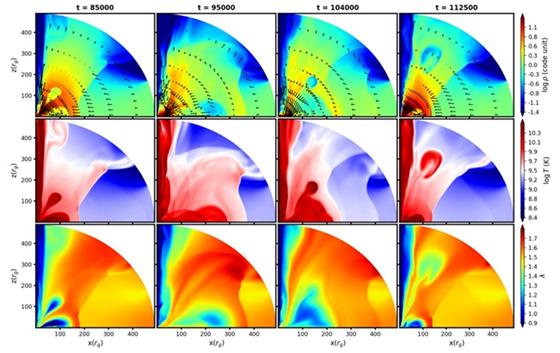
Fig: Contours of density and velocity vectors (arrows) in the first row, temperature (in kelvin) in the second row, and angular momentum (λ) in the third row with the α = 0.05 for model L2. The first, second, third, and last columns are captured at times 85,000tg, 95,000tg, 104,000tg, and 112,500tg, respectively. See text for details.
Therefore, oscillating shocks cause the high-energy radiation to vary with time, which can naturally explain the quasi-periodic oscillations (QPOs) commonly observed in many accreting black hole systems. Because the post-shock accretion disc behaves like a fluid, it oscillates more like a fluid torus than a solid object. The radiation emitted from this hot, fluid region therefore shows a power density spectrum with a fundamental frequency and additional secondary peaks.
According to the team, this is probably the first 2D numerical simulation of viscous transonic accretion flows onto black holes using a relativistic equation of state and for the electron-proton plasma. Finally, low-frequency C-type QPOs around a stellar-mass black hole, ranging from frequencies less than a Hz to tens of Hz, can be easily explained by oscillating shocks.
Publication link: https://iopscience.iop.org/article/10.3847/1538-4357/ae0ca7/pdf
*****
NKR/FK
(Release ID: 2220100)
Visitor Counter : 795