Ministry of Electronics & IT
Conclave on AI for Science Sets the Agenda for Open, Equitable, and Impact-Driven Research Ahead of India AI Impact Summit 2026
Posted On:
08 JAN 2026 5:30PM by PIB Delhi
As a key preparatory milestone leading up to the India AI Impact Summit 2026, the Conclave on AI for Science - Working Group Meeting was convened today at the IIT Bombay Research Park. Hosted by IndiaAI, Ministry of Electronics and Information Technology (MeitY), in collaboration with the Government of Maharashtra and IIT Bombay, the one-day hybrid conclave brought together leading scientists, policymakers, technologists, and innovators to explore how artificial intelligence can accelerate scientific discovery and deliver societal solutions.
The Working Group on Science chaired by Prof. Abhay Karandikar, Secretary, Department of Science and Technology (DST) articulated a shared vision of a future where AI advances science through open, transparent, and equitable collaboration, bridging global divides in capacity and participation. The group emphasized the need to build collective understanding and shared norms so that AI expands rather than narrows the frontiers of global science.
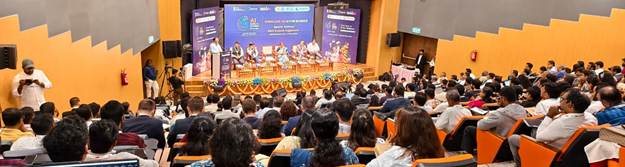
Prof. Abhay Karandikar, Secretary, DST, in his keynote address said “The use of AI in science is already causing significant disruption, particularly in hypothesis formulation and analysis. As scientific discovery itself becomes further transformed, the impact will be far greater than what we currently associate with AI driven applications. This calls for deeper technological innovation rooted in strong scientific foundations.”
In his address, Shri Amit Shukla, Joint Secretary (CD), Ministry of External Affairs, highlighted that research capacity divide and said, “Al is transforming the nature and pace of scientific research. Our responsibility is to ensure it becomes a force for global progress, used responsibly, inclusively, and as a public good.”
Representing the state government, Dr. Richa Bagla, Principal Secretary (Accounts & Treasury), Finance Department, Government of Maharashtra, said, “We look forward to stronger collaboration between technology institutions to co-create solutions that are scalable, secure, and citizen-centric.”
Delivering the Special Address, Shri Rajesh Aggarwal, Chief Secretary, Government of Maharashtra, said, “Science spans physics, chemistry, and mathematics and Al has successfully embedded itself across these disciplines, inspiring new discoveries. It will have further impact across sectors. This is why the India Al Impact Summit is crucial, as it strengthens our sovereignty and gives us a critical competitive edge.”
Shri Mohammad Y. Safirulla, Director, IndiaAI, noted, “The India AI Impact Summit is a global platform to democratize AI, bridge the digital divide and develop indigenous solutions, while aligning with global standards and empowering every voice in the global AI discourse.”
Prof. Mani Bhushan, IIT Bombay, said, “By bringing policy, academia, industry and students together, this conclave reflects the collaborative approach needed to advance AI for science.”
Prof. Shireesh B. Kedare, Director, IIT Bombay, underscored the role of academic institutions, saying, “While we must embrace Al, we must also handle it with care. A key question is how we keep the role of researchers relevant. The answer lies in domain-specific applications of Al, where Al acts as an integrating force, bringing everyone along without losing their identity.”
A major highlight was the keynote by Prof. Amit Sheth, University of South Carolina, on the neuro-symbolic approach to robust and trustworthy AI, illustrated through applications in health, pharmaceuticals, and manufacturing. He outlined a two-way symbiotic relationship between AI and Engineering, framing it as a strategic national imperative.
Prof. Pramod Khargonekar, University of California, Irvine spoke to a room full of AI enthusiasts about AI and the future of engineering. He explained the need for a mindset shift, where humans and machines collaborate to augment capabilities, drive discoveries, and tackle complex challenges across disciplines.
The panel discussion ‘AI for All: Building Global Collaboration for Local Challenges’, moderated by Prof. D. Manjunath (IIT Bombay), explored how global AI collaborations can be tailored to local scientific and societal needs. Panelists underscored the need for sovereign, collaborative, and product-oriented AI development, leveraging India’s scale, diversity, and grassroots deployments to drive innovation.
Another keynote by Prof. Amit Apte, IISER Pune provided a cautionary and nuanced view on the role of AI in fundamental scientific discovery, emphasizing the need for mathematical rigor.
The second panel, ‘Making Public AI Investments Work: Evaluation, Funding, and Pathways to Impactful Translation’, moderated by Prof. Ravi Gudi (IIT Bombay), examined how public funding in AI can be evaluated and translated into real-world outcomes. Speakers emphasized sovereign, inclusive, and responsible AI, backed by strong governance, holistic public investment, and a focus on safety, scalability, and real-world impact for India and the Global South.
The conclave concluded with a closed-door Working Group Meeting, followed by a concluding session chaired by Prof. Raghavan B. Sunoj (IIT Bombay), Shri Vikas Rastogi, Additional Chief Secretary (Agriculture), Government of Maharashtra, and Smt.. Kavita Bhatia, COO, IndiaAI.
Summarizing the outcomes, Smt. Kavita Bhatia, Scientist G, GC, MeitY; COO, IndiaAI said, “AI is increasingly becoming an enabling capability across all domains, including science. In this context, science has the potential to accelerate discovery, improve research productivity, and strengthen the translation of research into applications with measurable public value. Against this backdrop, the AI for Science Working Group assumes particular significance. The Working Group provides a structured platform to identify shared priorities, build partnerships, and develop actionable recommendations that can strengthen India’s research ecosystem and support mission outcomes.”
The Conclave on AI for Science reinforced India’s commitment to shaping a global AI ecosystem that is responsible, collaborative, and impact-oriented, laying strong groundwork for deliberations at the India AI Impact Summit 2026.
****
MSZ
(Release ID: 2212957)
Visitor Counter : 921