Ministry of Culture
‘Sanskriti Jammu & Kashmir’ stands like a lighthouse amid continuous attempts to destroy traditions: Dr. Sachchidanand Joshi
Kashmir is the land of the Rigveda : Rajan Khanna
Posted On:
18 DEC 2025 8:57PM by PIB Delhi
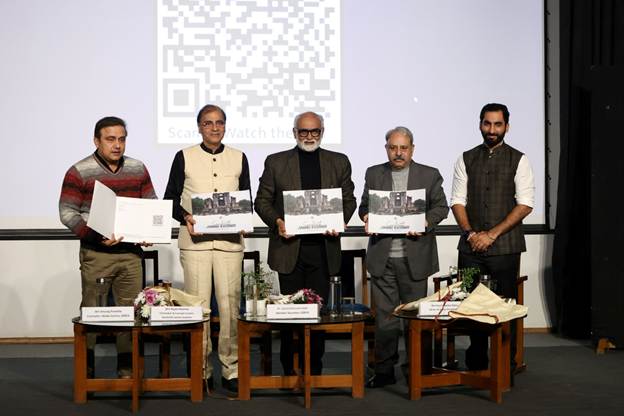
Jammu and Kashmir is not merely a region endowed with natural beauty; since ancient times it has also been a center of India’s cultural, spiritual, and philosophical consciousness. This core idea was highlighted through the launch of an important film and coffee table book titled ‘Sanskriti Jammu & Kashmir’, held at the Indira Gandhi National Centre for the Arts (IGNCA). The program was organized by the Media Centre of IGNCA. The film has been produced by IGNCA. The writer and co-producer of the film is Mr. Rajan Khanna, while the director and editor is Shivansh Khanna.
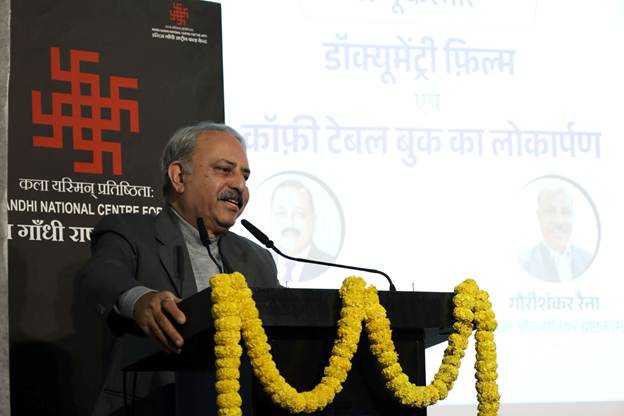
The program was presided over by Dr. Sachchidanand Joshi, Member Secretary of IGNCA. On this occasion, senior writer and broadcaster Mr. Gaurishankar Raina, the film’s writer Mr. Rajan Khanna, and Controller of the Media Centre Mr. Anurag Punetha were present. A meaningful panel discussion on ‘Sanskriti Jammu & Kashmir’ was also held, in which Dr. Sachchidanand Joshi, Mr. Rajan Khanna, and Mr. Gaurishankar Raina shared their views.
Dr. Sachchidanand Joshi said that shooting at the locations featured in 'Sanskriti Jammu & Kashmir' was not easy, as these areas are not only geographically difficult but have also become very hard to access in recent times. Photographs of some of these places are rarely seen. The film includes footage shot at such rare locations. Speaking about the significance of the film, he said that amid continuous attempts to distort and destroy history and to erase our traditional beliefs, this film will stand like a lighthouse. It will illuminate what our traditions are and what our history is. Through this film, many young people—who may not know the real history of Jammu and Kashmir but wish to understand it—can certainly be connected.
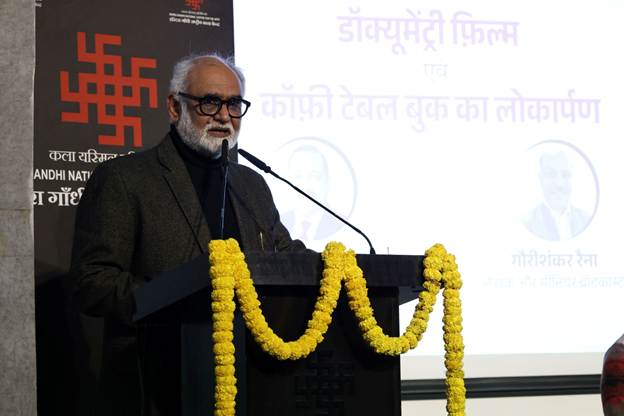
Towards the end, he also requested the film’s director Shivansh Khanna to disseminate some powerful shots and visuals of important temples through short reels. This would attract people to watch the full film and also help in its wider promotion.
The film’s writer Rajan Khanna said that just as there is a relationship between body and soul, there is also a relationship between nation, culture, and geography. The body is perishable, but the nation and culture are eternal. India is like a bouquet of flowers, and among them, the culture of Jammu and Kashmir is a distinct flower—one that embodies spirituality, history, and thought. When one visits the region, it is not just about visiting temples; the hymns of the Vedas, which form the foundation of Indian culture, are inscribed there, and their complete philosophy can be experienced. The vision of the great culture created by our ancestors is clearly visible in Jammu and Kashmir.
He further said that whenever Kashmir is mentioned, discussions often revolve around terrorism, jihad, or organizations such as Lashkar-e-Taiba and Jaish-e-Mohammed. But when Kashmir is discussed, why is there no mention of its 10,000-year-old history? Why is there no discussion about Anantnag, considered one of the world’s most ancient cities? Why is Kashmir’s history limited only to the period from 1339 to 1819? Kashmir’s history is also connected to the Rigveda. If we do not re-establish our civilizational foundation ourselves, whom will we blame? Even the future will not forgive us.
Mr. Gaurishankar Raina said that making such a film is extremely challenging. He has personally gone through this process and knows that it is not easy—especially making films on temples, which requires multiple permissions and access to places that are often difficult to reach. There are many hardships involved. He added that the research associated with such films is also very time-consuming and labor-intensive. Today is the age of electronic and digital media, and in such times, film is an extremely important medium through which one can convey meaningful narratives.
Earlier, in his inaugural address, Mr. Anurag Punetha said that whenever a film is made that documents something from a historical and cultural perspective, it performs a very significant task. Especially at a time when, for the last three or four decades, Kashmir has been primarily portrayed as a conflict zone, it is very important—through IGNCA and the visual medium of film—to convey to the country that Jammu and Kashmir has a rich cultural heritage, which still exists today. Its architecture remains an integral part of our collective memory. A society that forgets its heritage while remembering everything else faces a serious crisis. This film is a modest attempt to bring that memory back before everyone.
Mr. Punetha concluded by expressing his gratitude to the speakers, guests, and attendees. The program was moderated by Narendra Singh from the Media Centre.
*About the Film*
The film 'Sanskriti: Jammu & Kashmir’ is set against the breathtaking landscapes of Jammu and Kashmir. It begins with a calm and profound remembrance of the region’s ancient spiritual consciousness—of a land that historian Kalhana once described in his 'Rajatarangini' as being adorned with countless temples. Even today, some of these temples stand in their dignified presence, while many others remain as ruins—silent witnesses to the passage of time and historical upheavals.
Through vivid and impactful visuals, the film brings forth the efforts made by Sikh and Dogra rulers to revive temples and religious sites. It also highlights the philosophical and intellectual legacy of the Fourth Buddhist Council held at Harwan Monastery in Srinagar, as well as the Sikh tradition associated with the visit of Guru Hargobind Ji.
The film sheds light on lesser-known spiritual traditions of the Jammu and Kashmir region that have largely remained neglected—from the ancient Mamleshwar Temple in Pahalgam to the forgotten shrines around Gulmarg and the historic temples of Jammu. ‘Sanskriti: Jammu & Kashmir’ emerges as a cinematic rediscovery, inviting viewers to reconnect with a long-suppressed cultural and spiritual narrative. The film introduces audiences to a land where every stone carries within it the weight of memory, devotion, and cultural continuity.
*****
Sunil Kumar Tiwari
pibculture[at]gmail[dot]com
(Release ID: 2206275)
Visitor Counter : 613