Ministry of Science & Technology
Newly uncovered missing link in cellular cleanup can help develop therapeutic strategies for Alzheimer’s, Parkinson's, and Cancer
Posted On:
18 DEC 2025 4:28PM by PIB Delhi
Researchers have uncovered a surprising player in autophagy or the “self-eating” process that removes damaged parts, fights infections, and keeps long-lived cells like neurons in good working order.
Identification of key players in the early steps of autophagosome biogenesis, a key stage in the autophagy pathway, can lay the foundations for modulating the pathway for finding interventions that can restore the pathway in diseases such as Alzheimer’s, Parkinson's, and cancer.
Just as our homes need regular cleaning, our cells also clear out damaged and unwanted materials through a process called autophagy.
When a cell fails to clear waste, its health suffers, especially in long-lived neurons. The autophagy pathway, which removes damaged material and defends against infections, is disrupted in diseases like Alzheimer’s and Huntington’s. Autophagy also has dual roles in cancer: preventing it early on but supporting tumor growth later. Autophagy acts as tumor suppressor by maintaining genome integrity and cellular homeostasis by clearing cellular junk such as protein aggregates and damaged mitochondria. But it is also a double-edged sword as certain types of cancer cells hijack autophagy for their own survival and propagation. Understanding its regulation is crucial for the development of effective therapies.
Researchers from Jawaharlal Nehru Centre for Advanced Scientific Research (JNCASR), an autonomous institution under the Department of Science and Technology (DST) found that a group of proteins called the exocyst complex, which normally helps move important molecules to the cell surface, also plays a key role in autophagy. This complex comprises a team of 8 proteins; interestingly, 7 of the 8 proteins are required to help the cell grow the trash bag so that it can completely wrap up the waste. When this complex is missing, the cell’s bag-making factory stops working properly and even starts producing faulty, non-functional factories.
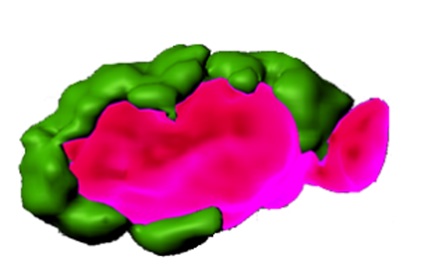
Fig: An autophagosome engulfing its cargo. In this microscopic image, an autophagosome, shown in green, attempts to wrap around a protein aggregate, shown in magenta. The size is around 1-2 microns.
The researchers led by Prof. Ravi Manjithaya used simple yeast cells to elucidate the formation of autophagosomes (cellular “trash bags”), thereby providing insights into how this vital process operates in higher organisms.
They elucidated the mechanism by which a protein complex exocyst, previously recognized for its role in secretion, also contributes to the autophagy pathway, which is crucial for maintaining cellular health. Since defects in autophagy are linked to several neurodegenerative diseases and cancers, the findings published in,” Proceedings of the National Academy of Sciences”, have opened new avenues for modulating this pathway to restore cellular balance and develop potential therapeutic.
Publication link: https://www.pnas.org/doi/10.1073/pnas.2426476122
*****
NKR/AK
(Release ID: 2205948)
Visitor Counter : 975