Ministry of Science & Technology
New light to track gene editing
प्रविष्टि तिथि:
10 DEC 2025 12:00PM by PIB Delhi
A newly engineered CRISPR protein could help scientists observe the molecular scissors called Cas9 enzyme as it enables them to edit genomes using the CRISPR-Cas9 system for treating genetic diseases including cancer.
Gene therapy could be a permanent cure for many life-threatening hereditary diseases. Developing effective, affordable, and safe gene therapy methods remained a challenge for decades. A major breakthrough to address this challenge came in the form of CRISPR, a gene-editing tool that uses a guide RNA to direct a Cas9 enzyme to a specific DNA sequence, where it precisely cuts the DNA. The CRISPR-Cas9 had been designed to cut and correct DNA with accuracy. However, scientists could not observe Cas9, the molecular surgeon, in living cells in real time. Traditional detection methods rely on fixing or breaking open cells, making it impossible to track the process as it unfolds.
Tracking gene editing as it happens or watching the molecular machinery as it works, cutting, repairing, and rewriting DNA inside living cells can help monitor CRISPR operations in living cells and tissues without destroying them.
Scientists from Kolkata based Bose institute, an autonomous institute of the Department of Science and Technology (DST), has come out with a solution for this. A team led by Dr. Basudeb Maji, has created GlowCas9, a CRISPR protein that lights up while performing gene editing.
Their study, published in Angewandte Chemie International Edition opens a new chapter in the visualization and tracking of genome engineering.
Arkadeep Karmakar, a Ph.D. researcher in Dr. Basudeb Maji’s lab, designed GlowCas9, a bioluminescent version of Cas9 that glows inside cells, by fusing Cas9 with a split nano-luciferase enzyme derived from deep-sea shrimp proteins.
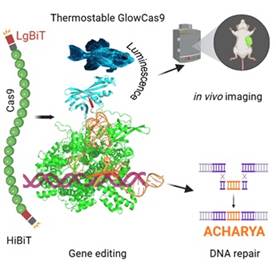
Fig: Schematic presentation of engineered thermostable reporter GlowCas9 development for theratracking applications
These inactive enzyme pieces reconnect when Cas9 folds correctly, producing light. This is because when the pieces are brought to close proximity, they can reassemble to restore enzymatic activity and produce a visible signal akin to the gentle light of fireflies. This glowing activity allows scientists to monitor CRISPR operations in living cells, tissues, and even plant leaves—without harming them.
They have found that GlowCas9 is very stable and maintains its structure and activity at higher temperatures compared to the conventional enzyme. Such sturdiness is important for gene therapy, where stable Cas9 delivery can greatly increase treatment success. GlowCas9 also increases the precision of homology-directed repair (HDR), a DNA repair process crucial for fixing hereditary mutations that are linked to genetic diseases like sickle cell anaemia, muscular dystrophy and so on.
As a symbolic demonstration of precision, the researchers programmed GlowCas9 to insert the DNA corresponding to “ACHARYA” into the genome, honoring Acharya Jagadish Chandra Bose, the legendary founder of the Bose Institute. This efficient, custom-designed DNA sequence insertion highlights the potential of the technology for targeted gene correction and repair. GlowCas9 can also be tracked in plant systems, hinting at safe, non-transgenic applications in crop improvement.
By merging gene editing with light emission, GlowCas9 pioneers the emerging field of theratracking or visualizing molecular gene therapy in motion. This invention moves us closer to a future where scientists not only correct genes but can literally watch healing begin.
Reference: Engineered Thermostable Chemically Responsive GlowCas9 System for Real-Time Therapeutic Monitoring Applications. Arkadeep Karmakar, Arpita Hota, Sadiya Tanga, Vivek Kumar, Pallabi Das, Anitha Eswari S, Mala Thapa, and Basudeb Maji*. Angewandte Chemie International Edition, 2025.
Link to publication: https://doi.org/10.1002/anie.202511707.
****
NKR/AK
(रिलीज़ आईडी: 2201313)
आगंतुक पटल : 2914
इस विज्ञप्ति को इन भाषाओं में पढ़ें:
हिन्दी