Ministry of Science & Technology
Kodaikanal Solar Observatory data helps tracing solar magnetic activity influencing satellite communication
Posted On:
02 DEC 2025 8:57PM by PIB Delhi
Astronomers have traced the variation of the Sun's magnetic activity with latitude using a new technique.
The study which identified concentration of solar activity with the exact locations of sunspot activity peaks during the solar cycle can improve the understanding of how the Sun's magnetic dynamo operates and how it might affect space weather and terrestrial climate.
The Sun is not a static ball of fire but a dynamic, magnetically active star that undergoes regular cycles of activity roughly every 11 years. Understanding these patterns is important because solar activity directly affects Earth through space weather, influencing everything from satellite communications to power grids.
A study led by astronomers at the Indian Institute of Astrophysics (IIA), an autonomous institute of the Department of Science and Technology (DST) used calcium K line spectroscopic data of 11 years (2015-2025) from the Kodaikanal Solar Observatory which recently celebrated its 125th anniversary to map how the Sun's magnetic activity varied with latitude.
The spectral line of singly ionized Calcium that occurs at 393.4 nm (Ca-K line) in the violet arises from the Sun’s chromosphere, above its visible surface, and is an important diagnostic of the magnetic field in this layer. The continuous daily observations of the Sun recorded by the Kodaikanal Solar Observatory, operated by IIA, is a treasure trove for researchers to analyse long term variability of various properties of the Sun.
The team used the Ca-K spectroscopic line data to monitor the magnetic activity across different solar latitude bands, and track its evolution roughly from the peak of solar cycle 24 till the peak of the current solar cycle 25.
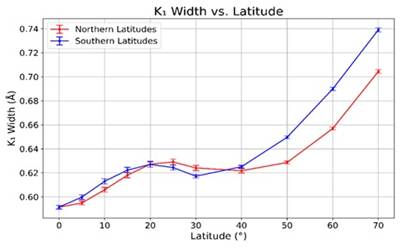
Fig 1: The line width of one of the secondary absorption spectral lines, K1, versus solar latitude for each solar hemisphere.
“Rather than looking at individual sunspots or magnetic regions, we used an earlier technique devised by our team member and professor at IIA, Jagdev Singh, that captures light from entire latitude bands, slicing the Sun into horizontal strips from pole to pole and analyzing the combined light from each strip”, said K.P. Raju of the Indian Institute of Astrophysics. This method reveals large-scale patterns that might be missed when studying isolated features. The Ca-K line has multiple spectral features, and they analysed these specific characteristics like line widths and intensity ratios that serve as proxies for magnetic activity, and tracked their change over the period of 11 years.
Explains K. Nagarju, a faculty at IIA and a co-author of the study, “The data revealed clear patterns showing that most solar activity concentrates between 40 degrees north and south latitudes, with particularly strong signals around 15-20 degrees in both hemispheres of the Sun, exactly where sunspot activity peaks during the solar cycle. The spectral measurements showed direct correlations with the actual coverage of magnetic features on the Sun's surface, confirmed through filling factor analysis using NASA's Solar Dynamics Observatory data”.
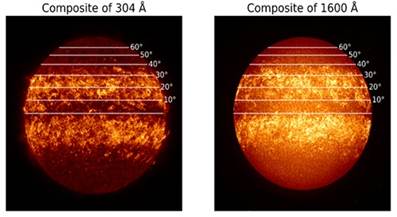
Fig 2: Composite images of the sun at 304 Å (left) and 1600 Å (right) constructed from the data overlapping with our observation days. (Original data are courtesy of SDO’s AIA).
They also found consistent differences between the northern and southern hemispheres, with the southern hemisphere generally showing steeper increases in activity toward higher latitudes and stronger correlations with magnetic activity indicators. Additionally, they calculated how much the spectral line changed per unit increase in magnetic filling factor, creating "spectral response profiles" that peak near the core of the calcium K line with clear north-south asymmetries that vary systematically with latitude. These hemispheric asymmetries provide clues about the complex magnetic processes that drive the solar dynamo.
“Our results confirm that solar activity follows predictable patterns related to the 11-year solar cycle, with the strongest magnetic activity occurring in specific latitude bands that shift over time. The observed variations directly reflect changes in temperature and magnetic field strength across the Sun's chromosphere, contributing to our broader understanding of how the Sun's magnetic dynamo operates”, said Apoorva Srinivasa, a former intern at IIA, and currently pursuing his PhD at Amrita Vishwa Vidyapeetham, an author of the study.
The other authors of the study published in the journal, Monthly Notices of the Royal Astronomical Society include Anu Sreedevi of IIT BHU (and former intern at IIA), Narayanankutty Karuppath of Amrita Vishwa Vidyapeetham, P. Devendran, T. Ramesh Kumar, and P. Kumaravel of IIA.
Publication link: https://doi.org/10.1093/mnras/staf1163
 ****
****
NKR/AK
(Release ID: 2197904)
Visitor Counter : 1422