Ministry of Science & Technology
Scientists supercharge promising material to catalyze clean hydrogen production
Posted On:
02 DEC 2025 8:57PM by PIB Delhi
A new strategy has been developed for enhancing the activity of catalysts used to split water for generating Hydrogen, one of the cleanest known fuels.
In the electrolysis of water, which is central to clean hydrogen production, the oxygen evolution reaction (OER) has long remained a challenge due to its sluggish kinetics and higher overpotential requirements compared to the hydrogen evolution reaction (HER). Developing noble-metal-free catalysts that can efficiently drive OER is therefore a pressing research priority.
Coordination polymers (COPs) are formed by the combination of metal ions and organic molecules and are currently used for electrolysis of water. However, they have a limitation. Typically, such COPs are fully coordinated by solvent and water molecules, leaving few active sites for electrocatalysis and limiting their direct application.
Researchers at the Centre for Nano and Soft Matter Sciences (CeNS), Bengaluru, an autonomous institute under the Department of Science and Technology (DST), have devised a novel strategy to significantly enhance the catalytic activity of coordination polymers (COPs) without compromising their bulk structure.
They employed argon plasma treatment, activating the COP. This was possible due to generation of coordinatively unsaturated metal sites (CUMSs). The process enhanced catalytic performance while preserving the structural integrity and bulk structure of the polymer.
Detailed structural studies revealed that the newly developed Ni- and Co-based COPs were consistent across both single-crystal and bulk powder X-ray diffraction (XRD) analyses. While the pristine materials displayed high onset potentials and sluggish performance for oxygen evolution in alkaline media, their activity was significantly boosted after argon plasma treatment. The plasma process created coordinatively unsaturated metal sites (CUMSs) without altering the bulk framework, as confirmed by powder XRD, transmission electron microscopy (TEM), X-ray photoelectron spectroscopy (XPS), and contact angle measurements.
The plasma-activated Ni- and Co-COPs demonstrated remarkable improvements in electrocatalytic performance.
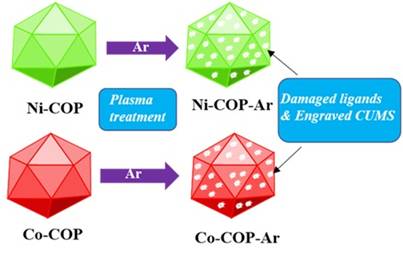
Fig: Illustration of the synthesized Ni- and Co-based coordination polymers (COPs) and their plasma treatment for generating CUMS
This work published in the journal ‘ACS Applied Nano Materials’ demonstrated an effective strategy to enhance the intrinsic activity of coordination-polymer-based electrocatalysts through structural modification, while preserving their overall integrity. The approach opens new possibilities for designing cost-effective and efficient catalysts for water splitting, contributing to the larger pursuit of clean and sustainable hydrogen energy.
Publication link: https://doi.org/10.1021/acsanm.5c02951
*****
NKR/AK
(Release ID: 2197902)
Visitor Counter : 1645