Ministry of Social Justice & Empowerment
From Manual Sewer Cleaning to Robotic Sanitation Operations
NAMASTE Training Supports a Safer and More Dignified Occupational Transition
प्रविष्टि तिथि:
23 NOV 2026 6:09PM by PIB Delhi
Transitioning sanitation workers from hazardous manual cleaning to mechanised sanitation operations is an important step towards improving occupational safety, health and dignity. Training and access to technology can help workers build technical skills and undertake sanitation work in safer conditions.
Raja (Name Changed), a 41-year-old Scheduled Caste sanitation worker from Mysuru, Karnataka, spent nearly 15 years engaged in manual sewer and septic tank cleaning, with prolonged direct exposure to hazardous waste. Inadequate access to machinery and training, along with the health challenges associated with toxic exposure, affected his physical well-being. With limited education and his family dependent on his income, opportunities to move to safer work remained constrained.
With an interest in mechanised sanitation operations, he received Occupational Safety and Mechanised Sanitation Training under the National Action for Mechanised Sanitation Ecosystem (NAMASTE) Scheme in 2026, as part of a batch of 45 sanitation workers. The training covered occupational health hazards, safe work practices and operation of the Bandicoot robotic sanitation system.
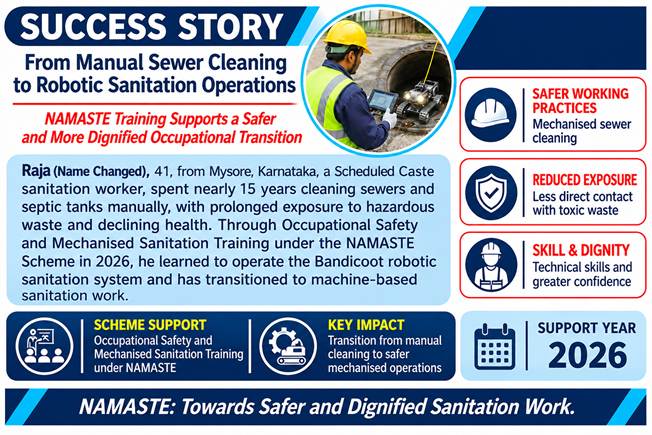
Following the training, Rajagopala is now working as a Bandicoot robotic sanitation system operator, marking a significant shift from manual sewer cleaning to machine-based sanitation operations. His new role enables him to undertake sanitation work with reduced direct exposure to hazardous waste and in a safer, more dignified environment.
His journey highlights how occupational safety training and mechanised equipment under the NAMASTE Scheme can support sanitation workers in acquiring technical skills, improving work conditions and moving towards safer and dignified livelihoods.
***
SS-194-TAR/KV/GA/RK
(रिलीज़ आईडी: 2340462)
आगंतुक पटल : 116