Ministry of Science & Technology
Pollen from wetland of Bandhavgarh Tiger Reserve regenerative capacity of tropical forest ecosystems
प्रविष्टि तिथि:
20 NOV 2026 3:13PM by PIB Delhi
A new study carried out at Bandhavgarh Tiger Reserve shows that in 2700- and 2300-years BP, the region experienced a strong Indian Summer Monsoon (ISM), while between 2300- and 1600-years BP, it underwent multiple climatic phases, including periods of high humidity and prolonged drought significantly influencing the composition, structure, distribution of forest vegetation and shifts in regional landscape through time.
This was followed by stable monsoon and increasing evidence of human activity between 1600 and 820 years BP and strengthening of monsoons during the last 400 years resulting in recovery of forests.
This indicated the resilience and regenerative capacity of tropical forest ecosystems that populated the region, under favourable climatic conditions.
Understanding the long-term variability of the ISM is essential because it is a key driver of India's climate, ecosystems, and water resources. As Indian agriculture is highly dependent on monsoon rainfall, even small changes in monsoon intensity or timing can affect crop productivity, food security, and the national economy. Reconstructing past climate and vegetation changes provides valuable long-term insights into natural monsoon variability and ecosystem responses.
However, there is a lack of high-resolution Late Holocene palaeoclimate records from the Core Monsoon Zone (CMZ) of central India.
Birbal Sahni Institute of Palaeosciences (BSIP), an Autonomous Institute of the Department of Science and Technology (DST), used pollen-based records from Bandhavgarh Tiger Reserve in central India's Core Monsoon Zone and integrated them with the Earth System Paleoclimate Simulation (ESPS) model to reconstruct vegetation and Indian Summer Monsoon (ISM) variability over the past ~2700 years.
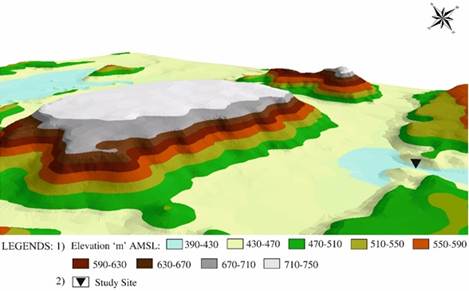
Fig 1: Three-dimensional (3D) elevation model of the Bandhavgarh Tiger Reserve, located in the Core Monsoon Zone, Madhya Pradesh, India.
This combination allowed researchers to reconstruct historical Indian Summer Monsoon (ISM) patterns for the past 3000 years, correlating climate changes with significant events in Indian history.
Dr. Anjali Trivedi, along with Anupam Nag and Prof. M. G. Thakkar from BSIP) studied sediment core from the Chakradhara Wetland of Bandhavgarh Tiger Reserve, located in Umaria district of Northeastern Madhya Pradesh, India, segmented the core and prepared samples for radio carbon dating and pollen analysis.
They also generated Earth System Palaeoclimate Simulation (ESPS) models to reconstruct climatic conditions over the past three millennia. These models were then used to compare the pollen dataset, ensuring the authenticity and reliability of the research findings.
They found that between approximately 2700- and 2300-years BP, a strengthened Indian Summer Monsoon (ISM) supported widespread dense moist deciduous forests dominated by Sal (Shorea robusta). Its proliferation indicates sustained rainfall of around 1100–1200 mm or more annually, along with a timely monsoon onset.
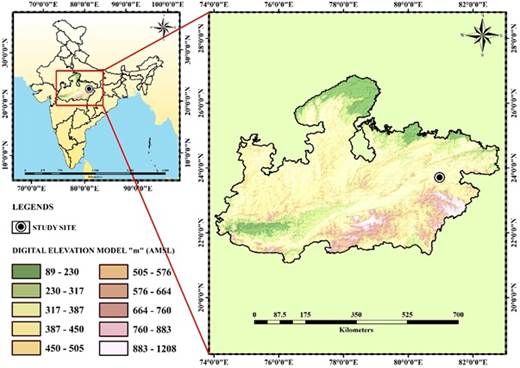
Fig 2: Digital elevation model (DEM) of the Bandhavgarh Tiger Reserve showing the location of the study site in the Core Monsoon Zone, Madhya Pradesh, India.
Between around 2300- and 1600-years BP, the region experienced multiple climatic phases, including periods of high humidity, prolonged drought, gradual environmental recovery, and a subsequent strengthening of the Indian Summer Monsoon (ISM). These climatic fluctuations significantly influenced the composition, structure, and distribution of forest vegetation, resulting in shifts in the regional landscape through time.
The period 1600 and 820 years BP saw relatively stable monsoon conditions supported dense tropical forests. From 820 to 400 years BP, weakening of the ISM led to reduced moist deciduous forests and expansion of dry deciduous vegetation, accompanied by increasing Cerealia and other cultivated pollen, indicating growing agricultural activity, land-use change and human influence.
Over the past ~400 years, strengthening monsoon conditions promoted the recovery and expansion of moist deciduous forests, demonstrating the resilience and regenerative capacity of tropical forest ecosystems under favourable climatic conditions.
The findings published in Quaternary Research can improve our understanding of climate–environment interactions and can contribute to better climate adaptation strategies, sustainable agriculture, and future climate resilience.
Publication link: https://doi.org/10.1017/qua.2026.10093
***
NKR/FT/AA
(रिलीज़ आईडी: 2339006)
आगंतुक पटल : 282