PIB Backgrounder
Opening Up India’s Space Economy
Enabling Private Players Participation
प्रविष्टि तिथि:
15 NOV 2026 11:05AM by PIB Delhi
|
India’s space journey began with a strong, government-led institutional base built around ISRO and the Department of Space. As capabilities matured, the Government adopted a more facilitative approach that kept public-sector leadership while encouraging private innovation, investment and entrepreneurship. Policy reforms opened the entire space value chain to Non-Government Entities, with IN-SPACe as the single-window interface between Govt. and private entities and NSIL as the commercial arm. The Indian Space Policy 2023 defined each institution’s role, while liberalised foreign investment rules, clear authorisation procedures and dedicated funding schemes supported start-ups. These steps are steadily building a collaborative, industry-led and globally competitive space ecosystem.
|
Where It All Began – From State-Led Foundations to Global Leadership
India's space journey has undergone a remarkable transformation over the past decade. It has evolved from pioneering scientific research into a globally competitive space programme. This progress reflects sustained national ambition, institutional vision and indigenous technological innovation. Today, India is advancing towards a more commercially dynamic space sector. Growing private-sector participation is further expanding its industrial and technological capabilities.
The foundations of this journey were laid through a strong institutional framework. The Indian National Committee for Space Research (INCOSPAR) was established in 1962. It functioned under the Department of Atomic Energy and spearheaded India's early space research initiatives. Subsequently, the Indian Space Research Organisation (ISRO) was established in August 1969, replacing INCOSPAR. In June 1972, the Government constituted the Space Commission and established the Department of Space (DoS). ISRO was brought under the DoS in September 1972.
As India's space capabilities matured, the Government recognised the need for broader institutional participation. This required moving beyond a predominantly government-led operational framework. Accordingly, the Government adopted a more facilitative and outcome-oriented approach to space-sector governance. This approach retained public-sector leadership while encouraging private innovation, investment and entrepreneurship.
A landmark step in this direction came on 24 June 2020. The Union Cabinet approved reforms enabling greater private-sector participation in space activities. These reforms marked a significant shift towards a collaborative public-private model. They also laid the foundation for a more competitive and commercially driven space sector. These reforms redefined the institutional framework governing India's space activities. They positioned the private sector as an active partner in advancing national capabilities, commercial opportunities and global competitiveness.
|
Key Indicators
Highlighting the Scale of India`s Space Sector Transformation
Growth of Space Economy: India’s space economy was estimated at about US$9 billion in August 2026, against about US$8.4 billion (about 2% of the global space economy) in 2023
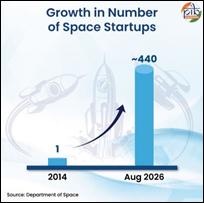
Start-up Growth: Registered space start-ups increased from one in 2014 to approximately 440 in August 2026.
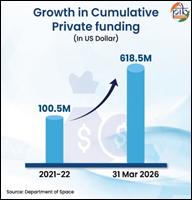
Private Investment: Cumulative investment in Indian space start-ups increased from US$100.5 million in 2021–22 to US$618.5 million by 31 March 2026.
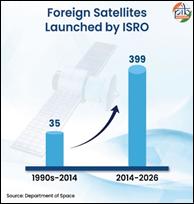
Commercial Launches: ISRO launched 399 foreign satellites between 2014 and January 2026, compared with 35 between 1990 and 2014.
Foreign Direct Investment: By mid-2026, the Government received 11 FDI proposals worth ₹1,745.40 crore for the space sector.
International Cooperation: As on June 2026, India's global partnerships expanded to over 300 space cooperation agreements across 61 countries and five multilateral organisations.
|
Collaborative Governance: Marketization of India's Space Sector (2020-2026)
Recognising the potential of private enterprises to expand India's space capabilities and strengthen its position in the global space economy, the Government of India announced major space-sector reforms on 24 June 2020. The expansion of India's space programme also brought an opportunity to tap the growing global commercial space market and scale up industrial participation. Read More on India’s Space Capability
Cabinet Approval of Reforms and Constitution of IN-SPACe (June 2020–November 2022)
The reforms enabled Non-Government Entities (NGEs) to participate across the entire space value chain. Their role expanded beyond supplying components and providing services.
The cabinet approval also established the Indian National Space Promotion and Authorisation Centre (IN-SPACe) as an autonomous agency. It operates under the DoS and serves as a single-window interface for private enterprises for regulatory clearances. Its mandate includes promoting private participation, authorising and supervising space activities, and facilitating access to ISRO facilities, subject to safety considerations and operational priorities. Its mandate also covers mission safety, launch readiness, orbital and frequency coordination, spacecraft registration and security requirements.
NewSpace India Limited (NSIL) was established in March 2019 as the commercial arm of the DoS. Its mandate was subsequently expanded to commercialise technologies developed using public funds. NSIL was also tasked with aggregating demand from government and other customers. It would further market and sell these technologies and services in domestic and international markets. Meanwhile, private-sector space activities continued to remain subject to applicable licensing, safety and security requirements.
Further strengthening this institutional framework, the Indian Space Association (ISpA) was launched in October 2021. It provides an industry platform for engaging with the Government and supporting the growth of India's space sector.
|
IN-SPACe and NSIL Delivered Measurable Outcomes
- NSIL revenues increased from ₹321.77 crore in FY 2021-22 to over ₹3000 crore in FY 2024-25.
- NSIL signed 118 technology transfer agreements covering 83 ISRO technologies.
- As of 31 January 2026, IN-SPACe had facilitated 71 technology transfers to industry and startups.
- By mid-2026, 113 authorisations had been granted by IN-SPACe to 52 NGEs, of which 18 were start-ups.
- Six Indian Non-Government Entities launched 18 satellites, while 25 payloads were flown or scheduled on POEM (PSLV Orbital Experimental Module) platforms.
|
Defining Roles and Responsibilities through the Indian Space Policy 2023
The Indian Space Policy 2023 clearly defined the roles and responsibilities of key sectoral institutions. It established a framework for coordinated participation across the space sector.
Under the policy, ISRO would focus on advanced research, emerging technologies and national missions. Mature operational systems would be transferred to industry for manufacturing and commercial production.
The policy also formalised the respective roles of IN-SPACe and NSIL, as outlined in the Cabinet Approval of Reforms section. It reinforced IN-SPACe's role in promoting and authorising private-sector activities. It also strengthened NSIL's mandate to commercialise space technologies and services.
Additionally, the Indian Space Policy 2023 enabled private enterprises (NGEs) to undertake end-to-end space activities. These included satellite manufacturing, launch vehicle development and space-based services.
Liberalised FDI Policy for the Space Sector (February 2024)
For a long time, FDI was permitted in establishment and operation of satellites through the Government approval route only. Opening up this route was among the major policy reforms undertaken to boost private participation in the space sector. The Union Cabinet approved amendments to the Foreign Direct Investment (FDI) policy for the space sector on 21 February 2024. The revised provisions came into effect on 16 April 2024, allowing foreign investment through the automatic route within prescribed limits.
Under the automatic route, foreign investment is permitted up to 74% in satellite manufacturing and operation, satellite data products, and ground and user segments.
The limit is up to 49% in launch vehicles and spaceports, and up to 100% in components and subsystems.
Investment above the prescribed limits required Government approval.
Norms, Guidelines and Procedures (NGP) for Authorisation of Space Activities (May 2024)
IN-SPACe released the Norms, Guidelines and Procedures (NGP) on 3 May 2024 to put the Indian Space Policy 2023 into practice. The NGP explains which space activities need IN-SPACe authorisation, the criteria for granting it and the conditions applicants must follow. Any entity carrying out space activities to or from Indian territory, or within India’s jurisdiction, needs this authorisation.
|
Capital for Every Stage: IN-SPACe’s Funding Schemes for Space Start-ups
Pre-incubation Entrepreneurship (PIE) - Launched in 2024, Pre-incubation Entrepreneurship (PIE) Programme is a 21-month programme with three phases: ideation, innovation and prototype demonstration. It is aimed at early-stage start-ups helping them to transform the idea into a prototype along with the development of entrepreneurs and allied business skills.
IN-SPACe Seed Fund Scheme - Launched in 2023, the seed-fund scheme supports early-stage space start-ups (startups established on or after July 1, 2022). This scheme enables these start-ups to demonstrate the novel idea and graduate to next level. A maximum grant of ₹ 1 Crore is provided to selected start-up on milestone basis in three or more instalments.
Technology Adoption Fund (TAF) - Once an idea works, the next challenge is turning it into a product. As part of this endeavor, the Technology Adoption Fund (TAF) was established in February 2025 with a total outlay of ₹500 crore. It promotes innovation and commercialisation of advanced technologies in the space sector. The fund provides partial financial support to Non-Government Entities (NGEs). It helps transform early-stage technologies into commercially viable products. Startups and MSMEs can receive up to 60% of the project cost. Moreover, large industries can receive up to 40%. However, the funding is capped at ₹25 crore per project.
Venture Capital Fund - As start-ups grow, they need larger funds to expand. In 2024, the Union Cabinet approved setting up of ₹1000 crore Venture Capital Fund under aegis of IN-SPACe. The fund proposes an indicative investment range of ₹10–60 crore per company, depending on its stage of growth, growth trajectory and potential impact on national space capabilities. Equity investment is indicated at ₹10–30 crore for growth-stage companies and ₹30–60 crore for late growth-stage companies.
|
Key Outcomes from Marketisation of the Space Sector
Skyroot Aerospace's Vikram-S
The reforms have opened launch activity to private enterprises, and each outcome reflects the results of this shift. The first major milestone of this expanded participation followed in November 2022. The Hyderabad-based Skyroot Aerospace successfully launched Vikram-S, India's first privately developed rocket and the country's first private launch authorised by IN-SPACe. Vikram-S, launched under Mission Prarambh, carried three customer payloads equipped with sensors to validate critical launch technologies for future orbital missions.
In May 2024, Agnikul Cosmos became the first Non-Government Entity (NGE) to launch a rocket from India’s first private launch pad, Dhanush, at Sriharikota. The mission also demonstrated the world’s first single-piece 3D-printed semi-cryogenic rocket engine, showcasing advances in indigenous rocket manufacturing and propulsion technology.
Click to Read More on Cryogenic Technology;
Click to Read More on 3D- Printing Tech
Skyroot Aerospace's Vikram-I
On 18 July 2026, Skyroot Aerospace’s small satellite launch vehicle Vikram-I successfully reached orbit on its first flight. Known as Mission Aagaman, it was the first time an Indian private company undertook an orbital launch of a rocket from Indian soil, an outcome made possible by private participation under the space reforms. Read More on Vikram-1
PSLV and SSLV: ISRO’s Launch Vehicles Now Built by Industry
The move to industry-led production is a landmark outcome of the space reforms. For decades, ISRO led the design and development of India’s launch vehicles, while Indian industry supplied components and services. The space-sector reforms have now opened the way for end-to-end industrial production. On 5 September 2022, NSIL signed a contract with Hindustan Aeronautics Limited (HAL), lead member of the HAL–L&T consortium, for the production of five PSLV-XL (Polar Satellite Launch Vehicle).
Additionally, on 10 September 2025, NSIL, ISRO, IN-SPACe and HAL signed the SSLV (Small Satellite Launch Vehicle) Technology Transfer Agreement, transferring SSLV technology to HAL for industrial production. This led to the strengthening domestic manufacturing, widening industry participation and deepening public–private partnership.
India’s Space Sector on the Path to Viksit Bharat 2047
India’s space journey shows how clear policy, institutional trust and enterprising youth can turn ambition into achievement. With industry-led participation, the Government projects the space economy to grow to about US$44 billion by 2033, around 8% of the global space economy, and to US$100 billion by 2040. On the road to Viksit Bharat 2047, start-ups and MSMEs will work with ISRO, NSIL and IN-SPACe to build new capabilities, create skilled jobs and develop young talent. With sustained collaboration and skill development, this partnership reflects the spirit of Aatmanirbhar Bharat, Make in India and Start-up India.
References
Department of Space
ISRO
IN-SPACE
Others
Click here to see pdf
****
PIB Research
(रिलीज़ आईडी: 2336430)
आगंतुक पटल : 189