PIB Backgrounder
Yuge Yugeen Bharat Museum
Preserving India’s Civilisational Heritage for Future Generations
प्रविष्टि तिथि:
15 NOV 2026 10:23AM by PIB Delhi
Yuge Yugeen Bharat: A Museum for the Ages
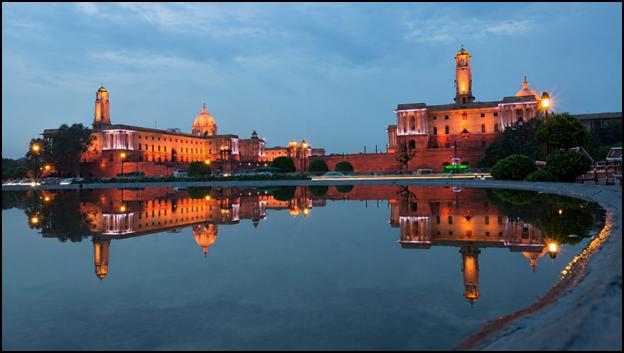
India's civilisational heritage, spanning over 5,000 years, reflects a rich legacy of art, architecture, knowledge systems, traditions and cultural practices that have evolved over centuries. To preserve and present this heritage, the Yuge Yugeen Bharat Museum is being developed as a landmark national cultural institution at the historic North and South Block Complex in New Delhi. Envisaged as a museum of the people, it will showcase the continuity, diversity and richness of India's civilisational journey through an integrated presentation of its tangible and intangible cultural heritage.
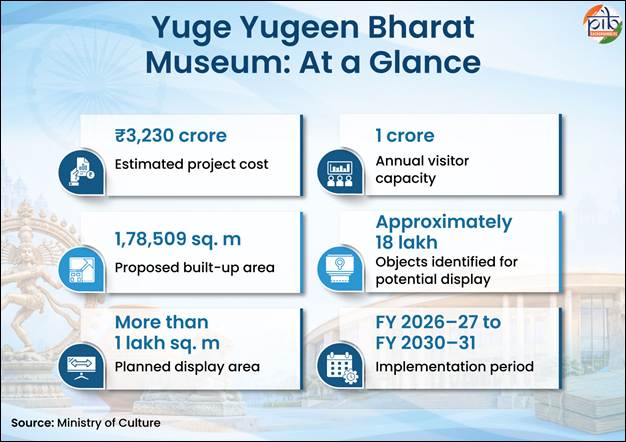
First announced by Prime Minister Shri Narendra Modi on 18 May 2023, the project received approval from the Cabinet Committee on Economic Affairs on 11 November 2026, with an estimated total project cost of ₹3,230 crore. Being developed by the Ministry of Culture, the museum will transform the historic North and South Blocks, formerly housing key government offices, into public cultural spaces through adaptive reuse while preserving their architectural character. Planned as a museum of global scale, it will bring together historical collections, thematic galleries and modern exhibition technologies to make India's cultural heritage accessible to citizens, researchers and visitors from across the world.
From Historic Buildings to a World-Class Museum
The Yuge Yugeen Bharat Museum will transform the historic North and South Blocks in New Delhi from centres of governance into public cultural spaces. Developed through adaptive reuse, the project will preserve the architectural heritage of these landmark buildings while creating modern exhibition spaces and visitor facilities. The museum is envisaged as a major cultural destination, combining heritage conservation with contemporary museum infrastructure.
Preserving Heritage Through Adaptive Reuse
- Historic Significance: The North and South Blocks served as centres of government administration until 13 February 2026, nearly 95 years after the inauguration of South Block. The South Block housed the Prime Minister's Office since Independence, and Cabinet meetings under 16 Prime Ministers were held in these buildings.
- Transformation into Public Spaces: Following the relocation of government offices to Seva Teerth, the new Prime Minister's Office, and the Kartavya Bhavans, the two buildings are being repurposed as part of the Yuge Yugeen Bharat Museum.
- Architectural Conservation: The project will preserve the buildings' historic character, façades and architectural integrity through minimal intervention.
- Reimagining Existing Spaces: Courtyards, corridors and rooms will be adapted into galleries and exhibition areas, creating a unified museum experience.
- Sustainable and Inclusive Design: The redevelopment will prioritise sustainable resource use and universal accessibility.
The proposed museum will rank among the world's largest cultural institutions in terms of exhibition space, with infrastructure designed to accommodate a substantial number of visitors.
- Proposed Built-up Area: Approximately 1,78,509 square metres across the North and South Block Complex.
- World's Largest Display Area: The museum plans to offer more than 1 lakh square metres of display space. This would exceed the display areas of the Louvre (73,000 sq. m), the British Museum (70,000 sq. m) and the Hermitage (66,800 sq. m).
- Visitor Capacity: Designed to accommodate 30,000 visitors per day and 1 crore visitors annually.
- Visitor Management: Timed entry and crowd management systems are planned to facilitate convenient movement through the museum.
- Public Amenities: Proposed facilities include children's zones, food courts, souvenir shops and performance spaces, alongside accessible public areas.
The museum's development will thus combine the conservation of two historically significant buildings with the creation of a large-scale, accessible cultural institution for citizens and visitors from India and abroad.
Bringing India's Civilisational Journey to Life
The Yuge Yugeen Bharat Museum will present India's civilisational journey through curated thematic galleries, historical collections and immersive experiences.
Phased Development and Implementation
The museum will be developed in phases, allowing galleries and exhibitions to be introduced progressively.
- Implementation Period: FY 2026-27 to FY 2030-31.
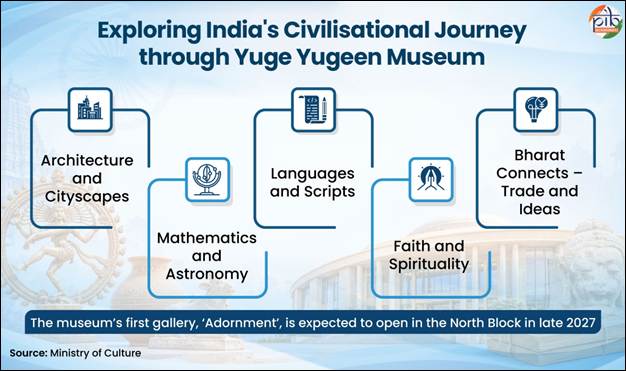
- First Gallery: The Adornment gallery is expected to open to the public in the North Block in the later part of 2027.
- Expansion of Galleries: A modular approach is being formulated to add further thematic galleries in subsequent phases.
- Project Oversight: Implementation will involve coordinated project management, design and technical oversight, quality assurance and periodic monitoring.
The museum is expected to strengthen the preservation and public presentation of India's cultural heritage while creating opportunities for education, research, cultural engagement and tourism.
Thematic Galleries and Exhibitions
The museum will feature galleries on themes such as Architecture and Cityscapes, Mathematics and Astronomy, Languages and Scripts, Faith and Spirituality, and Bharat Connects - Trade and Ideas, among others.
These are among the themes identified for the museum, with additional galleries planned through a modular approach.
A Collection Reflecting India's Cultural Diversity
- Approximately 18 lakh objects have been identified for potential display at the museum, bringing together collections from different institutions across the country.
- The identified objects are drawn from the National Museum, other museums under the Ministry of Culture, 52 Archaeological Survey of India (ASI) site museums, various State museums and private collections.
- Content and collection analysis is underway to determine how these objects will be incorporated into the museum's exhibitions.
- The project also includes dedicated collection storage and conservation facilities to support the preservation and management of heritage objects.
Technology and Interactive Experiences
The museum will integrate contemporary technologies to make its exhibitions more engaging and accessible.
- Immersive Experiences: Planned use of Augmented Reality (AR), Virtual Reality (VR) and Artificial Intelligence (AI) to support interactive interpretation and storytelling.
- Digital Documentation: The Ministry of Culture's collaboration with Google Arts & Culture, announced on 5 November 2026, includes digitisation efforts relating to the museum's historic buildings and collections.
- Modern Museum Infrastructure: Integration of intelligent building systems, exhibition technologies and conservation facilities to support museum operations and visitor experiences.
A Cultural Institution for Generations to Come
Beyond preserving and showcasing India's civilisational heritage, the Yuge Yugeen Bharat Museum is expected to contribute to cultural tourism, education and research while creating opportunities for public engagement. As a national cultural institution, it will benefit a wide range of visitors, including students, researchers, scholars, cultural practitioners, the general public, and domestic and international tourists, offering opportunities to explore and appreciate India's diverse cultural legacy.
The project is expected to generate direct and indirect employment during its construction and operational phases. It is expected to create opportunities for artisans, craftspeople, researchers, museologists, designers, performers and other creative professionals, and to support livelihoods in the hospitality and tourism sectors. To promote Make in India, the project will encourage domestic manufacture of world-class museum materials and products through structured vendor development, creating opportunities for Indian artisans, manufacturers, conservation professionals and technology providers.
The museum is also expected to generate recurring revenue through ticket sales, food and beverage facilities, events and venue rentals, digital experiences, guided tours, retail outlets and other visitor services. With infrastructure planned to accommodate up to 1 crore visitors annually, the project aims to combine long-term cultural preservation with public accessibility and revenue-generating visitor services. Its educational, cultural and tourism-related benefits are intended to extend to visitors from across India and abroad.
References
Ministry of Culture
https://www.pib.gov.in/PressReleasePage.aspx?PRID=2334964&utm®=48&lang=2
https://www.pib.gov.in/PressReleasePage.aspx?PRID=2333271&utm®=48&lang=2
https://www.pib.gov.in/PressReleasePage.aspx?PRID=2029510
Prime Minister’s Office
https://www.pib.gov.in/PressReleaseDetail.aspx?PRID=1952361®=48&lang=1
Cabinet
https://www.pib.gov.in/PressReleasePage.aspx?PRID=2228026&utm®=48&lang=2
Click here to see pdf
***
PIB Research
(रिलीज़ आईडी: 2336426)
आगंतुक पटल : 204