Ministry of Social Justice & Empowerment
From the Margins to Leadership
Inspiring Journey Of Six Women From Telangana And Delhi Reflect Their Empowerment Through Safer Livelihoods, Entrepreneurship And Community Leadership Under NAMASTE
प्रविष्टि तिथि:
11 NOV 2026 6:30PM by PIB Delhi
Women engaged in sanitation and waste management are increasingly emerging as entrepreneurs, decision-makers and community leaders, demonstrating how access to institutional support, mechanisation and livelihood opportunities can contribute to their socio-economic empowerment.
The inspiring journey of six women from Telangana and Delhi reflect this transformation, highlighting their determination to move beyond traditional occupational roles and build more secure, independent and dignified futures for themselves and their communities.
In Siricilla, Telangana, five women sanitation workers Anusha Reddy, Kavitha Goud, Swathi Yadav, Srilatha Naidu and Madhavi Kumar (all names changed) had been working as septic tank cleaning helpers under private contractors. Each earned an average monthly income of approximately ₹15,000 while undertaking physically demanding sanitation-related work involving occupational risks and limited opportunities for professional advancement. Despite their experience in sanitation services, financial constraints and limited access to resources made it difficult for them to establish an independent enterprise.
A significant turning point came when the five women learned about the Swachhta Udyami Yojana (SUY) during a locally organised loan mela. Recognising the opportunity to become entrepreneurs, they collectively decided to establish a mechanised sanitation enterprise. With financial assistance under the scheme, they acquired mechanised desludging vehicles and began providing sanitation services under Siricilla Municipal Corporation. This marked an important transition from working as sanitation helpers to collectively owning and managing mechanised sanitation operations.
Through mechanisation, the women moved towards safer and more efficient sanitation practices, reducing their dependence on hazardous manual cleaning methods. Their responsibilities expanded to operating mechanised vehicles, coordinating desludging services and managing their enterprise. The initiative strengthened their economic independence, enhanced their professional confidence and enabled them to take greater ownership of their livelihoods.
Today, Anusha, Kavitha, Swathi, Srilatha and Madhavi are contributing to improved sanitation services while demonstrating the potential of women-led enterprises in the sector.
A similar journey of empowerment and leadership can be seen in Seemapuri, Delhi, through the experiences of Anita (name changed), originally from Prayagraj, Uttar Pradesh. After moving to Delhi following her marriage, she began supporting her family by sorting waste alongside her husband, who was engaged in waste picking. Over time, she gained experience in waste management activities and started operating a small scrap shop, contributing to her family's financial stability.
Her journey towards community leadership began when she was mobilised by a Resource Organisation and became associated with a Self Help Group (SHG). Through active participation and commitment to collective development, she gradually emerged as a community leader and became the President of the SHG. Recognising her leadership abilities and experience, a local NGO subsequently engaged her as a Senior SHG Mobiliser and Community Mobiliser, providing her with an opportunity to support other women and waste pickers in accessing information, resources and institutional assistance.
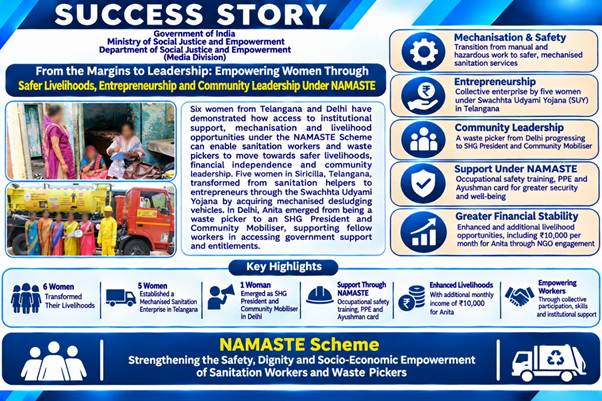
Anita's association with the National Action for Mechanised Sanitation Ecosystem (NAMASTE) Scheme further strengthened her journey towards safer working conditions and socio-economic security. Through the scheme, she received occupational safety training, Personal Protective Equipment (PPE) and an Ayushman card, supporting her access to safer occupational practices and healthcare benefits. Her engagement with the NGO also enabled her to earn an additional monthly income of ₹10,000 while continuing her involvement in waste picking activities, contributing to greater financial stability for her family.
Drawing upon her own experiences, Anita now plays an active role in mobilising waste pickers, strengthening community groups and spreading awareness about the NAMASTE Scheme. She sensitises fellow workers about registration procedures, occupational safety measures and available government benefits, helping them connect with formal support systems. Her transition from waste picker to SHG President and community mobiliser reflects how access to opportunities, collective participation and institutional recognition can strengthen women's leadership and enable them to support the development of their communities.
The journey of these six women demonstrate the wider impact of interventions aimed at strengthening the safety, dignity and socio-economic empowerment of sanitation workers and waste pickers. While the five women from Telangana have moved towards collective entrepreneurship through mechanised sanitation services, Anita has emerged as a community leader, supporting fellow workers in accessing information, entitlements and livelihood opportunities.
The NAMASTE Scheme, through its focus on occupational safety, mechanisation, capacity building, social security linkages and livelihood support, is contributing towards the development of a safer and more inclusive sanitation ecosystem. These interventions not only help improve working conditions but also create opportunities for workers to enhance their skills, strengthen their financial independence and participate more actively in economic and community development.
Their achievements highlight how women's empowerment extends beyond individual income generation to include enterprise ownership, collective decision-making, leadership and the ability to create opportunities for others. By transforming their experience and skills into entrepreneurship and community mobilisation, these women are contributing to a more inclusive and dignified sanitation and waste management sector.
From sanitation helpers to enterprise owners, and from waste picking to community leadership, their journeys reflect the transformative potential of financial assistance, mechanisation, occupational safety measures and institutional support.
Through NAMASTE and associated livelihood interventions, the Government of India continues to advance its commitment towards the safety, dignity and socio-economic empowerment of sanitation workers and waste pickers, enabling women to become active contributors to a safer, more self-reliant and inclusive India.
***
SS-178-TAR/KV/GA/RK
(रिलीज़ आईडी: 2335147)
आगंतुक पटल : 55
इस विज्ञप्ति को इन भाषाओं में पढ़ें:
हिन्दी