Ministry of Earth Sciences
Dr Jitendra Singh highlights expansion of disaster preparedness and weather monitoring infrastructure with new Seismological Observatory inaugurated in high seismic region of Kishtwar
IMD strengthens weather monitoring network in the region from not a single Doppler Weather Radar in 2014 to 4 installed in last 12 years and 4 more being installed making it total 8; Automatic Weather Stations from 3 to 12 out of which 4 for Kishtwar and 2 each for Doda and Ramban; Rainfall monitoring infrastructure expanded with Rain Gauge Stations increased from 9 to 15
Four more Doppler Weather Radars to be commissioned in Doda, Kishtwar, Anantnag and Baramulla; Minister calls for greater public adherence to scientific weather warnings
Dr Jitendra Singh Calls for Greater Public Trust in Scientific Weather Warnings as Meteorological Infrastructure Expands Across Jammu and Kashmir
प्रविष्टि तिथि:
02 NOV 2026 4:23PM by PIB Delhi
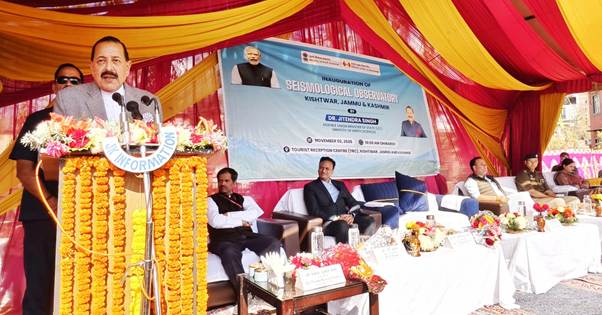
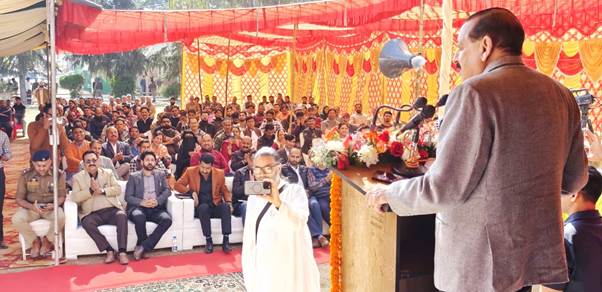
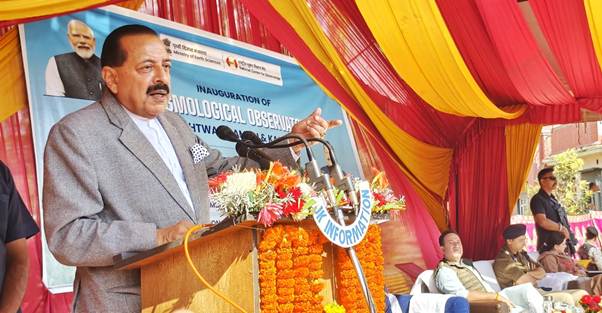
Inaugurating the new Seismological Observatory in the high seismic zone of Kishtwar today through the Ministry of Earth Sciences, Union Minister of State (Independent Charge) for Science & Technology, Earth Sciences, Minister of State in the Prime Minister's Office, Department of Atomic Energy and Department of Space, Dr Jitendra Singh today highlighted the significant expansion of meteorological and weather monitoring infrastructure in Jammu & Kashmir after 2014, particularly in the erstwhile Doda district, with additional installations brought in after the Chasoti cloudburst tragedy last year.
Addressing the gathering, Dr Jitendra Singh said that the India Meteorology Department (IMD) had strengthened the weather monitoring network in the region from not a single Doppler Weather Radar in 2014 to 4 installed in last 12 years and 4 more being installed making it total 8; Automatic Weather Stations from 3 to 12 out of which 4 for Kishtwar and 2 each for Doda and Ramban.
Dr. Srinivasa Kumar Tummala, Secretary, Ministry of Earth Sciences, Govt of India, Senior Scientist Suresh and others came specially from Delhi for the event.
MLA Padder-Nagseni Constituency and Leader of Opposition, J&K Legislative Assembly, Sh. Sunil Sharma; MLA of the Kishtwar Assembly Constituency and Ms. Shagun Parihar also spoke on the occasion. Deputy Commissioner Kishtwar, Pankaj Sharma and SSP Kishtwar Sunny Gupta were also present among others.
The Minister said, the expansion of scientific and weather monitoring infrastructure has also strengthened the region's disaster preparedness in an area that is vulnerable to earthquakes, landslides and other weather-related challenges.
The new observatory at Kishtwar is equipped with state-of-the-art digital seismic equipment and will transmit data in real time to the 24x7 Earthquake Monitoring Centre of the National Centre for Seismology in New Delhi. With the establishment of the new facility, Jammu and Kashmir now has four Seismological Observatories, including those at Jammu, Srinagar, Udhampur and Kishtwar.
Dr Jitendra Singh said the observatory would continuously monitor earthquake activity in the region and contribute to a better understanding of its seismic hazards. The information generated would also support the district administration and rescue teams in responding more effectively, besides helping in planning safer infrastructure.
Highlighting the transformation in meteorological infrastructure since 2014, Dr Jitendra Singh said that there was no Doppler Weather Radar coverage in the region earlier. After 2014, four Doppler Weather Radars have been installed at Banihal, Jot, Jammu and Srinagar, significantly expanding weather monitoring capabilities.
He further informed that four more Doppler Weather Radars are set to be commissioned in 2027 at Doda, Kishtwar, Anantnag and Baramulla, further strengthening weather surveillance and extending coverage across the region.
The Minister also highlighted the significant expansion of the Automatic Weather Station network. From three Automatic Weather Stations earlier at Udhampur, Kathua and Ramban, nine additional stations have been added, taking the total number to 12. These include four stations in Kishtwar, two each in Doda and Ramban, and one in Kathua.
Dr Jitendra Singh said that the expansion of scientific infrastructure has been guided by the needs and geographical vulnerabilities of the region. He noted that administrative boundaries may change, but geographical challenges remain, making it essential to strengthen weather monitoring and early warning systems across vulnerable areas.
The rainfall monitoring network has also been expanded, with the number of Rain Gauge Stations increasing from nine to 15 across the five districts of the parliamentary constituency. These stations provide regular rainfall information and strengthen local-level weather monitoring.
Highlighting the reach of weather and agromet services, the Minister said that weather forecasts are now disseminated at the Panchayat level across all Panchayats in the five districts. The weather forecast and agromet advisory services have reached 5,467 beneficiaries, enabling wider access to weather-related information.
He also referred to the strengthening of specialised meteorological facilities in the region, including the High-Altitude Cloud Physics Laboratory at Patnitop, Jammu and Kashmir. The meteorological infrastructure in Jammu has also been strengthened with the establishment of a Regional Meteorological Centre to provide weather and early warning services.
Dr Jitendra Singh said that access to timely weather information has made a tangible difference to local administration and disaster preparedness. Referring to recent experiences, he noted that advance weather information helped the district administration plan and manage activities with greater ease.
Emphasising the importance of public cooperation, the Minister said that scientific weather warnings can save lives only when they are taken seriously and acted upon. He recalled an instance when traffic restrictions were imposed following a weather alert and subsequent damage to the highway demonstrated the importance of adhering to timely warnings.
“Information is important, but following the information is equally important,” he emphasised, calling upon citizens to cooperate with the administration during weather alerts and advisories.
Dr Jitendra Singh also spoke about the need to counter unverified and alarmist information with scientific and evidence-based communication. He said that weather-related information and predictions should be understood on the basis of scientific assessment and credible sources.
Highlighting the positive potential of technology and social media, the Minister said that access to digital information and new platforms has created opportunities for young people, including those living in remote areas. He urged the youth to make constructive use of the opportunities and facilities now available to them.
Dr Jitendra Singh also reflected on the wider transformation of the region, referring to improved connectivity and the development of Kishtwar as a major power hub. He said the region's scientific and infrastructure capabilities were being strengthened alongside efforts to improve the safety and well-being of its people.
The event was attended by senior officials, public representatives and other dignitaries.
***
NKR/AK
(रिलीज़ आईडी: 2331574)
आगंतुक पटल : 279
इस विज्ञप्ति को इन भाषाओं में पढ़ें:
हिन्दी