Ministry of Science & Technology
Indian scientists identify a few Martian analogue sites
प्रविष्टि तिथि:
16 OCT 2026 3:39PM by PIB Delhi
Two key minerals identified in areas of Tamil Nadu and the Atacama Desert in Chile, which reflect geological, chemical, and physical similarities with Mars, have helped establish these as Martian analogue sites.
In the era of intense planetary exploration, identifying terrestrial analogue sites has become a pressing requirement, as recent studies demonstrate that orbital data alone cannot fully characterize Martian minerals. High-precision, state-of-the-art analytical tools are essential for these investigations.
Advanced instrumentation, including a laser Raman spectrometer, supported by the DST-FIST at the Department of Geology, University of Kerala, has helped identify melanterite in Neyveli, Tamil Nadu, and Gypsum in the Atacama Desert (Chile) and the Tiruchirappalli Badlands, a semi-arid geological and paleoclimatic terrain in Tamil Nadu. Both minerals are hydrous sulphates that record water–rock interactions. While gypsum preserves evidence of past aqueous environments, melanterite indicates transient wet, acidic, and oxidizing conditions, processes relevant to those inferred on Mars.
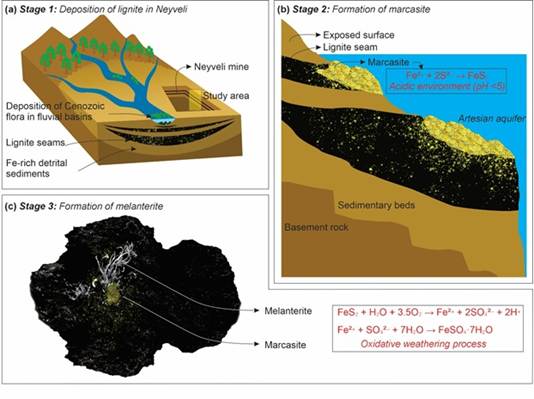
Fig 1: Stage-wise depiction of the formation of melanterite from marcasite from the lignite substratum of Neyveli
The identification was carried out by the research team from the University of Kerala, led by Dr. Sajin Kumar K.S., Project Coordinator, DST-FIST. The DST-FIST-supported Laser Raman Spectrometer was used to detect the distinctive spectral fingerprints of the minerals and confirm their identification. Melanterite provides evidence for short-lived wet conditions through sulphide oxidation, a process relevant to sulphate formation on Mars, while gypsum records past aqueous activity and can preserve biosignatures within its mineral matrix. Thus, these terrestrial minerals provide useful analogues for understanding past water activity and potentially habitable environments on Mars.
These findings have been published as two research papers in the Journal of Geophysical Research: Planets, a leading journal on planetary science.
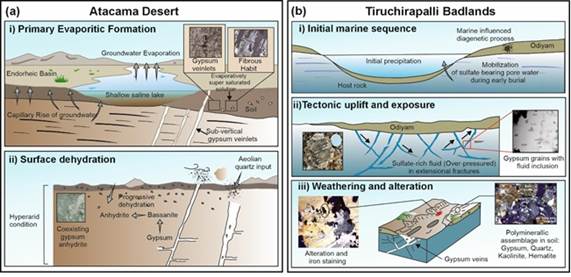
Fig 2: Schematic illustration of gypsum formation sequences in the two terrestrial analog sites (a) Atacama Desert (b) Tiruchirappalli Badlands
The team is now focusing on rare analogue sites in extreme conditions across different parts of the globe to understand primitive life for astrobiological studies, using the same facility.
Such facilities supported by the DST-FIST can advance planetary science by improving our understanding of past habitable environments on Mars and other planetary bodies. Identifying minerals capable of recording water activity and preserving biosignatures can also help guide future planetary missions toward the most promising locations in the search for evidence of life beyond Earth.
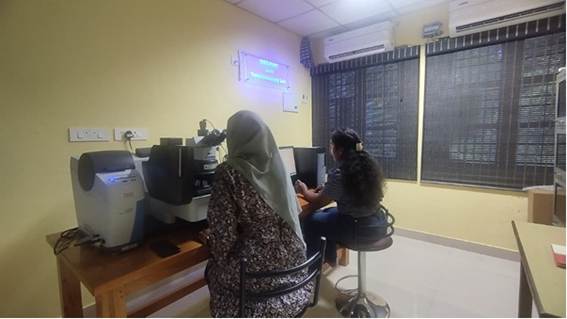
Fig 3: The laser Raman instrument facility at the Department of Geology, which is funded by the DST-FIST
Publication Links:
- https://agupubs.onlinelibrary.wiley.com/doi/epdf/10.1029/2025JE009544
- https://agupubs.onlinelibrary.wiley.com/doi/10.1029/2026JE009913
***
NKR/FT/AA
(रिलीज़ आईडी: 2324335)
आगंतुक पटल : 153