PIB Backgrounder
Women, Work and Enterprise: India’s Push for Better Livelihoods
प्रविष्टि तिथि:
15 OCT 2026 12:23PM by PIB Delhi
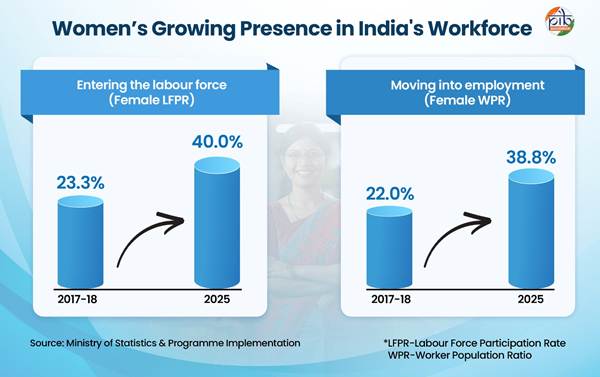
India’s women employment story is moving from participation to better-quality work. PLFS shows female Labour Force Participation Rate (LFPR) rising from 23.3% in 2017-18 to 40% in 2025, while Worker Population Rate (WPR) increased from 22% to 38.8%. Building on this improvement, policy support is strengthening women’s work through formal enterprise recognition, credit, market access, safer workplaces, skilling and new livelihood avenues. Now, the focus is on turning higher participation into stronger income, security and economic development.
|
Rising Women’s Employment and Expanding Economic Opportunities
Women’s employment in India is moving beyond presence alone. The rise in labour force participation marks an important shift, alongside greater focus on the nature and quality of employment. As more women enter the labour force, the next dimension of progress lies in the opportunities that work creates. Economic empowerment is strengthened when employment provides income, security, recognition and greater control over economic choices.
This broader transition is being supported through policies that expand women’s access to safer workplaces, social protection, entrepreneurship, formalisation and financial opportunities. These measures help strengthen the quality of women’s participation in the economy, translating into secure and empowering opportunities.
Quantity Shift: Rise in Workforce Participation
Women’s engagement with India’s labour market has strengthened considerably in recent years. For women aged 15 years and above, LFPR increased from 23.3% in 2017-18 to 40.0% in 2025 .
This increase has also translated into a larger share of women actually working. WPR increased from 22.0% for women in 2017-18 to 38.8% in 2025. In absolute terms, an estimated 20 crore women aged 15 years and above were employed in India during 2025.
|
Labour Force Participation Rate (LFPR) measures the share of the population that is either working or seeking or available for work.
Worker Population Ratio (WPR) measures the proportion of employed persons in the population.
|
Women as Workers, Entrepreneurs and Economic Contributors
As participation expands, the nature of women’s engagement with the economy is also changing.
Women’s Growing Presence in Enterprise
An increasing number of women are taking up entrepreneurship and establishing their own businesses. Women’s entrepreneurship broadens economic participation by creating opportunities to earn, build assets and grow businesses. It strengthens financial independence while expanding skills and access to resources.
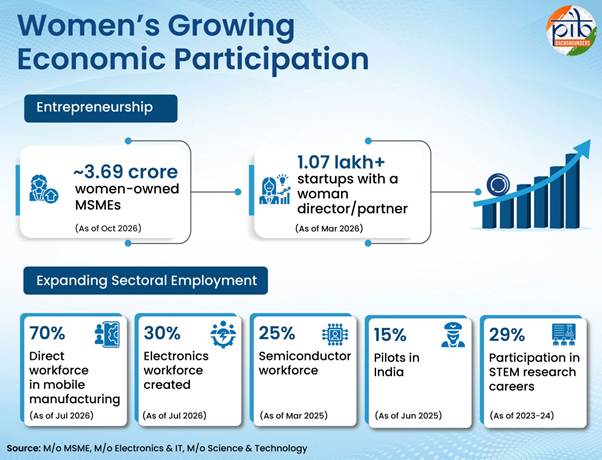
- Women-owned MSMEs: As of October 2026, ~3.69 crore registered MSMEs were women-owned, representing ~38% of all registrations.
- Women in startups: By March 2026, over 1.07 lakh recognised startups had at least one-woman director or partner. These accounted for approximately 48% of all recognised startups.
Women in Technology and High-Skill Sectors
Alongside entrepreneurship, women’s participation is also expanding across manufacturing and high-skill sectors.
- As on July 2026, women constitute nearly 70% of the direct workforce in mobile phone manufacturing. Across the wider electronics manufacturing sector, women account for nearly 30% of the workforce created over the last decade.
- Women are also building a significant presence in the semiconductor industry. They constitute around 25% of the workforce and nearly a fourth of India’s chip design and engineering workforce (as on March 2025).
- The civil aviation sector similarly reflects growing women’s participation in specialised roles. Women account for 15% of pilots in India, among the highest shares globally. Additionally, women account for 15% of air traffic controllers, 11% of flight dispatchers and 33% of Flight Operations Inspectors in DGCA (as on June 2025).
- The expansion is also visible in India’s research ecosystem. The Research & Development Statistics 2025-26 report shows that women’s participation in STEM research careers increased from 13% in 2000-01 to 18.6% in 2020-21 and 29% in 2023-24.
Building Women-Led Enterprises from Recognition to Growth
As women build businesses across different segments, support for their long-term growth becomes increasingly important. Formal recognition, finance and market access provide key areas for strengthening women-led enterprises.
Formalisation: Giving Women’s Work an Economic Identity
Many women-led economic activities begin at a small scale, making formal recognition important. Formalisation provides an official identity and improves access to credit, government schemes, skills and business development services.
- Swavalambini Scheme (2025) : The scheme supports young women from business ideation to enterprise creation through entrepreneurship training, finance and market guidance, and legal support. Selected participants also receive 21 weeks of mentorship and handholding to help develop sustainable enterprises.
|
It was launched in February 2025 as a pilot across six higher education institutions in Assam, Meghalaya, Mizoram, Uttar Pradesh and Telangana.
|
The targets under the Swavalambini pilot have been achieved.
- A total of 82 faculty members had been trained under Faculty Development Programme;
- 1276 participants have been trained out of 1200 participants under Entrepreneurship Awareness Programme; and
- a total of 602 participants have been trained out of 600 participants under Entrepreneurship Development Programme.
- Yashasvini Campaign (2024): The campaign aims to promote greater participation of women in entrepreneurship by achieving gender parity on the Udyam Registration Portal and Udyam Assist Platform by 2029. It also seeks to promote the mandated 3% public procurement target for women-owned micro and small enterprises (MSEs).
It also supports existing and prospective women entrepreneurs through awareness, handholding and capacity-building initiatives. As on July 2026, the Yashasvini Campaign had facilitated over 22 lakh women-owned MSME registrations. Furthermore, in FY 2025-26, total procurement from women-owned MSEs was 3.8%, exceeding the 3% public procurement target.
Credit: Financing Enterprise Growth
Formalisation brings enterprises into the recognised business ecosystem, while access to finance enables them to invest, innovate and expand.
Financial Support for Women-led MSMEs
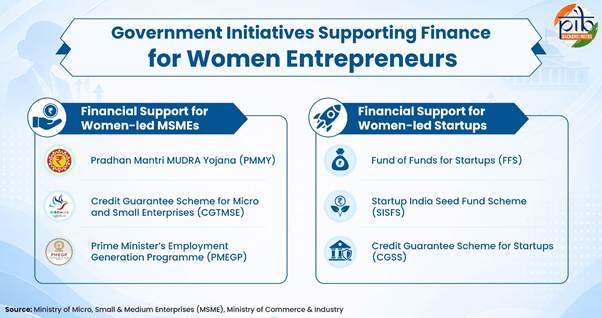
- Pradhan Mantri MUDRA Yojana (PMMY) : Launched in 2015, PMMY seeks to expand access to collateral-free credit up to ₹20 lakh for micro and small enterprises engaged in non-corporate and non-farm income generating activities.
- Since inception, PMMY had sanctioned more than 57.79 crore loans by April 2026, with women entrepreneurs accounting for two-thirds of all loans sanctioned.
- Credit Guarantee Scheme for Micro and Small Enterprises: The Scheme was launched to strengthen credit delivery to MSEs and improve access to finance for unserved and underserved entrepreneurs. Under the Scheme, women-led MSEs receive enhanced guarantee coverage of 90%, along with a 10% concession on the guarantee fee.
- As on February 2026 (FY 2000-01 to FY 2025-26), it approved ~30.75 lakh guarantees worth ~₹2.07 lakh crore for women-owned MSEs.
- Prime Minister’s Employment Generation Programme (PMEGP): The PMEGP is a credit-linked subsidy scheme that supports new micro-enterprises in the non-farm sector. Beneficiaries receive margin-money (subsidy) assistance against bank loans. Under the Scheme, women are eligible for a 25% subsidy in urban areas and 35% in rural areas.
- By May 2026, women accounted for nearly 40% of all micro-enterprises assisted under PMEGP. They also received around 45% of the total margin-money subsidy disbursed.
Financial Support for Women-led Startups
Launched in 2016, Startup India is the flagship Government of India initiative to promote innovation and build a strong startup ecosystem. Under this, the Government supports startups across sectors and at different stages of their business cycle through multiple funding initiatives.
- Fund of Funds for Startups (FFS): Established in 2016, FFS supports startup funding by providing capital to SEBI-registered Alternative Investment Funds (AIFs). In turn, AIFs invest in startups through equity and equity-linked instruments.
- As of January 2026, supported AIFs have invested ~₹2,995 crore in women-led startups from 2025 onwards.
- Startup India Seed Fund Scheme (SISFS): Launched in 2021, it provides seed funding to startups across sectors through approved incubators.
- As of January 2026, incubators supported under the Scheme had approved ~₹294 crore in funding for women-led startups.
- Credit Guarantee Scheme for Startups (CGSS): Operationalised from April 2023, CGSS supports collateral-free debt funding for eligible startups. It provides credit guarantees on loans extended by banks, financial institutions, NBFCs and SEBI-registered AIFs.
- As on January 2026, loans amounting to ~₹39 crore have been guaranteed to women-led startups.
Market Access: Connecting Women’s Work to Buyers
Market access helps women entrepreneurs reach more buyers and better understand demand, quality standards, branding and pricing.
- Womaniya Initiative: Womaniya is an inclusion-focused initiative on the Government e-Marketplace that connects women-owned MSEs and SHGs with formal government buyers. Through a dedicated digital interface, they can register and list products such as handloom, jute, coir and home décor items.
- By July 2026, over 2.17 lakh women-owned MSEs were registered on GeM (a dedicated e-market for different goods & services procured by Government Organisations / Departments / PSUs).
- In FY 2025-26, total contract value exceeded ₹28,000 crore to women MSEs, marking 27.6% growth over the previous year.
- Women received 5.6% of the total order value awarded through GeM, exceeding the mandated procurement target of 3%.
For detailed information, may refer to: Womaniya: Building Inclusive Market Access for Women Entrepreneurs
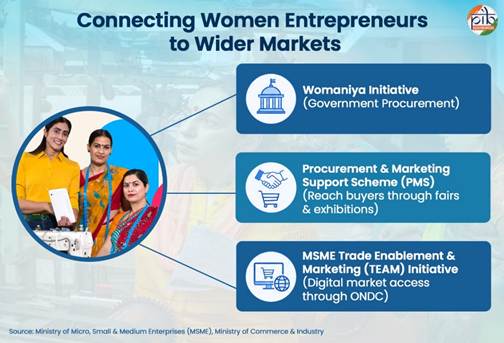
- Procurement & Marketing Support Scheme (PMS) : The Scheme helps registered MSEs access markets through trade fairs, exhibitions, vendor-development programmes, e-commerce and packaging support. Women-owned MSEs are eligible for a 100% subsidy on built-up space rent for trade fairs.
- MSME Trade Enablement & Marketing (TEAM) initiative : To provide MSE with access to digital marketing, the TEAM initiative was launched for three years (2024-27) under the RAMP Programme. It aims to empower MSEs to access new markets, expand their customer base and boost income via Open Network for Digital Commerce (ONDC).
- Up till 2025-26 , 1,700 women-owned MSEs were registered under the initiative.
Market access completes the enterprise value chain. Formalisation gives enterprises an identity, credit enables production, and market support turns production into income and sustainable growth.
Building the Skills Pipeline for Emerging Sectors
As women’s opportunities expand across technology and specialised sectors, future-ready skilling becomes important for widening access to these roles.
|
Women Candidates Trained Across Emerging Sectors under Major Skill Development Schemes (2021-22 to 2025-26)
|
|
Scheme
|
Objective
|
Sector
|
|
|
|
Artificial Intelligence
|
Semiconductor
|
Renewable Energy
|
|
Pradhan Mantri Kaushal Vikas Yojana 4.0 (PMKVY 4.0)
|
Emphasis on training in futuristic and new-age technologies, including artificial intelligence.
|
20,393
|
5,927
|
76,671
|
|
National Apprenticeship Promotion Scheme (NAPS)
|
Promotes apprenticeship training through paid on-the-job experience across traditional and emerging sectors, supported by direct stipend assistance for trainees.
|
1,534
|
-
|
19,899
|
|
Craftsman Training Scheme (CTS) through Industrial Training Institutes (ITIs)
|
Provides vocational and technical training through ITIs, building job-ready skills across traditional and emerging trades.
|
512
|
31
|
5,753
|
Targeted Initiatives for Women
- Nurturing Aspirations through Vocational Training for Young Adolescent Girls (NAVYA): Launched in 2025, NAVYA aims to provide targeted skilling of 3,850 adolescent girls under PMKVY 4.0 in non-traditional and future-oriented job roles. As of 31 August 2026, 1,105 girls have been trained under the Scheme.
- AI Careers for Women : Launched in 2025, the programme is establishing 30 Centres of Excellence in women's colleges across six states. These centres will support 150 spoke centres across Tier-II and Tier-III towns.
It aims to provide 20,000 learners with practical, industry-relevant AI training and project-based experience. Participants will receive certifications, internships, apprenticeships, fellowships, career guidance and access to AI-enabled job opportunities.
- Women in Science and Engineering–Knowledge Involvement in Research Advancement through Nurturing (WISE-KIRAN) : The Scheme promotes women’s participation in science and technology R&D through fellowship and institutional programmes.
- Fellowships include WISE Fellowship for Ph.D. (WISE-PhD), WISE Post-Doctoral Fellowship (WISE-PDF), WISE–Societal Challenges with Opportunities (WISE-SCOPE), WISE Internship in Intellectual Property Rights (WISE-IPR) and Women’s Instinct for Developing and Ushering in Scientific Heights and Innovations (WIDUSHI). These support doctoral and post-doctoral research, career re-entry, translational research, IPR training and continued research engagement.
- Institutional programmes include Consolidation of University Research for Innovation and Excellence (CURIE), Vigyan Jyoti, Gender Advancement for Transforming Institutions (GATI) and the Women in Space Leadership Programme (WiSLP).
- In 2025-26, 180 women pursued PhDs, 606 women scientists received post-doctoral or translational research support, 26 senior scientists received R&D support, and 29,443 schoolgirls were supported in STEM.
- More than 110 women scientists gained employment, 450+ saw research participation, skill upgradation or career re-entry.
These initiatives are strengthening women’s pathways into emerging and specialised fields through skilling and research support.
Labour Reforms Ensuring Safer Work Opportunities
For women, wider participation in the workforce depends not only on the availability of jobs, but also on whether those jobs can be accessed and sustained. Labour regulation plays an important role in shaping these conditions.
|
In November 2025, the Government consolidated 29 existing labour laws into four Labour Codes: the Code on Wages, 2019, the Industrial Relations Code, Code on Social Security, and Occupational Safety, Health and Working Conditions Code, 2020.
|
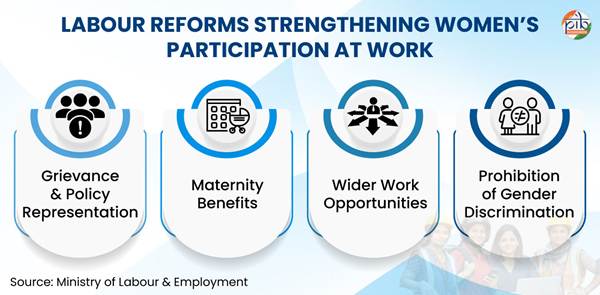
Within this consolidated framework, several provisions strengthen women’s workplace rights, safety, representation and access to employment.
- Grievance representation: Women must be represented in Grievance Redressal Committees in proportion to their workforce share.
- Maternity benefits: Eligible women receive up to 26 weeks of paid maternity leave. Adoptive and commissioning mothers (a biological mother who uses surrogacy) are entitled to 12 weeks of maternity leave. Other key provisions include:
- Women are entitled to ₹3,500 as medical bonus where free prenatal and postnatal care is not provided.
- Women are entitled to two nursing breaks during the working day until the child is 15 months old.
- Establishments with at least 50 workers must provide crèche facilities. The employer must allow four visits a day by the woman to the crèche which includes the rest intervals.
- Wider work opportunities: Women may work in all establishments, including night shifts with consent and prescribed safeguards.
- Prohibition of Gender Discrimination: Gender discrimination in recruitment, wages and employment conditions is prohibited.
- Policy representation: Women must constitute one-third of Central/ State Advisory Boards. The Board shall advice on minimum wages and measures to expand women’s employment.
Stronger Pathways for Women’s Work
India’s approach to women’s work is increasingly focused on strengthening the conditions in which women can work and progress economically. As opportunities widen, women’s contribution is becoming more visible across employment, entrepreneurship and newer areas of the economy.
Greater access to skills, finance, markets and enabling workplaces further supports these pathways. This will deepen women’s role in India’s growth and advance women-led development on the journey towards Viksit Bharat.
References
Ministry of Labour & Employment
https://www.labour.gov.in/static/uploads/2026/06/4b7ec0e8206aa4860576d6f75b432e97.pdf
https://www.pib.gov.in/PressReleasePage.aspx?PRID=2078530&lang=2®=48
https://www.pib.gov.in/PressReleaseIframePage.aspx?PRID=2256177&lang=2®=48
Ministry of Finance
https://www.pib.gov.in/PressReleasePage.aspx?PRID=2249915&lang=1®=3
Ministry of Micro, Small & Medium Enterprises
https://www.pib.gov.in/PressReleasePage.aspx?PRID=2236871®=48&lang=2
https://www.pib.gov.in/PressReleasePage.aspx?PRID=2209712®=48&lang=2
https://www.cgtmse.in/
https://www.pib.gov.in/PressReleasePage.aspx?PRID=2236871&lang=1®=20
https://sansad.in/getFile/loksabhaquestions/annex/187/AS289_FewgL8.pdf?source=pqals
https://www.pib.gov.in/PressReleasePage.aspx?PRID=2099687&lang=2®=3
https://www.msme.gov.in/offerings/schemes-and-services/details/prime-minister-employment-generation-programme-and-other-credit-support-schemes-1-MDMzETMtQWa
https://www.pib.gov.in/PressReleasePage.aspx?PRID=2258590&lang=1®=1
https://www.msme.gov.in/offerings/schemes-and-services/details/marketing-promotion-schemes-1-QzMzETMtQWa
https://ramp.msme.gov.in/ramp/RAMP-initiative/msme-team-initiative/msme-team-initiative
https://www.msme.gov.in/static/uploads/2026/05/1bfda06b460e72543530b40817573495.pdf
https://dashboard.msme.gov.in/#
https://sambandh.msme.gov.in/PPP_Index.aspx
Ministry of Commerce & Industry
https://www.pib.gov.in/PressReleasePage.aspx?PRID=2253019&lang=1®=3
https://www.startupindia.gov.in/content/sih/en/about-startup-india-initiative.html
https://www.pib.gov.in/PressReleasePage.aspx?PRID=1595854&lang=2®=48
https://www.pib.gov.in/PressReleasePage.aspx?PRID=2202984&lang=1®=3
https://www.pib.gov.in/PressReleasePage.aspx?PRID=2127843®=48&lang=2
https://www.pib.gov.in/PressReleasePage.aspx?PRID=2241313®=48&lang=2
Ministry of Skill Development and Entrepreneurship
https://www.pib.gov.in/PressReleasePage.aspx?PRID=2226498&lang=1®=3
https://www.pib.gov.in/PressReleasePage.aspx?PRID=2204133&lang=1®=1
https://www.pib.gov.in/PressReleasePage.aspx?PRID=2123510&lang=2®=3
https://www.pib.gov.in/PressReleasePage.aspx?PRID=2225466&lang=1®=1
https://www.pib.gov.in/PressReleasePage.aspx?PRID=2294851®=48&lang=2
https://www.pib.gov.in/PressReleasePage.aspx?PRID=2149336&lang=2®=3
https://nstiwshimla.dgt.gov.in/en/node/2209
Ministry of Statistics & Programme Implementation
https://www.pib.gov.in/PressReleasePage.aspx?PRID=2246009&lang=1®=1
https://www.pib.gov.in/PressReleasePage.aspx?PRID=2057970&lang=2®=3
https://mospi.gov.in/uploads/publications_reports/publications_reports1787307445576_78c40fd2-1acd-40fb-abb8-15f9491ba4b8_QBUSE_Bulletin_(2).pdf
https://www.mospi.gov.in/national-sample-survey-office
Ministry of Electronics & IT
https://www.pib.gov.in/PressReleasePage.aspx?PRID=2284808®=48&lang=2
Ministry of Women and Child Development
https://sansad.in/getFile/annex/270/AU3029_YErb7m.pdf?source=pqars
Ministry of Science and Technology
https://www.pib.gov.in/PressReleasePage.aspx?PRID=2298220&lang=1®=48
Press Information Bureau (PIB) Archive
https://www.pib.gov.in/PressReleasePage.aspx?PRID=2250664&lang=1®=3
https://www.pib.gov.in/PressReleasePage.aspx?PRID=2181702&lang=2®=3
https://newindiasamachar.pib.gov.in/WriteReadData/Magazine//2026/May/M202605011.pdf
https://www.pib.gov.in/FactsheetDetails.aspx?Id=150499®=3&lang=1
https://www.pib.gov.in/PressNoteDetails.aspx?ModuleId=3&NoteId=154624®=48&lang=2
https://www.pib.gov.in/blogs/blogsdescr.aspx?feaaid=581&lang=1
Invest India
https://www.investindia.gov.in/team-india-blogs/women-shaping-future-indian-industries
International Organisations
https://www.unwomen.org/sites/default/files/2024-03/un-women-womens-economic-empowerment-strategy-en.pdf
https://www.ilo.org/sites/default/files/wcmsp5/groups/public/%40ed_emp/%40emp_ent/%40ifp_seed/documents/publication/wcms_766156.pdf
https://www.worldbank.org/ext/en/topic/competitiveness/small-and-medium-enterprises-smes-finance#tab-context
https://digitalforwomen.worldbank.org/access-markets
Click here to see PDF
*****
PIB Research
(रिलीज़ आईडी: 2323706)
आगंतुक पटल : 193