Ministry of Rural Development
“By treating the landscape, twin objectives of watershed development as well as river rejuvenation can be achieved”- Secretary, DoLR, Shri Narendra Bhooshan
प्रविष्टि तिथि:
29 SEP 2026 8:07PM by PIB Delhi
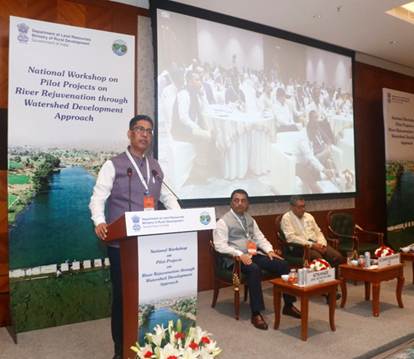
Department of Land Resources organised a National Workshop on proposed Pilot projects on River Rejuvenation through the watershed approach, at New Delhi on 29 September 2026.
Secretary, Department of Land Resources, Shri Narendra Bhooshan, emphasised that river rejuvenation requires treating the landscapes that feed rivers, with interventions tailored to the specific hydrological conditions of each catchment.
The Workshop brought together hydrologists, groundwater experts, geospatial scientists from IITs, experts from ICAR Institutes, National Remote Sensing Centre (NRSC), Central Ground Water Board, NMCG, National River Conservation Directorate (NRCD), Indian Institute of Remote Sensing, National Institute of Hydrology (NIH), National Geophysical Research Institute, Watershed practitioners, State Government representatives, research institutions, NGOs and International Organisations to deliberate on a scientific framework for river rejuvenation through watershed development.
Secretary, DoLR, Shri Narendra Bhooshan, stated that the proposed pilots will focus on restoring river hydrology through catchment treatment, groundwater recharge, soil and water conservation, and improvement of base and lean-season flows.
He emphasised that “River/Streams Rejuvenation through Watershed Development Approach” can achieve twin objectives of watershed development as well as river rejuvenation. We need to scientifically understand the hydrology of each catchment and establish whether targeted interventions can restore the lost hydrological function of a river or stream.”
He emphasised that planning should be based on a hydrological baseline, including rainfall, groundwater, catchment condition and water balance.
CEO, National Rainfed Area Authority (NRAA), Dr. Chandra Shekhar Kumar, as Chief Guest of the programme, said, “For small rivers, where long-term flow data is often limited, we need a systematic data-based framework that brings together legacy data, scientific analysis, high-resolution mapping and Decision Support Systems to guide river selection and treatment planning.”
Joint Secretary, Watershed Management, DoLR, Shri Nitin Khade, said, “The objective of these pilots is to increase river flows through groundwater recharge, soil and water conservation and intensive watershed treatment, while simultaneously improving agricultural productivity and income of farmers residing in the catchment areas. The challenge is to achieve both objectives in a balanced manner.”
Shri Khade said that the proposed pilots will focus on first-, second-, and third-order streams, with selection based on parameters including historical decline in flow, catchment condition, rainfall, groundwater depletion, intervention potential and data availability.
The workshop also highlighted the importance of convergence with government programmes and schemes, including VB-G RAM G, CAMPA, Ministry of Jal Shakti and State schemes and programmes, CSR, NGOs, along with support from research institutions and international organisations. The workshop emphasized on giving effect to Whole of Government and Whole of Society Approach.
The workshop deliberated on river selection, hydrological baselines, catchment treatment, GIS and remote sensing, intervention design, institutional frameworks, multidisciplinary teams, monitoring and evaluation, convergence, community participation and long-term maintenance.
The proposed monitoring framework will assess outcomes across four dimensions: Hydrological, Environmental, Agricultural and Socio-economic, with the objective of generating evidence that can guide the potential scaling up of watershed development approach based river rejuvenation across the country.
******
SS/HR
(रिलीज़ आईडी: 2316698)
आगंतुक पटल : 139