Ministry of Science & Technology
Beyond one: Indian researchers’ experiment could lead to a new tool for quantum measurement
प्रविष्टि तिथि:
24 SEP 2026 3:07PM by PIB Delhi
Researchers have made the first experimental measurement of a quantum measure exceeding one, beyond the upper limit of ordinary probability. The result brings Quantum Measure Theory (QMT), a framework rooted in quantum foundations and the search for quantum gravity, into the laboratory, with potential applications in quantum measurement and computing.
Quantum mechanics is usually described in terms of the state of a system at a particular time and the outcomes obtained when we measure it. A complementary viewpoint is to describe a quantum system through its possible histories, meaning the different ways it can evolve between preparation and detection or the path that the photon could take in an experiment from a laser to a detector. QMT assigns a generalized measure to sets of such histories, incorporating the interference between them. Unlike an ordinary probability, this quantum measure can exceed one.
The difficulty is that a general set of histories does not necessarily correspond to a sequence of ordinary measurements, so its quantum measure is not straightforward to access experimentally.
An experiment by the Raman Research Institute (RRI), an autonomous institute of the Department of Science and Technology (DST) has now measured the quantum measure assigned to a chosen collection of possible photon paths between the laser source and the detector.
In a future implementation, a filter could select a chosen collection of photon paths while leaving the photons available for further quantum operations. That could potentially turn this “event-filtering” into a new tool for quantum measurement and quantum computing.
To make QMT experimentally accessible, RRI physicists started constructing an “event-filter” that would select a set of photon routes (called event). Sanchari Chakraborti, then a PhD student at RRI, performed the experiment under the supervision of Urbasi Sinha, the paper’s co-author and senior professor at RRI.
To build this event-filter, they allowed the photons in the laser beam to traverse different routes in their optical setup. They then used polarisation, which tells the orientation in which the light waves are oscillating, to distinguish different routes and select the particular collection of routes they wanted. Later, they erased the distinguishing information so that the routes could interfere. In the reported experiment, published in the journal Quantum, the researchers measured input and output laser powers to infer the photon-detection probability. They then used the event-filter’s calibration to determine the “quantum measure”.
The quantum measure assigns a weight to a chosen collection of photon routes. They measured a quantum measure of about 1.17, agreeing within experimental uncertainty with the prediction of about 1.18 after accounting for imperfections in the apparatus. The value 1.17 showed that the quantum measure was behaving differently from ordinary classical probability that cannot exceed one.
Then how did the quantum measure exceed one? In the quantum world, contributions from different possible photon routes can also interfere with one another like waves: when two waves’ crests overlap, they create a bigger wave. This allows the quantum measure that includes interference between the routes to exceed one. The important caveat is that they didn’t measure a probability greater than one. The detector probability remains an ordinary probability below one. What can exceed one is the quantum measure.
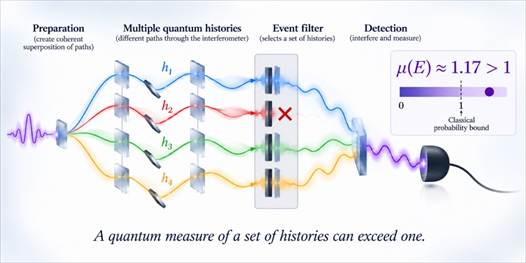
Fig.: Event-filtering of quantum histories. An optical field explores multiple possible histories. The event filter selects a chosen set of histories while preserving the interference needed to determine their quantum measure. The measured result, μ(E)≅1.17, exceeds the classical probability bound of unity, even though the inferred photon-detection probability itself remains between zero and one. (Credit: Urbasi Sinha, RRI)
The study demonstrates for the first time the measurement of a quantum measure exceeding one. It shows that this quantity is not merely an abstract concept that can be calculated on paper: it can be measured experimentally. “There is something particularly satisfying about seeing an idea that grew out of fundamental questions about quantum mechanics become an optical experiment on a laboratory table. We’re not claiming that this resolves the quantum measurement problem,” says Sinha. “But we’ve enlarged the class of questions about quantum processes that can be connected to an experimental measurement.”
The quantum measure is central to QMT, which co-author Rafael Sorkin developed partly in the search for quantum gravity. Its focus on complete histories makes it a natural framework for describing quantum processes across spacetime. This experiment brings that framework into the laboratory; it does not test a theory of quantum gravity.
Sorkin, a researcher emeritus at Canada’s Perimeter Institute for Theoretical Physics and a Distinguished Visiting Faculty member at RRI, passed away on 12 September 2026, shortly after the paper was accepted.
“This paper means a great deal to me personally as well as scientifically,” says Sinha.
Publication Link: https://doi.org/10.22331/q-2026-09-24-2215
****
NKR/FT/AA
(रिलीज़ आईडी: 2314350)
आगंतुक पटल : 273