Ministry of Jal Shakti
Day 2 of IIWW 2026 Brings Diverse Perspectives Together on Water Security, Innovation and Resilient WASH Services
From Source Sustainability to AI-Enabled Solutions, IIWW 2026 Technical Sessions Spotlight the Future of Water Management
प्रविष्टि तिथि:
23 SEP 2026 10:04PM by PIB Delhi
The second day of the 9th India International Water Week (IIWW 2026) transitioned into its full technical schedule at Bharat Mandapam, New Delhi, centering on the theme of climate-resilient water management. Organized by the Ministry of Jal Shakti, the day featured parallel deliberations across Country, Water Leaders', Practitioners', and Thematic Forums, alongside dedicated side events and the concurrent Second International WASH Conference.
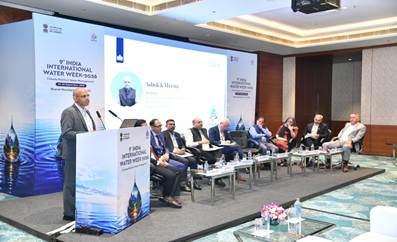
Addressing the Netherland-led Country Forum on “Success Stories in Water Management, Food Security and Source Sustainability”, Secretary, Department of Drinking Water and Sanitation, Shri Ashok K.K. Meena highlighted that India and the Netherlands share a common understanding that water management is not merely an engineering challenge but also a governance, community and climate-resilience challenge. He noted that India’s experience under Jal Jeevan Mission has demonstrated that water security requires strong political commitment, community ownership, scientific planning, accountable institutions and digital innovation working together. He further emphasised that the Mission’s focus is increasingly shifting from infrastructure creation to sustainability, service quality and long-term water security.
Shri Meena also highlighted the growing scope of India-Netherlands cooperation in advancing climate-resilient and sustainable water systems. He referred to initiatives such as the Sujalam Bharat Digital Public Infrastructure and Decision Support Systems for source sustainability, which support data-driven planning, asset management and risk-informed decision-making. Emphasising the importance of source sustainability, greywater management and local government ownership, he noted that India looks forward to learning from the Netherlands’ extensive experience in water governance while deepening collaboration through research, innovation, capacity building and knowledge exchange.
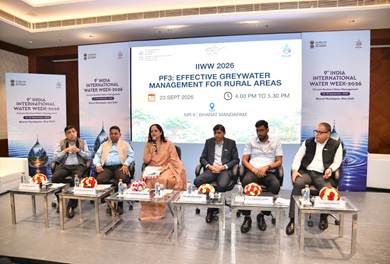
The technical session on “Effective Greywater Management for Rural Areas”, chaired by Ms Aishvarya Singh, Joint Secretary & Mission Director, Swachh Bharat Mission (Grameen), DDWS highlighted the increasing importance of greywater management in the context of expanding rural water supply coverage. The session brought together State Mission Directors, development partners, Panchayati Raj representatives and grassroots practitioners to share experiences and best practices from different parts of the country, including Andhra Pradesh, Sikkim, Bihar, Jammu & Kashmir and Jharkhand.
In her remarks, Ms Singh emphasised that there is no one-size-fits-all approach to greywater management and that solutions must be adapted to local conditions and community needs. The deliberations focused on decentralised treatment and reuse models, integration of greywater management into Gram Panchayat Development Plans (GPDPs), and strengthening community participation to ensure sustainable water and sanitation outcomes in rural areas.
On the second day of the Second International WASH Conference 2026, six technical sessions were organised on the themes of (i) Digital Technology, AI and Innovation for WASH; (ii) Governance, Community Participation and Institutional Strengthening; (iii) Climate Resilience, Nature-Based Solutions and Sanitation; (iv) Water Quality, Safety and Emerging Contaminants; (v) Financing, Economic Models and Techno-Economic Solutions; and (vi) Governance, Community Participation and Institutional Strengthening. A total of 25 technical papers were presented, showcasing innovative approaches, emerging research and practical solutions for strengthening climate-resilient and sustainable WASH services.
Technical sessions Details
The first technical session, “Digital Technology, AI & Innovation for WASH,” focused on the use of technology to strengthen the management, monitoring and maintenance of water and sanitation services. Four papers covered a digital communication and monitoring system for rural sanitation in Bihar, a low-cost IoT-based system for on-site detection of heavy metal ions, smart water meters as water-saving devices, and AI-driven decision support for predictive operation and maintenance of rural water supply systems. The presentations highlighted the potential of digital technologies, IoT and AI to improve service monitoring, efficiency and asset management.
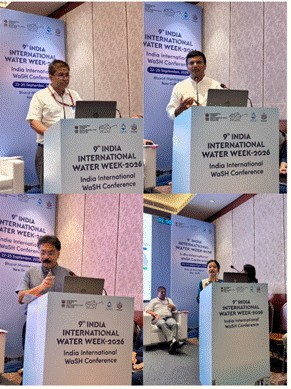
The second technical session, “Governance, Community Participation & Institutional Strengthening,” focused on community participation, inclusive approaches and institutional collaboration for sustainable WASH services. Four papers covered a gender-inclusive sanitation model at PCMC, community ownership and digital engagement for rural piped water services in Bihar through the Dastak Abhiyan, inter-departmental collaboration for WASH through the Jal Vidya Programme in Assam, and a service-learning framework for rural sanitation. The session highlighted the role of community ownership, institutional coordination and inclusive approaches in strengthening WASH outcomes.
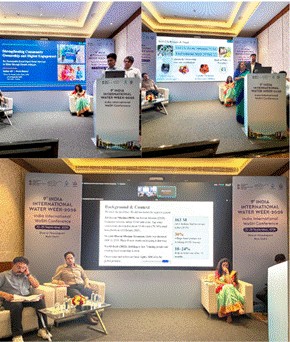
The third technical session, “Climate Resilience, Nature-Based Solutions & Sanitation/Other,” focused on approaches to strengthening climate resilience and sustainability across water, sanitation and waste management systems. Four papers covered climate adaptation in urban water systems, a cost-effective climate-resilient model for solid waste management, participatory village planning for greywater management, and the application of remotely operated vehicles, AI and sensor technologies for water infrastructure protection and asset management. The session highlighted the role of climate-responsive planning, community participation and technology-enabled approaches in building resilient WASH systems.
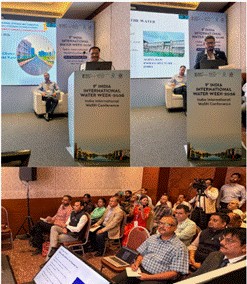
The fourth technical session, “Water Quality, Safety & Emerging Contaminants,” focused on approaches to strengthening water quality management and water safety. Five papers examined an integrated approach to safe, energy-independent rural handpump water supply, drinking water quality under the Jal Jeevan Mission in Bongaigaon, Assam, sensor-based detection of water-borne pathogens, community-scale water disinfection technologies, and the use of Jal Jeevan Mission water quality data for seasonal public health risk identification. The presentations highlighted the importance of integrated monitoring, appropriate technologies and data-driven approaches to ensuring safe drinking water.
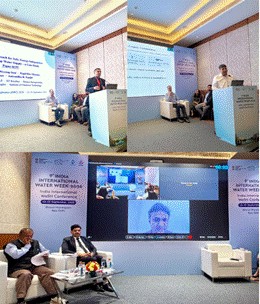
The fifth technical session, “Financing, Economic Models & Techno-Economic Solutions,” focused on approaches to improving the financial, technological and economic sustainability of WASH services. Four papers covered tablet-based inline chlorination as a cost-effective water safety solution, sustainable approaches to river water filtration and quality assessment, innovative economic models for rural WASH and community sustainability, and the socio-economic assessment of the GOBARdhan component in rural Gujarat. The session highlighted the role of cost-effective technologies, innovative economic models and local capacity building in supporting sustainable water and sanitation services.
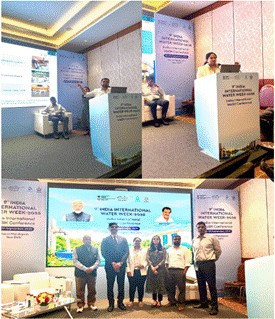
The sixth technical session, “Governance, Community Participation & Institutional Strengthening,” focused on community participation, local governance and resilience in WASH service delivery. Four papers examined community participation and social governance in achieving SDG 6 in Rajasthan, the performance of the Swachh Bharat Mission in rural Hoshiarpur, Punjab, approaches to strengthening institutional linkages for flood-resilient WASH systems, and the climate resilience of rural water sources in PESA areas of Himachal Pradesh. The presentations highlighted the importance of community participation, institutional linkages, and locally responsive approaches in strengthening sustainable and climate-resilient WASH systems.
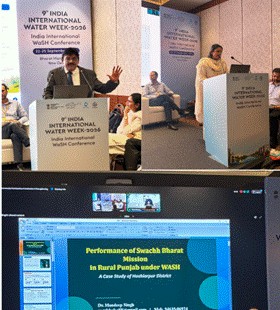
Discussion moved from the opening day's high-level themes into detailed, sector-specific work, spanning water governance and equity, technology adoption and efficiency, climate risk, treated wastewater reuse and community-led recharge. The Thematic Forum opened its paper presentations, across the first three of the Forum's seven sub-themes. The sessions drew on the shortlisted papers gathered in the conference proceedings.
COUNTRY FORUM (CF)
CF-2 on Sharing Technology-Driven Initiatives in Water Security: German and EU Solutions for Sustainable Water Management in India, was chaired by Mr. Gottfried von Gemmingen, Head of Economic Cooperation & Development at the German Embassy in New Delhi, with GIZ, Siemens, Watershed Monitoring Inc., Asoti Engineering, HUBER Envirotech, and NIVUS Technologies, on digital and precision technologies for water security.
CF-3 on Success Stories of Countries in Water Management, Food Security and Source Sustainability, convened with the Netherlands and CEEW was chaired by Mr. Jaap Slootmaker, Vice-Minister of Water & Soil Affairs at the Ministry of Infrastructure and Water Management, Govt. of the Netherlands and co-chaired by Shri Ashok K. K. Meena, IAS, Secretary, Department of Drinking Water and Sanitation, Ministry of Jal Shakti, Government of India, discussed circular water economies, climate-resilient agriculture and knowledge transfer.
WATER LEADERS’ FORUM (WLF)
WLF-1 on Partnership and Cooperation for Inclusive Water Management, convened with Maharashtra and the World Bank, Drinking Water & Sanitation Department, Jharkhand; IWMI; Development Support Centre, Ahmedabad and Paani Foundation, Maharashtra, was chaired by Dr. Sanjay Belsare, Secretary (CAD), WRD, Maharashtra, and co-chaired by Shri Ajith Radhakrishnan, Senior Water Resources Management Specialist, World Bank, discussed partnership models for water access, quality and resilience across India's agro-climatic regions.
WLF-2 on Technological Solutions for Efficient Water Utilisation, convened with FICCI and chaired by Smt. Naina Lal Kidwai, Chair, FICCI Water Mission, FICCI and co-chaired by Shri Pradeep Kumar Agrawal, Joint Secretary & Chairman, Central Ground Water Authority, focused on smart irrigation, digital water management, leak detection and industrial water efficiency.
PRACTITIONERS’ FORUM (PF)
PF-1 on State Initiatives in Water Management, was chaired by the Shri Bhopal Singh, Former Member, Central Water Commission, with Shri Zaigam Ali Khan Joint Secretary, NRCD as co-chair, brought together officers and representatives from WRD, Maharashtra; Greater Chennai Corporation; NEIDA; WRD, Madhya Pradesh; and WRD, Haryana, discussed State-level interventions in conservation and service delivery.
PF-2 on Large-Scale Adoption of Water Saving and Climate-Smart Technology: Lessons from States, was chaired by Shri Eknath Dawale, IAS, Principal Secretary, WRD, Maharashtra, and Shri Sumant Narain, Joint Secretary, National Water Mission as co-chair on micro-irrigation, solar pumps and digital mapping across Maharashtra, Bihar, Karnataka and Gujarat.
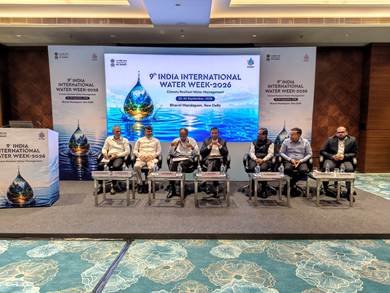
PF-3 on Effective Greywater Management for Rural Areas, convened with the Department of Drinking Water and Sanitation was chaired by Smt. Aishvarya Singh, JS&MD, SBM(G), DDWS and co-chaired by Shri Brijesh Pandey, Secretary, PWD, Govt. of Tripura on the 3Rs (Reduce, Recharge and Reuse) approach, with about 5.46 lakh villages now having greywater management arrangements; the panel drew in SBM(G) mission directors and grassroots Swachhagrahis and sarpanches.
PF-4 on Smart Irrigation Management, was chaired by Shri Yogesh Paithankar, Member (WP&P), Central Water Commission, and co-chaired by Shri Rajeev Kumar, Chief Engineer, UGBO, Central Water Commission. The panelists discussed remote sensing, IoT and AI in irrigation, with IWMI and technology providers.
THEMATIC FORUM (TF)
Eight Thematic Forum sessions ran through the day presenting shortlisted papers and spanning the first three of the Forum's seven sub-themes.
Sub-theme 1, Inclusive and Equitable Water Governance: TF-1 Equity in Water Allocation and Access to All Sectors, was chaired by Shri S. Masood Husain, Former Chairman, CWC, and co-chaired by Shri Vineet Gupta, Member, CWMA; TF-2 Water Governance Principles: Indicators, Audit and Standards, was chaired by Shri B. R. K. Pillai, Professor of Practice, IIT Roorkee, and co-chaired by Dr. P. Somasekhar Rao, Director (Technical), Advanced Centre for Integrated Water Resources Management, Govt. of Karnataka; and TF-3 Institutional Reforms and Strengthening was chaired by Shri Yogesh Paithankar, Member (WP&P), CWC with Shri Ashish Banerjee, Chief Engineer (IMO), CWC as co-chair. Papers examined equity-based groundwater allocation, women's participation in water governance and the Solar Didi self-help-group model, water auditing and benchmarking of irrigation projects, and parliamentary discourse on river governance.
Sub-theme 2, Collaboration for Optimal Use of Water Resources: TF-4 Treated Wastewater Reuse Across Sectors was chaired by Shri Praveen Gupta, Member (Thermal) Central Electrical Authority, with Shri Nalin Kumar Srivastava, Deputy Director General, NMCG as co-chair. TF-5 Multi-Stakeholder Partnerships for Efficient Water Management, was chaired by Shri S. K. Haldar, Chairperson, CWMA, with Shri Gopal Kumar, Country Representative, India & Bangladesh, IWMI as co-chair; and TF-6 International Collaboration in the Field of Climate-Related Risk chaired by Prof. Dr. Deepak Khare, Department of Water Resources Development & Management and co-chaired by Dr. Manish K. Nema, Scientist-E, National Institute of Hydrology, Roorkee. Papers ranged over the circular economy in wastewater, water-sensitive cities, geospatial technologies in the Ken-Betwa link, and drought and flood risk assessment, including a basin-based approach to climate resilience in Kerala.
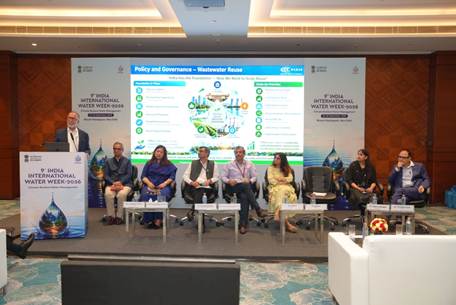
Sub-theme 3, Technology and Community for Water Security: TF-7 Forecasting and Modelling for Water Security, was chaired by Dr. A. K. Gosain, Professor Emeritus, Department of Civil Engineering, IIT Delhi, and co-chaired by Dr. Ajai Pradhan, President & CEO, Cetus Consulting Pvt. Ltd. and TF-8 Community Participation in Groundwater Recharge, was chaired by Shri Cyril V. Darlong Diengdoh, Commissioner & Secretary, WRD, Govt. of Meghalaya and co-chaired by Dr. Dipankar Saha, Chair Professor, Center for Advanced Water Technology & Management, Manav Rachna University and Board President, Water for People. TF-7 spanned AI, machine learning and remote sensing for water security, SCADA and GIS integration, and flood modelling at river confluences; TF-8 drew on community-led desilting, spring rejuvenation, managed aquifer recharge and the Atal Bhujal Yojana.
SIDE EVENTS (SE)
SE-1 on Scaling Water-for-Food Solutions in India: Maximising the Impact of PMKSY through Finance, Partnerships and Innovation, convened by the World Bank with the International Water Management Institute (IWMI), examined how the Pradhan Mantri Krishi Sinchayee Yojana can be strengthened through better financing, stronger partnerships and new innovation to make irrigation water go further for farmers. The session was chaired by Shri Pradeep Kumar Agrawal, Joint Secretary and Chairman, Central Ground Water Authority, and graced by Shri Saroj Jha, Global Director, Water Department, World Bank, who brought a global perspective on financing water security for agriculture.
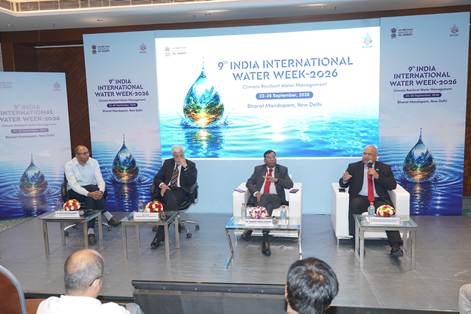
SE-2 on GSDP Conversation Series: Accelerating India's Water Vision 2047 through Indo-German Cooperation, convened by the German Embassy, looked at how the India-Germany partnership can help translate India's long-term water vision for 2047 into practical action on the ground.
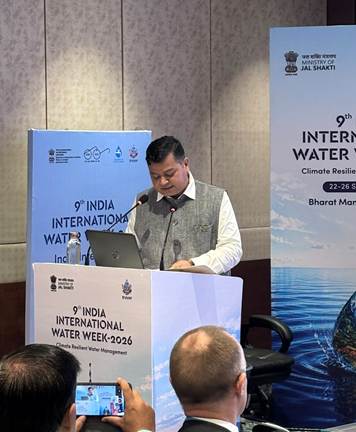
H. E. Jasper Wieck, Ambassador, Embassy of the Federal Republic of Germany, New Delhi, delivered the Inaugural Address. The session was also graced by the august presence of Shri Raj Bhushan Choudhary, Hon’ble Minister of State for Jal Shakti, who delivered the keynote address.
***
PS/ND/HM/AK
(रिलीज़ आईडी: 2314214)
आगंतुक पटल : 124