PIB Backgrounder
Pradhan Mantri Khanij Kshetra Kalyan Yojana (PMKKKY)
Sharing the Gains of Mining with Those Who Bear Its Cost
प्रविष्टि तिथि:
17 SEP 2026 6:03PM by PIB Delhi
Overview
Minerals are a vital national resource. Their extraction generates revenue, supports industries, and creates employment. Yet the districts that host mines often carry high costs. Displacement, pollution and loss of traditional livelihoods weigh on the people living there.
India has built a dedicated mechanism to return a share of mining revenue to these communities. This framework operates through District Mineral Foundations (DMFs). DMFs collect statutory contributions from holders of mining leases. The Pradhan Mantri Khanij Kshetra Kalyan Yojana (PMKKKY), launched on 17th September 2015, directs these funds into welfare and development projects on the ground.
About the Scheme
Every mining-affected area deserves a minimum standard of social and physical infrastructure. Pradhan Mantri Khanij Kshetra Kalyan Yojana (PMKKKY) has been framed in the national interest to provide for the welfare of these areas and its people. The Scheme is implemented by the DMFs, using the funds that accrue to them under the Act.
The Mines and Minerals (Development and Regulation) Act, 1957 requires States to incorporate PMKKKY into their DMF rules. Revised guidelines for the Scheme were issued in January 2024. They provide an updated framework for planning and executing projects.
Objectives
- Implement developmental and welfare projects in mining-affected areas. Such works complement the ongoing programmes of the States and the Centre.
- Minimise the adverse effects of mining on the environment, health and socio-economic conditions of local people. This covers impacts felt both during mining and after it ends.
- Ensure long-term, sustainable livelihoods for the affected population.
District Mineral Foundation: The Institutional Base
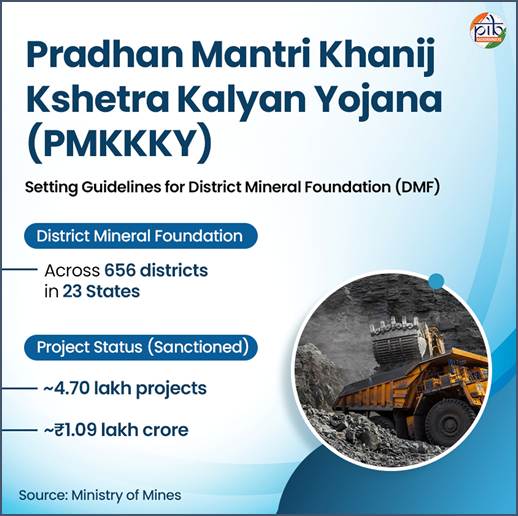
Provision for District Mineral Foundation (DMF) was introduced through the 2015 amendment to the Mines and Minerals (Development and Regulation) Act, 1957. DMFs are non-profit trusts formed with an objective to work in the interest of persons and areas affected by mining-related operations. It covers every district affected by mining. The operation of DMFs falls under the jurisdiction of the relevant State Government. The fund for DMF is collected at the district level. DMFs have so far been set up in 656 districts across 23 States. Each state has framed its own DMF rules.
Safeguards for Scheduled and Tribal Areas
Mining-related operations largely affect less developed and remote areas of the country. They also impact vulnerable communities, particularly Scheduled Tribes. This makes it essential to ensure that special care and attention is devoted to them. While making rules, the State Government follows the constitutional provisions relating to the administration of Scheduled and Tribal Areas. It also follows the Panchayats (Extension to the Scheduled Areas) Act, 1996 and the Scheduled Tribes and Other Traditional Forest Dwellers (Recognition of Forest Rights) Act, 2006.
How the Foundations Are Funded
Holders of mining leases are required to pay a certain amount in respect of the mineral extracted in proportion to the quantity extracted, known as royalty. The contribution to the District Mineral Foundation (DMF) is prescribed as follows:
- Ten per cent of the royalty in respect of mining leases or prospecting licence-cum-mining lease granted on or after 12.01.2015.
- Thirty per cent of the royalty in respect of mining leases granted before 12.01.2015.
Where the Funds Go
The utilisation of PMKKKY funds follows a defined framework, balancing priority welfare needs with infrastructure development.
High-Priority Sectors: at least 70 per cent of funds
- Drinking water supply.
- Environment preservation and pollution control measures.
- Health care and education.
- Welfare of women and children, and of the aged and differently abled.
- Skill development and livelihood generation.
- Sanitation and housing.
- Agriculture and animal husbandry.
Other Priority Sectors: up to 30 per cent of funds
- Physical infrastructure.
- Irrigation.
- Energy and Watershed development.
- Any other measure that raises environmental quality in mining districts.
Progress on the Ground
The scale of implementation is reflected in the numbers. Over 4.70 lakh projects, worth more than ₹1 lakh crore, have been sanctioned so far. More than 2.92 lakh of these projects stand completed. Another 78,809 works are under execution, backed by committed funds of over ₹30,512 crore as on July 2026.
|
Project Status
|
Number of Projects
|
Amount (₹ crore)
|
|
Sanctioned
|
4,70,020
|
1,09,938
|
|
Completed
|
2,92,156
|
49,973
|
|
Ongoing
|
78,809
|
30,512 (committed)
|
A Fairer Deal for Mining Districts
Minerals belong to the nation. Their benefits must therefore reach those who bear the costs of extraction. Through DMF-PMKKKY, these benefits are channelled into improving education, healthcare, drinking water, and livelihood opportunities in mining-affected areas.
As implementation deepens, affected communities will secure a fairer share of the wealth beneath their land. Mining can thus advance both national growth and local wellbeing together.
References
Ministry of Mines
https://mines.gov.in/webportal/content/about-dmfpmkkky
https://mines.gov.in/admin/download/6a895eaeb2fd21787387566.pdf
https://ibm.gov.in/writereaddata/files/10172016123146MR.pdf
National DMF Portal
https://dmfindia.mines.gov.in/login
Finance Commission of India
https://fincomindia.nic.in/asset/doc/commission-reports/12th-FC/reports/eng/Chapter%2013.pdf
Government of Maharashtra
https://mahakhanij.maharashtra.gov.in/district-mineral-foundation.aspx
Ministry of Finance
https://ies.gov.in/arthapedia/concept/district-mineral-foundation-dmf
https://ies.gov.in/arthapedia/concept/pradhan-mantri-khanij-kshetra-kalyan-yojana-pmkkky
Pradhan Mantri Khanij Kshetra Kalyan Yojana (PMKKKY)
*******
PIB Research
(रिलीज़ आईडी: 2311538)
आगंतुक पटल : 195