PIB Backgrounder
Signed, Sealed and Exporting
India’s Trade Agreements in Action
प्रविष्टि तिथि:
18 AUG 2026 11:45AM by PIB Delhi
India’s FTA journey is moving from expanding its network of agreements to making fuller use of the market access. Recent export performance shows the growing commercial importance of FTA partners. A shift is visible in early export gains, rising preferential CoO issuance and a wider range of exports to these markets. This indicates that more businesses are beginning to engage with opportunities created by the agreements. The transition is also being supported by government initiatives that help exporters access preferential benefits and enter new markets.
|
India’s FTA Export Landscape
Over the past decade, India has pursued a more confident and forward-looking trade strategy, expanding its network of Free Trade Agreements (FTA). Each agreement reflects the scale of the Indian market, the country’s economic potential and growing international confidence in the capabilities of its 1.4 billion people.
The recent trade agreements span major global markets, widening trade partnerships and creating diverse opportunities for exporters.
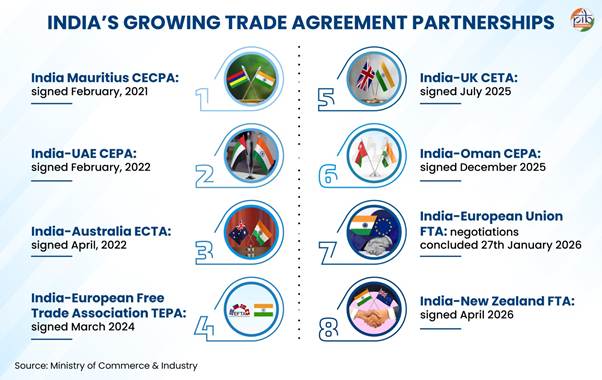
Beyond newer engagements, India is also focusing on their effective utilisation. The emphasis is on translating market access into wider export participation, investment and employment while safeguarding domestic priorities. This balanced approach aims to strengthen the contribution of FTAs to India’s journey towards Viksit Bharat by 2047.
Export Performance across FTA Markets
India’s expanding trade-agreement network connects exporters with several markets. This expansion is supported by the country’s growing export base. In FY 2025-26, combined merchandise and services exports reached a record US$ 863.1 billion, including merchandise exports of US$ 441.8 billion. The momentum has continued in FY 2026-27.
- During April-June 2026, combined exports were estimated at US$ 232.73 billion, increasing by 11.37% from the corresponding period last year.
Within this overall export performance, India’s FTA partners constitute important markets for merchandise exports.
|
Table 1: India’s Merchandise Exports to FTA Partners (2025-26)
|
|
FTA market
|
Exports (US$ million)
|
|
FTA Groups
|
|
ASEAN
|
38,416.33
|
|
SAFTA
|
25,774.68
|
|
FTA Countries
|
|
UAE
|
37,359.11
|
|
United Kingdom
|
13,444.19
|
|
Singapore
|
11,863.66
|
|
Nepal
|
7,447.11
|
|
Australia
|
7,284.17
|
|
Malaysia
|
6,825.55
|
|
Japan
|
6,039.50
|
|
Republic of Korea
|
6,012.03
|
|
Sri Lanka
|
5,516.83
|
|
Thailand
|
5,058.60
|
|
Oman
|
4,021.48
|
|
Bhutan
|
1,252.86
|
|
New Zealand*
|
566.51
|
|
Mauritius
|
473.64
|
|
Source: Ministry of Commerce & Industry
|
*Signed, yet to be effective
|
Among these markets, the UAE and Australia illustrate the early progress under India’s recent trade agreements.
|
India’s New-Generation FTAs: Early Success Stories
|
|
India-UAE CEPA: Delivering Early Trade Gains
The India-UAE Comprehensive Economic Partnership Agreement (CEPA) came into force on 1 May 2022. It was India’s first full free trade agreement in a decade, with negotiations completed in record 88 days.
Largest individual FTA export market: India exported merchandise worth US$ 37,359.11 million to the UAE in FY 2025-26. Among India’s trade agreements, the UAE was India’s largest export destination.
Bilateral Trade Crosses US$ 100 Billion: Bilateral trade crossed US$ 100.06 billion in FY 2024-25, recording a 19.6% growth. This milestone was achieved within three years after the agreement came into force.
Success driving a wider partnership: Following bilateral trade success, India and the UAE set a new target of doubling trade to US$ 200 billion by 2032.
|
|
India-Australia ECTA: Expanding a Successful Trade Partnership
The India-Australia Economic Cooperation and Trade Agreement (ECTA) came into force on 29 December 2022. The ECTA is India’s first trade agreement with a developed economy in more than a decade.
Strong export performance: Total bilateral trade reached US$ 24.1 billion in FY 2024-25. India’s exports to Australia have increased from US$ 4 billion in FY 2020-21 to US$ 7.28 billion in FY 2025-26, recording 80%+ growth.
Complete duty-free market access: Australia provided immediate zero-duty access across 98.3% of its tariff lines. From 2026 onwards, all Indian exports are now eligible for zero-duty access to the Australian market.
Success taken forward through new initiatives: The ECTA provides the foundation for a more ambitious Comprehensive Economic Cooperation Agreement (CECA) , currently under negotiation. It aims to cover goods, services, mobility, digital trade, rules of origin and emerging areas of cooperation.
|
Early gains are also reflected in the growing use of tariff concessions and the wider range of products exported. They show how businesses are increasingly using the opportunities created by these agreements.
Export Facilitation and Product Diversification under Recent FTAs
Facilitating Exporters’ Access to FTA Benefits
A trade agreement opens preferential market access, while its practical use depends on exporters claiming the available benefits. Under an FTA, exporters generally need to provide proof of origin for their goods. This establishes their eligibility for the preferential tariff treatment available under the agreement.
A preferential Certificate of Origin (CoO) confirms that the goods meet the prescribed rules of origin. This allows qualifying goods to receive reduced or zero customs duties.
Preferential access is being used across agreements at different stages of implementation.
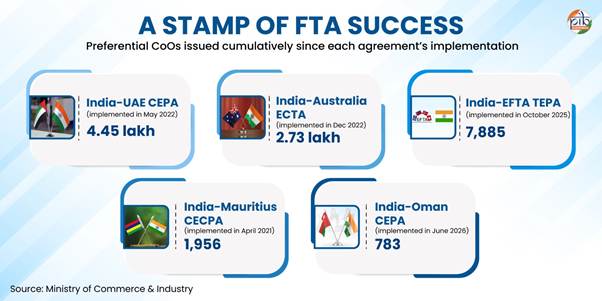
- The UAE CEPA and Australia ECTA, operational since 2022, have generated a large volume of origin certification, indicating robust utilisation of tariff concessions.
- Early uptake has also been noticed under newer agreements. The EFTA TEPA generated 7,885 CoOs after becoming operational in October 2025. 783 CoOs have been issued under the Oman CEPA following its implementation in June 2026.
The increase in preferential CoO issuance is supported by government measures that simplify procedures for exporters.
- e-CoO 2.0: The system provides end-to-end digital issuance of preferential and non-preferential CoOs, bringing exporters, issuing agencies and chambers of commerce onto a common platform. Aadhaar-based electronic signatures and QR-code verification support secure authentication and faster service delivery.
- Simplified Rules under FTAs: Documentation requirements have also been simplified under newer agreements.
- The India-EFTA TEPA and India-UK CETA allow exporters to establish origin through self-declaration.
- The UK agreement also permits importer’s knowledge and waives origin documentation for consignments below £1,000. The provisions support e-commerce shipments and small businesses.
- The India-Australia ECTA allows multiple qualifying products to be included in a single CoO.
- Support through Trade Connect: The platform complements above measures by helping exporters identify and use FTA benefits. Its Tariff Explorer provides access to tariff schedules across markets. Exporters, including MSMEs, can obtain trade information, seek guidance and raise CoO-related concerns, reducing effort in navigating export procedures.

A Wider Range of Products Reaching FTA Markets
The reach of an FTA is also reflected in the range of products entering partner markets. This product-level expansion is visible across several of India’s recent agreements.
|
Table-2: Expansion in Exported Tariff Lines under Recent FTAs
|
|
Market
|
Initial tariff-line coverage
|
Latest tariff-line coverage (2025-26)
|
Increase
|
|
UAE
|
7,546 (2021-22)
|
8,053
|
6.7%
|
|
Australia
|
5,396 (2020-21)
|
5,668
|
5.0%
|
|
Mauritius
|
3,593 (2021-22)
|
4,345
|
20.9%
|
|
Oman
|
2,879 (May 2026)
|
3,371 (June 2026)
|
17.08%
|
FTAs Connecting Indian Goods and Skills to Global Markets
Increased Market Access for Merchandise Goods
Recent FTAs provide preferential access to a substantial share of partner-country tariff lines.
- Agreements already in force
- India-UK CETA: Nearly 99% of Indian exports can enter the UK duty-free
- India-Oman CEPA: Concessions cover 98% of Oman’s tariff lines
- India-EFTA TEPA: 92.2% of tariff lines, representing 99.6% of India’s exports
- India-Mauritius CECPA: Preference market access covers 310 Indian product lines
- India-UAE CEPA: 97% of UAE tariff lines, covering 99% of Indian exports
- India-Australia ECTA: Duty-free access across 100% of Australian tariff lines for Indian exports
- Agreements awaiting implementation
- India-EU FTA: Preferential treatment across 97% of EU tariff lines, covering ~99.5% of bilateral trade value
- India-New Zealand FTA: Duty-free access for 100% of Indian exports from entry into force
These agreements expand market access across several labour-intensive sectors. This includes textiles, agriculture and processed food, leather and footwear, marine products, gems and jewellery, carpets and handicrafts. Wider opportunities in these sectors enable smaller producers and local enterprises to participate more actively in international trade.
Further, calibrated tariff liberalisation and transition arrangements preserve policy space to safeguard farmers and sensitive domestic sectors.
New Opportunities for Indian Services
Alongside goods, India’s recent FTAs have expanded opportunities for service providers and professionals. This is particularly significant given the sector’s growing contribution to employment, exports and overall economic activity.
|
Services account for nearly 30% of India’s employment. Further, services exports stood at US$ 421.3 billion in FY 2025-26. Given its scale, the sector forms an important part of India’s FTAs.
|
Key commitments covering market access, professional mobility and related support measures are highlighted below.
- For Indian professionals, the India-New Zealand FTA provides a dedicated pathway for up to 5,000 skilled Indians to stay for up to three years. These cover fields such as IT, engineering, healthcare, education, construction, AYUSH, yoga, culinary arts and music. Other key provisions include commitments across 118 services sectors and MFN treatment across 139 sectors.
For detailed information please refer to: India – New Zealand Free Trade Agreement Signed
|
What is MFN?
Most-Favoured-Nation (MFN) treatment is a principle of non-discrimination in which all trading parters of a country are treated equally.
|
- Under the India-EU FTA, commitments span 144 services sub-sectors, including IT/ITeS, professional, business, education, financial, tourism and construction services. Other provisions include facilitating the movement of business visitors and intra-corporate transferees, entry and work rights for dependants. It also provides a five-year framework for Social Security Agreements, student mobility and post-study work opportunities.
For detailed information please refer to: India–EU Partnership: India’s Growing Engagement with European Union
- Mobility provisions under the India-UK CETA cover professionals in IT, healthcare, finance and education. They allow smoother entry for business visitors, intra-corporate transferees, contractual suppliers and independent professionals. The associated Double Contribution Convention also prevents dual social-security payments, with estimated savings exceeding ₹4,000 crore.
For detailed information please refer to: India–UK CETA Comes into Effect
- Under the India-EFTA TEPA, Indian service providers receive enhanced access to 128 sub-sectors in Switzerland, 114 in Norway, 110 in Iceland and 107 in Liechtenstein. The opportunities span IT and business, professional, education, media and cultural services. The agreement also includes Mutual Recognition Agreements (MRAs) in nursing, chartered accountancy and architecture.
For detailed information please refer to: India-EFTA Trade Pact: Boosting $100 Billion Investment and 1 Million Jobs
- The India-Oman CEPA provides for the temporary entry and stay of intra-corporate transferees, contractual suppliers, business visitors and independent professionals.
For detailed information please refer to: India–Oman CEPA
- Under the India-Australia ECTA, Australia made commitments across around 135 services sub-sectors. MFN treatment is also extended in 120 sub-sectors, covering IT, business services, healthcare, education and audio-visual services.
- Under the India-UAE CEPA, Indian service providers gain access to ~111 sub-sectors across 11 broad areas. These include business, communication, construction, education, financial, health, tourism, transport, environmental and cultural services.
- The India-Mauritius CECPA provides access to around 115 sub-sectors across 11 broad areas. This includes professional, computer, telecommunications, financial, education, tourism, transport, audio-visual and yoga services.
Taking India’s FTA Journey Forward
India’s recent FTAs are entering a deeper phase of implementation. As businesses make greater use of the access secured under these agreements, their impact will extend. This will widen export participation, diversify trade and strengthen commercial relationships with partner markets.
As recent agreements enter a deeper phase of implementation, India is also widening its future trade agenda. Around ten trade agreements are under discussion including new negotiations with the Eurasian Economic Union, Peru, Chile, Israel, Canada and Maldives. Further, existing agreements such as the India-Korea CEPA and India-Sri Lanka ETCA are being upgraded.
At the heart of this expanding network lies a larger promise: taking the enterprise and aspirations of Indians to more markets worldwide.
References:
Prime Minister's Office (PMO):
https://www.pib.gov.in/PressReleasePage.aspx?PRID=2216270&lang=1®=3
Ministry of Commerce & Industry:
https://www.pib.gov.in/PressReleasePage.aspx?PRID=2290437
https://www.pib.gov.in/PressReleasePage.aspx?PRID=2284139&lang=2®=48
https://www.commerce.gov.in/files/2026-04/Annual_0.pdf
https://www.pib.gov.in/PressReleasePage.aspx?PRID=1810279®=48&lang=2
https://www.pib.gov.in/PressReleasePage.aspx?PRID=2195127®=48&lang=2
https://www.pib.gov.in/PressReleasePage.aspx?PRID=1812730®=3&lang=1
https://www.pib.gov.in/PressReleasePage.aspx?PRID=2248223&lang=1®=3
https://www.trade.gov.in/pages/certificate-of-origin
https://www.pib.gov.in/PressReleasePage.aspx?PRID=2149736®=48&lang=2
https://content.dgft.gov.in/Website/HBP_07_2026_Chapter_02.pdf
https://www.trade.gov.in/pages/about-trade-connect-eplatform
https://www.pib.gov.in/PressReleasePage.aspx?PRID=2267513®=48&lang=2
https://www.commerce.gov.in/files/2026-04/final_1.pdf
https://www.pib.gov.in/PressReleasePage.aspx?PRID=2288851®=48&lang=2
https://www.pib.gov.in/PressReleasePage.aspx?PRID=2236134&lang=1®=3
https://sansad.in/getFile/lsapps/loksabhaquestions/annex/188/AU1405_0GOh6X.pdf
https://www.pib.gov.in/PressReleasePage.aspx?PRID=1821785®=48&lang=2
World Customs Organization:
https://www.wcoomd.org/en/topics/origin/overview/faq-origin.aspx#Q6
World Trade Organisation:
https://www.wto.org/english/thewto_e/whatis_e/tif_e/agrm6_e.htm
Department of Foreign Affairs & Trade (Australian Government):
https://www.dfat.gov.au/trade/agreements/in-force/australia-india-ecta/australia-india-ecta-official-text/chapter-4-rules-origin
https://www.dfat.gov.au/trade/agreements/in-force/australia-india-ecta/outcomes/australia-india-ecta-benefits-australia-overview
PIB Archives:
https://www.pib.gov.in/PressNoteDetails.aspx?ModuleId=3&NoteId=154945®=48&lang=2
https://www.pib.gov.in/PressReleasePage.aspx?PRID=2177724®=48&lang=2
https://www.pib.gov.in/PressReleasePage.aspx?PRID=2240065&lang=1®=3
https://www.pib.gov.in/PressReleasePage.aspx?PRID=2233417®=3&lang=1
Click to see pdf
***
PIB Research
(रिलीज़ आईडी: 2300733)
आगंतुक पटल : 595